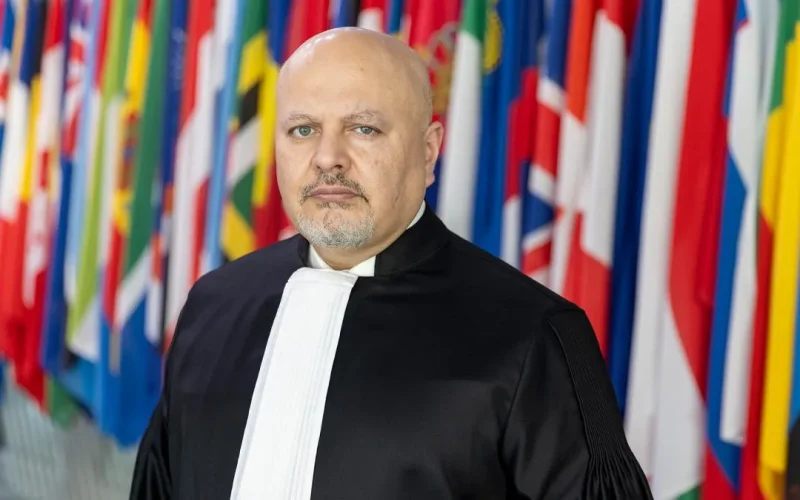
WE act for Karim A. A. Khan KC, Prosecutor of the International Criminal Court. On Friday, at a Special Session of the Assembly of States Parties, your delegations will vote in person and by secret ballot on whether the Prosecutor should be removed from office under Article 46 of the Rome Statute, in respect of allegations he has consistently denied.
Before that vote is cast, you are entitled to know how this process has been conducted. The President of the Assembly has closed every formal channel through which Mr Khan’s legal team might make representations to you and has written to all States Parties suggesting that you should not meet with us. Mr Khan KC and his legal representatives were refused accreditation to attend the session on 24 July. The right under the rules to address you on the substantive decision of misconduct has been flatly denied to us.
Consider what that means. You are the decision-makers. You alone will determine whether the Prosecutor is removed. Yet the man whose removal you are considering has been told that his representatives may not address you, may not answer before you the case put against him, and may not correct errors—of which there are many—in the material placed in front of you. We know of no court or tribunal in any proper and fair legal system that bars a person facing the gravest professional sanction from being heard.
So we write openly, though restricted by confidentiality obligations, because no other route has been left to us.
These are the facts.
First, this matter has been investigated for nearly two years, internally by the ICC’s Independent Oversight Mechanism and externally by the UN Office of Internal Oversight Services. The OIOS investigation ran for thirteen months, from November 2024 to December 2025. Its investigators interviewed more than thirty individuals and gathered more than five thousand pages of material. After all of that, the OIOS did not reach definitive factual conclusions on the contested allegations.
Second, the Bureau of the Assembly then established an independent Judicial Panel to assess that evidence, precisely because it recognised that the task demanded judges of experience and standing, impartial and free of any political interest in the outcome. The Bureau itself selected the three members of the Panel: a former judge of the European Court of Human Rights and President of the Administrative Tribunal of the Council of Europe; a former President of their nation’s Court of Appeal and member of the Commonwealth Secretariat Arbitral Tribunal; and a judge of their nation’s Constitutional Court and former member of the Administrative Tribunal of the African Development Bank. Between them, they bring decades of service at the highest levels of international and national justice, drawn from different regions of the world. Between December 2025 and March 2026, those judges conducted a meticulous review of the OIOS report and the underlying material, applying the long-standing standard of proof of beyond reasonable doubt, a standard the Bureau expressly recognised as the correct one.
Third, on 9 March 2026 the Panel delivered its conclusion. The three judges were unanimous. They stated in their report’s conclusion: “The Panel is unanimously of the opinion that the factual findings by OIOS do not establish misconduct or breach of duty under the relevant legal framework.” In addition, one of the judges, in a separate supporting opinion, stated he had “serious doubts” about the allegations. That determination should have ended this matter.
It did not. On 8 June 2026, the Bureau took the first non-consensual decision in its history. In a vote reportedly split along regional lines, thirteen states substituted their own assessment of the evidence for the unanimous conclusion of the judges, declared that misconduct was established, suspended the Prosecutor and referred his removal to the Assembly. Those thirteen states heard no witnesses. They conducted no investigation of their own. Their resolution offers no explanation of why the considered view of three senior judges should give way to the contrary view of a subset of a political body.
Let us be clear. Thirteen diplomats on the Bureau, a political entity, disregarded the meticulous analysis and the unanimous reasoned conclusion of the judges because the judges did not deliver to them the outcome they wanted. The consequence is that the unanimous conclusion of three eminent judges has been set aside and unlawfully made redundant because it did not produce the outcome that it appears some had already pre-determined.
The work of the Judicial Panel offered a sober and rigorous legal process that led towards a reasoned and impartial outcome. Instead, what we are witnessing is the powerful few, disappointed by the impartiality of the judges they appointed, now seeking to shape a process that they hope will deliver their desired outcome.
Nor did it stop there. Mr Khan was never charged with the matter on which the Bureau’s finding now rests and was never given the opportunity to respond to it. And in early July, reports emerged of moves to lower the voting threshold for a misconduct finding from two-thirds of States Parties to an absolute majority. No national jurisdiction would tolerate the rules of a removal process being rewritten while that process is under way.
We have asked, formally and repeatedly, for the complete record of these proceedings to be preserved. That request stands, and we repeat it here.
Justice, whether before the International Criminal Court or before a local court, requires at a minimum that contested evidence be assessed by independent and impartial judges. That was the role the entire Bureau assigned to the independent Judicial Panel. The Panel performed it. If the Assembly now removes a Prosecutor contrary to the unanimous conclusion of the judges appointed to assess his case, under rules changed after the process began, every future Prosecutor will understand the lesson. Independence carries a price, and the machinery of the Court can be turned against its own officeholders whenever their independence becomes inconvenient.
Our request to each State Party is this: ensure your delegation is present at the Special Session. Insist on following the Judicial Panel’s findings. Vote against any new finding of misconduct and against the removal of the Prosecutor. Bring this matter to a close on 24 July.
We remain willing to meet any Permanent Mission and to answer any question, if permitted to do so. Until then, this message will have to serve.
- Tayab Ali is head of the legal team defending Prosecutor Khan and Sareta Ashraph is the lead counsel