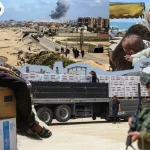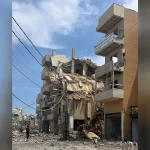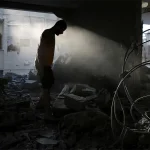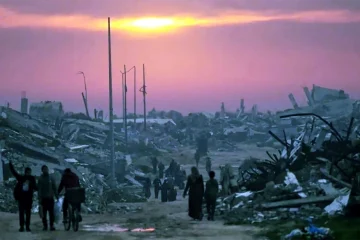
AFTER two years, an end to Israel’s military campaign and siege of the Gaza Strip is perhaps closer than at any other point. Regardless of what happens next, the damage and destruction already wrought have been immense and will have impacts that will continue to be felt for years, if not decades, to come.
Palestinians in the Gaza Strip have borne the brunt of the Israeli campaign, which an ever-growing consensus of international legal experts and rights organisations view as a genocide. But the international system of norms, laws, and institutions that has been developed over time to mitigate the worst effects of conflicts on civilians has also been thrown into crisis by what Tom Dannenbaum termed, in a recent interview with The New Humanitarian, “the backlash of the powerful”.
Dannenbaum is a professor of international law at Stanford University in the United States. The New Humanitarian spoke with him to understand what is happening with the various international legal cases being undertaken in response to Israel’s conduct in Gaza and what consequences are being imposed on the system of international law for taking up these efforts.
“It’s not taking on Israel that has precipitated a crisis for international law,” Dannenbaum said. “It’s the fact of brazen violations of international law by a powerful state that is underwritten by the most powerful state in the international system, namely the United States, that has created the crisis.”
“There is a sense that emerging from this moment is going to require more than just weathering the storm. It’s going to require something more fundamental in terms of rehabilitating and reconstructing the system,” he added.
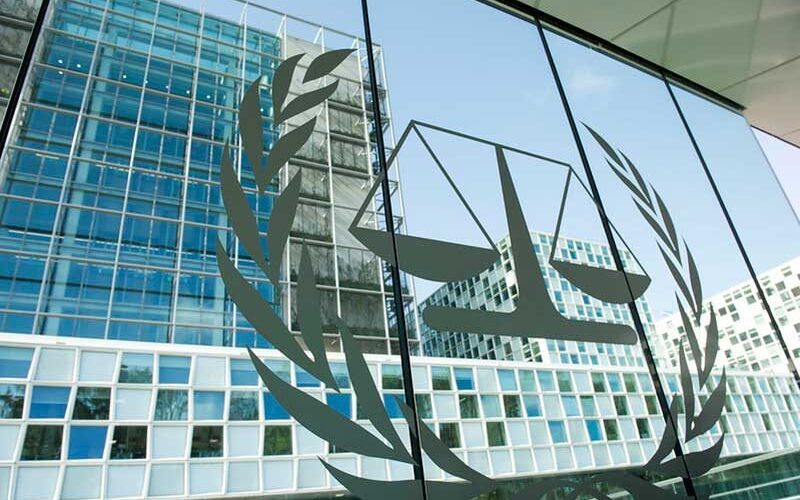
The International Criminal Court (ICC) – the only international court with jurisdiction to try individuals for war crimes, crimes against humanity, aggression, and genocide – has been conducting an investigation since 2021 into violations allegedly committed by both Palestinians and Israelis in the Israeli-occupied Palestinian territories.
That investigation covers crimes committed since 7 October 2023, when Hamas launched an unprecedented attack into southern Israel, killing around 1,200 people and taking about 250 others as hostages back to Gaza. The attack precipitated Israel’s retaliatory military campaign and siege, which has killed over 66,000, wounded nearly 170,000 others, laid waste to the enclave, and starved the 2.1 million Palestinians trapped within its borders.
The ICC issued arrest warrants in November 2024 for Israeli Prime Minister Benjamin Netanyahu and former defence minister Yoav Gallant. Three leaders of Hamas were also under investigation but have since been confirmed killed.
In December 2023, South Africa also initiated a case at the International Court of Justice (ICJ), the UN’s top court – which focuses on disputes between states – accusing Israel of committing genocide in the Gaza Strip.
We spoke to Dannenbaum about the status of the ICC and ICJ cases, the punitive action powerful states – primarily the US – are taking in response to them, what impact (if any) an opinion issued by the ICJ in July 2024 finding that Israel’s occupation of the Palestinian territories is illegal and must end has had, and what it all means for the possibility of justice and accountability and the future of the international legal system.
This interview has been edited for length and clarity.
The New Humanitarian: Has taking on cases related to Israel precipitated a crisis for the international legal system?
Dannenbaum: The institutions of international law – mainly the ICC and the ICJ – were faced with a situation where if they were to have avoided addressing the violations in Palestine, and particularly the atrocities in Gaza, they would have so clearly stripped themselves of the legitimacy upon which they depend for any kind of internalisation of the relevant norms as binding and authoritative that they would have found themselves in an existential crisis.
Instead, having taken appropriate action under international law – authorising arrest warrants, issuing provisional measures, allowing the ICJ genocide case to proceed – they’ve encountered another kind of crisis, which is the backlash of the powerful. That backlash has been exacerbated significantly by the transition of the United States from only selectively supporting or facilitating the implementation of international law to being fundamentally hostile to international law and willing to dismantle its institutions. Of course, that creates a crisis for international institutions. How could it not, to be faced with overt hostility from the most powerful actor in the system?
But if they’d gone the other route, they would have stripped themselves of legitimacy. Without that legitimacy, there would be no internalisation of their rulings and norms, and ultimately that’s the primary mechanism of compliance.
So the institutions were faced with a crisis either way, and faced with that crisis, the only thing to do was to act audaciously, in other words, to seek to uphold the law in the face of hostility from the powerful, knowing that there was no guarantee that they would prevail given the headwinds that they face in that respect.
The New Humanitarian: What is the current status of the ICC’s Palestine war crimes investigation?
Dannenbaum: The investigation is ongoing, and it’s worth bearing in mind that the investigation was opened in 2021 and encompasses crimes going back to 2014. Before 7 October 2023, one of the primary focal points of investigation had been settlements and settler violence in the West Bank. So that investigation was always ongoing on the back burner.
Now, even at the time of the application for the Gaza arrest warrants, the prosecutor had indicated that this was just the beginning and that there were other investigations ongoing, both with respect to what’s been happening in Gaza over the last couple of years, but also with respect to activity in the West Bank, including going back to 2014.
In April of this year, the Guardian reported that the court had required that any further applications for arrest warrants made by the Chief Prosecutor of the ICC, Karim Khan, would have to be made under seal and not publicly announced. Applying for warrants under seal is not something unique, but what’s distinctive, at least as far as we know, is the requirement that the prosecutor do that. So we actually don’t know if the apparent inactivity on other cases at the ICC in relation to the situation in Palestine is because applications have been made under seal and the warrants have not yet been issued, or they have been issued under seal, so we just don’t know about them, or because no applications have been made at all.
The precise reasons for the decision to require applications to be made under seal are not public. Most likely, the decision is predicated on the safety of victims, witnesses, and others who engage with the court. But we don’t know exactly.
In August, Middle East Eye reported that arrest warrant applications for Israel’s National Security Minister Itamar Ben Gvir and Finance Minister Bezalel Smotrich for the crime against humanity of apartheid had been ready for some time, but that the Office of the Prosecutor had not yet submitted the completed applications to the court.
The other thing that’s happened is that the chief prosecutor has had to step back from his role altogether due to an internal investigation relating to sexual misconduct. The consequence of that is that now the two deputy prosecutors at the ICC are handling the situation in Palestine together. And it’s not clear exactly what the decision-making process is between the two of them.
The New Humanitarian: What actions has the US taken against the ICC because of the Palestine investigation?
Dannenbaum: Shortly after Donald Trump came into office, the US issued sanctions on the prosecutor of the ICC predicated on his pursuit of accountability in the context of the Palestine situation. This was before he stepped back from his role. Subsequently, it imposed sanctions on four judges at the ICC, two of whom were judges of the pre-trial chamber in the case that resulted in the arrest warrants for Netanyahu and Gallant.
The US later extended the sanctions to two additional judges (now six in total) and the two deputies who are currently leading the Office of the Prosecutor (so, three prosecutors in total). Recent reporting indicates that the administration is now poised to sanction the court as a whole, which would be a significant and potentially debilitating escalation.
The administration has also issued sanctions on Francesca Albanese, the UN Special Rapporteur for the occupied Palestinian territories, in part because of her advocacy for the pursuit of accountability in relation to crimes occurring in Palestine, as well as three NGOs for their engagement with the ICC in relation to the Palestine investigation.
Separately, Trump ordered aid and assistance to South Africa to be cut, citing South Africa’s action at the ICJ against Israel under the Genocide Convention, among other reasons.
The New Humanitarian: What impact are those actions by the US having on the ICC?
Dannenbaum: From the outside, it’s difficult to know quite how severe the impact on the court’s functioning has been from the combination of US sanctions and less overt measures that have been reportedly taken, in particular by the Israeli government, but also by other countries such as the UK. I’m referring in that respect to allegations that David Cameron sought to influence Karim Khan not to apply for the arrest warrants.
It’s not clear how severely those efforts have undermined the court’s work. What is clear is that those are serious impediments to the effective functioning of the court, that there are real questions about the capability of the court to survive this kind of assault, and that these kinds of attacks on the court themselves potentially implicate offences against the administration of justice, which is a stand-alone offence within the ICC framework.
The reporting in August that arrest warrant applications for Smotrich and Ben Gvir were ready also indicated that they were being held back from submission because of the deputy prosecutors’ concern about sanctions. If that is accurate, it would entail a significant impact on ICC functioning. Of course, the deputy prosecutors have since been sanctioned anyway.
On the one hand, the fact that the Office of the Prosecutor applied for the arrest warrants for Netanyahu and Gallant and that the court issued them, notwithstanding an external pressure campaign, is itself indicative of a certain level of institutional resilience. On the other, it’s obvious that these kinds of pressures are going to affect how individuals think about their work and their lives and their careers and their families, and so it poses an existential threat to the ICC.
Sanctions on the court as a whole will, of course, make it very difficult for the institution to function. The court has reportedly paid staff in advance for the remainder of 2025 and is looking into financial and technological service providers that would not need to sever ties in the event of sanctions on the institution as a whole.
Thus far, ICC States Parties have failed to deploy all available methods of shielding the court from these attacks. Most obviously, the European Union has declined to invoke and apply its blocking statute, which is designed specifically to guard against the impact of sanctions regimes on EU operators.
The New Humanitarian: The South Africa genocide case at the ICJ has slipped into the background. Have there been any developments in that case, and when can we expect any?
Danenbaum: The ICJ moves slowly. South Africa was required to submit its first memorial (evidence and legal arguments) in October 2024. Israel had nine months to submit its counter memorial, which was due in July of this year. But it applied for an extension. The court granted a six-month extension, so it’s now due in January 2026. After that, the court will give each party another six months to file a second round of memorials, and then there will be potentially a significant number of intervening states that want to provide their own written submissions. Then there will be oral hearings.
So, it’s likely that we won’t have an outcome in this case until, at the very earliest, the end of 2027 or early 2028, and possibly longer than that. In the intervening months, we’ll have relatively little information, at least until oral proceedings, because the memorials are filed confidentially. We’ll know when they’re filed, but we won’t know much about what’s in them.
Before the outcome of this case, we will have hearings and very likely an outcome in the case in which The Gambia has alleged that Myanmar has committed genocide against the Rohingya. That is highly significant for the South Africa-Israel case because it raises key questions about how to infer genocidal intent from a pattern of conduct. Those questions, to the extent that they’re answered in that case, will have a huge bearing on what we can expect from the court in the South Africa-Israel case.
Last month, the Independent International Commission of Inquiry on the Occupied Palestinian Territory and Israel, which is mandated by the United Nations Human Rights Council, released a landmark report concluding that Israel has committed genocide in Gaza. Although the ICJ will, of course, perform its own independent evaluation, it would not be surprising if it were to draw on the commission’s fact-finding and analysis just as it drew on those of the International Criminal Tribunal for the former Yugoslavia almost two decades ago in a case in which it found genocide at Srebrenica.
The New Humanitarian: A little over a year ago, the ICJ issued an advisory opinion saying that Israel’s occupation of the Palestinian territories is illegal. What impact, if any, has that opinion had since it was released?
Dannenbaum: Clearly, conditions in both Gaza and the West Bank have deteriorated since the advisory opinion. So, in terms of changing conditions on the ground, it has not had a positive impact. It hasn’t restrained Israeli policy in either Gaza or the West Bank.
The advisory opinion was not directly responsive to Israel’s actions in Gaza. Nonetheless, in reflecting on what has happened since the opinion, it cannot be ignored that, particularly after the 2nd of March of this year, we saw a precipitous deterioration in humanitarian conditions in terms of access to food, access to safe water, and access to medical care, with no aid at all entering until the 19th of May. That was then followed by the severe insecurity around aid distribution sites after the shift to the Gaza Humanitarian Foundation model.
On the 22nd of August, the Famine Review Committee determined that the situation had crossed the threshold of famine. Amidst everything else, that is a specific mark of profound shame regarding what Israel has done in Gaza and the world’s failure to prevent it.
In the West Bank, we’ve seen expanded authorisation for settlements, settler violence with impunity, and a significant number of killings and injuries inflicted on Palestinians by Israeli forces and or settlers.
There has been no movement at all in Israel towards the obligation to, as rapidly as possible, end the illegal occupation; no movement at all towards cessation of existing violations and or reparation for prior violations. Indeed, Israel has approved the expansion of existing settlements, deepening and exacerbating violations that were clearly identified in the advisory opinion.
So in all of those respects, there has not been compliance with the obligations that were identified and articulated through the advisory opinion.
The New Humanitarian: That’s pretty bleak. Are there any silver linings?
Dannenbaum: The advisory opinion did change the legal context and discursive context within which third-party states are acting. But it has not yet made a difference on the ground, where the conditions are undeniably urgent.
Still, there are arguably some significant changes. The cause of those changes is difficult to identify in terms of a single factor. But the advisory opinion is one factor among many, including the fact of deteriorating conditions, especially in Gaza, and the growing pressure on third-party states to respond.
A growing number of states that had been resistant to doing so have now recognised Palestinian statehood. Just in the past several weeks, this includes a significant number of powerful Western states, such as the UK, France, Canada, Spain, and Australia. Recognising Palestinian statehood is both important on its own terms and relevant to advancing the imperatives outlined by the court in the advisory opinion. But it alone won’t achieve those objectives. It cannot mask the grave and continuing deterioration in the conditions that would be necessary for genuine Palestinian self-determination.
We saw the high-level New York declaration issued in July, in which Western and Arab states came to an agreement on the importance of committing to concrete, tangible, and time-bound steps towards Palestinian statehood, the ending of the occupation as rapidly as possible, and taking concrete measures aligned with the advisory opinion. In September, the UN General Assembly endorsed the declaration by an overwhelming majority (142-10), which is significant. However, it remains to be seen how third-party states will seek to build on this broad agreement to try to induce meaningful change on the ground, particularly given US and Israeli opposition.
The EU Commission has proposed multifaceted sanctions, with support for the move growing within the bloc. Belgium, Slovenia, Spain, Luxembourg, and Ireland have been among the leaders in that effort. The politics within the EU are such that it remains uncertain whether the proposal will receive the necessary support. However, if it is approved, this would be a significant, albeit long belated, step in pressuring Israel.
Several EU states, including many of those just mentioned, are imposing or considering their own direct sanctions in various forms. Norway’s sovereign wealth fund, which is the world’s largest, recently divested from a number of firms implicated in violations in Gaza and the West Bank, following an ethics review. And then there are targeted sanctions that a number of states have on certain settlers or settler groups or, in some cases, on Israeli government ministers, Itamar Ben Gvir and Bezalel Smotrich.
Ultimately, existing actions remain woefully insufficient when juxtaposed with the reality in Gaza and the West Bank, the urgency of the imperative to respond to that reality, and what is necessary to induce change.
The New Humanitarian: Where do you see all of this going in terms of the future of international law?
Danenbaum: For those of us who work on international law, and particularly the areas of international law relating to the protection of human beings and societies from the gravest threats, there’s a strong inclination to continue to rely on this framework and the language of international law to articulate violations and to seek to mobilise resistance to those violations.
We can’t fall into the trap of accepting perpetrators’ efforts to deny the relevance, meaning, or reality of the legal constraints that they violate. That their power shields them from accountability in this moment does not mean that they are not committing crimes or violating the law. They are, and it is important to continue to say so.
There are states that are doing that and taking action in a principled and compelling way – for example, Slovenia, Chile, Spain, Norway, and Ireland. These states have been equally strong across situations on the imperative to comply with and to enforce international law. Although often frustrated and with uneven participation, there has been significant transnational legal and investigative cooperation in response to massive violations in Syria, Ukraine, and Gaza. And the fact that states are bringing ICJ cases that do not directly affect their own national interests is itself an important development.
So, the most hopeful scenario is that states that are taking those kinds of positions continue to do so and that law-affirming civil society actors in states that have taken more hypocritical or overtly hostile postures will gain political influence to the point that those states start to change their posture, rehabilitate the regime of international law, and act effectively to insulate it from assaults that seek to undermine it.
But it is uncertain that those forces will prevail. So there is a real possibility that the system will ultimately break under the pressure of this current set of violations, the brazenness with which they have been perpetrated, and the broader trend of assaults on the rule of law and institutions of accountability. It is imperative to resist that pressure. What would emerge from such a collapse is, I think, really unclear.
There is a real value in having a set of principles around which we can organise collectively to articulate wrongs in a way that is intelligible across lines of division and across multiple communities and traditions. To lose that would be a grave loss for the functioning of international relations.
Edited by Andrew Gully.
–––––
The New Humanitarian puts quality, independent journalism at the service of the millions of people affected by humanitarian crises around the world. Find out more at www.thenewhumanitarian.org.