FOR a generation, the calculus of grand corruption in Nigeria was brutally simple: capture a position of trust, loot what the office affords, and rely on the near-total impunity that has historically shielded the politically connected from consequence. That calculus is being rewritten. Not with the swiftness Nigerians have long demanded, and not without setbacks, but with a consistency that is beginning to look less like a campaign of convenience and more like the outline of a functioning accountability state.
In recent months, the Economic and Financial Crimes Commission (EFCC) has secured convictions, court-ordered forfeitures and active prosecutions against men and women who once stood at the very apex of Nigerian public life – an Accountant-General of the Federation, a federal minister, an Attorney-General, a Central Bank governor and a state governor among them. Crucially, the dragnet has not spared the private sector: bank chairmen and corporate directors accused of raiding the very institutions Nigerians trusted with their savings are being marched through the same courtrooms as the public officials they so often did business with.
THE ACCOUNTANT-GENERAL WHO MOVED BILLIONS
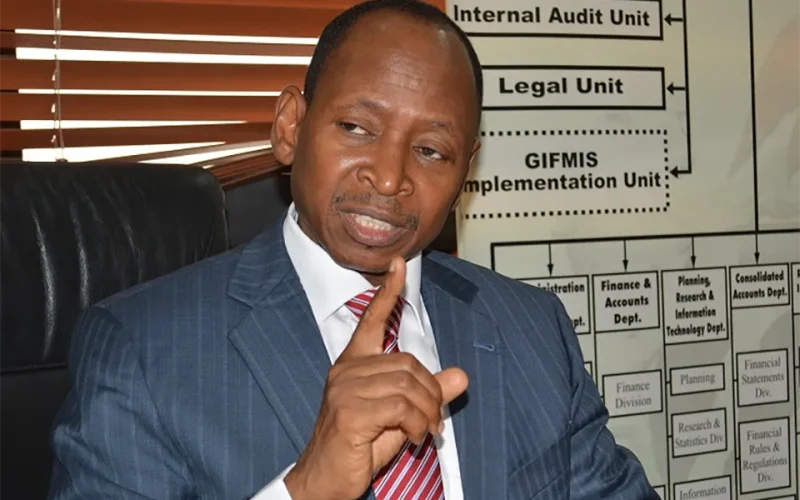
At the centre of one of the most consequential trials is Ahmed Idris, Nigeria’s former Accountant-General of the Federation, who stands accused alongside three co-defendants – Geoffrey Olusegun Akindele, Mohammed Kudu Usman and Gezawa Commodity Market and Exchange Limited – on a 14-count charge bordering on stealing and the fraudulent diversion of public funds amounting to ₦109.5 billion. Idris was arrested in his native Kano in mid-2022 and flown to Abuja for interrogation. His trial has since become a protracted contest over the admissibility of his own statements to investigators, with a trial-within-a-trial ordered to determine whether those statements were voluntarily made. The matter has been adjourned to October for final written addresses – a reminder that even where the evidence trail is substantial, Nigeria’s justice system moves at a pace that tests public patience.
A MINISTER, A WARRANT, AND 75 YEARS
Where Idris’s case illustrates the grinding length of these trials, the prosecution of Saleh Mamman shows what the other end of that road can look like. The former Minister of Power, who served under ex-President Muhammadu Buhari, was convicted on all 12 counts of a money-laundering charge tied to the diversion of ₦33.8 billion meant for the Mambilla and Zungeru hydroelectric power projects – the very schemes that were supposed to end Nigeria’s chronic darkness. Mamman did not appear for his own judgment; the court issued a warrant for his arrest and proceeded regardless, sentencing him in absentia to a cumulative 75 years in prison, alongside forfeiture of recovered foreign currency and four properties traced to him. Justice James Omotosho did not mince words, holding that officials who divert funds meant for national development bear direct responsibility for the infrastructure crisis and the darkness in which millions of Nigerians still live.
“The actions of public officials accused of diverting funds meant for national development have contributed significantly to the country’s lingering infrastructure crisis and widespread darkness.”
Justice James Omotosho, Federal High Court, Abuja
THE NATION’S CHIEF LAW OFFICER, UNMASKED
Perhaps no case better captures the audacity of grand corruption – nor the scale of the state’s response – than that of Abubakar Malami, SAN, who served as Attorney-General of the Federation and Minister of Justice between 2015 and 2023. In one of the most far-reaching asset-recovery rulings the EFCC has secured, the Federal High Court in Abuja ordered the final forfeiture of 48 of 57 properties linked to Malami, valued at roughly ₦212 billion. Justice Joyce Abdulmalik dismissed objections filed by Malami, his wife and son, and several companies claiming ownership, ruling bluntly that the question before the court was not who owned the properties, but whether the money used to acquire them was lawfully obtained.
The forfeited estate reads like an inventory of a private empire: luxury hotels in Kano, a university, shopping plazas, filling stations, warehouses and residential compounds spanning the Federal Capital Territory, Kebbi, Kano and Kaduna states. Among the assets swept into the state’s net were not one but two mosques built with the disputed funds – the Zeennoor Mosque in Kano and a second mosque valued in the hundreds of millions of naira – a detail that has struck many Nigerians as a stinging irony: wealth allegedly stolen from the public purse funneled even into houses of worship. Malami separately faces a 16-count charge of conspiracy and money laundering involving an alleged ₦8.7 billion, in which his wife, Nana Hadiza, and one of his sons, Abdulaziz, are named as co-defendants – a case that keeps the family’s legal exposure very much alive even as the civil forfeiture battle concludes.
THE CENTRAL BANKER AND HIS 753 HOUSES
Godwin Emefiele’s fall from the governorship of the Central Bank of Nigeria to the defendant’s dock has become one of the defining sagas of this accountability drive. Emefiele faces multiple, overlapping prosecutions alleging the diversion of public funds totalling roughly ₦154.39 billion, spanning charges of controlling billions of naira through proxy accounts held in the name of Kelvito Integrated Services and other entities, and directing disbursements through an aide, Eric Ocheme, who remains at large. In a case that has drawn national attention, the EFCC secured the final forfeiture of a 753-unit housing estate in Abuja’s Lokogoma district, which the agency says Emefiele and Ocheme acquired unlawfully while Emefiele held Nigeria’s most powerful financial office. The estate has since been formally handed to the Ministry of Housing and Urban Development for completion, with the government holding it up as a model of how recovered assets should be redeployed for public benefit rather than left to rot in litigation limbo. Emefiele has appealed the forfeiture, arguing he was not properly notified – an argument the trial court has already rejected, finding the EFCC’s published notice could not reasonably be described as hidden.
THE GOVERNOR AND THE CHRISTMAS GRAIN MONEY
The crackdown has reached into state government too. Darius Dickson Ishaku, who governed Taraba State until 2023, is standing trial alongside a former permanent secretary, Bello Yero, on a 15-count charge involving the criminal breach of trust and conversion of ₦27 billion in public funds. Testimony this year has laid bare the mechanics of the alleged scheme in granular, almost domestic detail: prosecution witnesses have described how local government funds earmarked for the purchase of Christmas grain for ordinary Taraba residents were instead routed into a private company’s account on the instructions of state officials. One witness told the court that Ishaku had advised him to disappear for six months rather than cooperate with EFCC investigators – testimony that, if accepted, speaks to a governor allegedly more concerned with evading accountability than with the grain that never reached the people who needed it.
THE BANKS ARE NOT EXEMPT
What distinguishes this current wave from Nigeria’s periodic and often theatrical anti-corruption gestures of the past is its reach beyond the political class. Tunde Ayeni, former chairman of the board of the now-defunct Skye Bank Plc (absorbed into Polaris Bank), has been re-arraigned for a third time on an amended 18-count charge involving the diversion of ₦15.6 billion in depositors’ funds, with prosecutors alleging he directed multi-billion-naira transfers out of the bank’s suspense account into companies linked to his own interests. In a parallel case, BFI Group Corporation and six of its directors are on trial over an alleged scheme to defraud the Central Bank of Nigeria of €100 million through a fabricated capital-importation certificate – a case that stalled again this month when a defendant collapsed in court mid-cross-examination, only underscoring how physically and emotionally gruelling these marathon trials have become for all involved.
THE VAULT EMPTIES: A SOCIALITE’S N8.9BN FORTUNE
If Malami’s mosque and Emefiele’s housing estate illustrate how deep the culture of concealment has run inside public office, the case of Aisha Achimugu shows how far its tentacles reach into Nigeria’s world of private glamour and philanthropy. On 16 July 2026, Justice Jude Onwugbuzie of the FCT High Court in Apo, Abuja, granted the EFCC’s application for the final forfeiture of jewellery valued at ₦4,645,170,294.90, eleven exotic vehicles worth ₦4,293,000,000, US$50,000 in cash and a further ₦30 million belonging to Achimugu, chief executive of Oceangate Engineering Oil & Gas Ltd and Felak Concept Group – a haul exceeding ₦8.9 billion now vested in the Federal Government.
Achimugu’s fall began not with a whistleblower but with financial intelligence: a pattern of massive inflows and outflows running into billions of naira and millions of dollars across more than 136 bank accounts linked to her, none of it declared as revenue in statements filed with the Federal Inland Revenue Service. When EFCC operatives searched her residence, they recovered jewellery, cash and other valuables that she then declined to declare as her own on an Assets Declaration Form issued during interrogation – an omission the court treated as corroborating the Commission’s case rather than undermining it. Her legal team filed affidavits contesting the order and sought to have the earlier interim forfeiture set aside; the EFCC, led by Ekele Iheanacho, SAN, opposed the application under Section 17 of the Advance Fee Fraud and Other Related Offences Act, which allows courts to order the forfeiture of assets reasonably suspected to be proceeds of unlawful activity without requiring a criminal conviction first.
The judgment caps more than two years of scrutiny that began, in the public imagination at least, with a seven-day fiftieth birthday celebration on the Caribbean island of Grenada in January 2024, attended by prominent political and entertainment figures including Lagos State Governor Babajide Sanwo-Olu. Achimugu was declared wanted by the EFCC in March 2025, arrested at the Nnamdi Azikiwe International Airport in April 2025, and has separately lost a further US$13 million linked to Oceangate to a Federal High Court forfeiture order in March 2026. She maintains that her wealth predates any political association and traces to a business she built from 2001, and that cash found in her home belonged to her mother – arguments that, twice now, have not survived the reversed burden of proof that defines Nigeria’s civil forfeiture regime, under which it falls to the asset holder, not the state, to prove that unexplained wealth was honestly earned.
The case sits at the centre of a wider debate about the instrument the EFCC is increasingly reaching for. Civil forfeiture is faster and evidentially lighter than criminal prosecution — it asks only whether assets are reasonably linked to unlawful activity, not whether their holder is guilty beyond reasonable doubt — and critics warn it can be turned against the merely unpopular as easily as the genuinely corrupt. Its defenders counter that it is exactly the tool required against a class of wealth that has, for decades, outrun any plausible legitimate income while criminal trials stall for years in an overburdened judiciary. Either way, the harder question the Achimugu case leaves hanging is institutional rather than personal: how 136 accounts across ten banks moved billions in undeclared funds before any flag was raised loudly enough to matter, and what Nigeria’s Financial Intelligence Unit and banking regulators intend to do about the architecture that let it happen.
“The court found that Achimugu did not dislodge the evidence led by the EFCC and also failed to discharge the burden of showing that the assets were from lawful origins.”
Ruling summary, FCT High Court, Apo, Abuja
THE MINISTER WHO BORROWED A PLANE TO FAKE A NATION’S DREAM
Few episodes capture the theatre of Nigerian grand corruption quite like the case now unfolding against Hadi Sirika, the country’s former Minister of Aviation. Sirika is standing trial before the FCT High Court in Abuja alongside his daughter, Fatima Sirika; his son-in-law, Hamma Jalal Sule; and their company, Al Buraq Global Investment Limited, on an amended six-count charge of abuse of office and misappropriation of public funds exceeding ₦2 billion. At the centre of the case is Nigeria Air – the long-promised national carrier that successive governments have dangled before Nigerians for years – and the elaborate theatre the EFCC says Sirika staged to convince the country it had finally arrived.
According to testimony from a 12th prosecution witness, EFCC investigator Christopher Odofin, Sirika’s ministry chartered an Ethiopian Airlines aircraft under an agreement executed on 24 May 2023 – just five days before he left office – solely to have the Nigeria Air logo painted onto its fuselage for a public unveiling at the Nnamdi Azikiwe International Airport in Abuja. The aircraft, crewed by staff still in Ethiopian Airlines uniforms and greeted by people the prosecution says were locally assembled for ceremonial photographs, sat on Nigerian tarmac for less than 72 hours. Once the display ended, the Nigeria Air branding was stripped off and the plane flown back to Addis Ababa – leaving Nigerians with a launch ceremony but, six years on, still no airline. Odofin further testified that a consultancy contract for the stillborn Nigeria Air project, awarded to a firm called Tianaero Nigeria Limited and linked to a close Sirika associate, ballooned from just over ₦299 million in April 2022 to more than ₦599 million by October the same year.
THE AGENCY THAT NEVER EXISTED – WITH A REAL BUDGET LINE
If Sirika’s case shows how far officials will go to fake success, the saga of Adeniyi Adeyemi Matthew shows how far an outsider could go to fake an entire institution. Adeyemi styled himself Director-General of the Presidential Foreign Investment Promotion Council (PFIPC) – a body that, investigators say, never legitimately existed at all. Yet the fictitious council did not merely exist on paper in some obscure corner of government: it opened accounts referencing the Central Bank of Nigeria, operated out of the federal secretariat, and was written into the 2026 Appropriation Act with a budget allocation of ₦1.3 billion, roughly US$950,000. It took a presidential order from Bola Tinubu, after the story broke, to trigger a formal corruption investigation into an agency that had, by then, already made it into the nation’s annual budget.
Forensic examination ordered by the presidency found that the letter purporting to establish the PFIPC carried a forged signature of Tinubu’s chief of staff, Femi Gbajabiamila. The Accountant-General’s Office has since insisted the council never actually operated a Central Bank account and never received public funds or salaries – a claim that, if true, raises its own uncomfortable question about how a wholly fictitious agency travelled so far through the budgeting process before anyone noticed. Adeyemi, for his part, has offered an even more explosive counter-narrative: in a television interview, he claimed he paid ₦400 million – money he says he borrowed and has yet to repay – to secure his appointment as the council’s director-general, naming Gbajabiamila as the recipient of the alleged bribe, an allegation the presidency has dismissed, branding Adeyemi a con artist running a made-up outfit. When Adeyemi failed to appear before the Federal High Court in Abuja to answer charges of forgery and impersonation, the court issued a warrant for his arrest; he was picked up in Osun State after several weeks on the run and is now in police custody in Abuja, alongside two co-accused, facing prosecution over the council’s creation and operation.
Taken alongside the Sirika and Achimugu cases, the PFIPC affair completes a troubling picture: Nigeria’s culture of grand deception has evolved past looting real institutions into inventing them outright, and past disguising failure into fabricating success for the cameras. Whether it is a borrowed aeroplane standing in for a national airline or a phantom council drawing a nine-figure budget line, the through-line is the same – a governance system porous enough that spectacle, forged paperwork and a confident title could, for a time, pass for the real thing.
A LEDGER OF ACCOUNTABILITY
Taken together, the cases now working their way through Nigeria’s courts represent one of the most sustained assaults on elite impunity the country has mounted in decades. The table below summarises the current state of the highest-profile prosecutions and forfeitures.
| NAME | FORMER POSITION | CORE ALLEGATION | SUM INVOLVED | STATUS |
| Ahmed Idris | Accountant-General of the Federation | Stealing and fraudulent diversion of public funds, 14-count charge with three co-defendants | ₦109.5bn | On trial, FCT High Court |
| Saleh Mamman | Minister of Power | Conspiracy and money laundering of funds meant for Mambilla and Zungeru hydro projects | ₦33.8bn | Convicted, sentenced to 75 years |
| Abubakar Malami, SAN | Attorney-General of the Federation | Final forfeiture of 48 of 57 properties; separate 16-count conspiracy and money-laundering charge with wife and son | ₦212bn forfeited / ₦8.7bn charge | Assets forfeited; criminal case pending |
| Godwin Emefiele | Governor, Central Bank of Nigeria | Multiple prosecutions over alleged diversion of public funds; unlawful acquisition of a 753-unit estate through proxies | ₦154.39bn / 753 housing units | On trial across several charges; estate forfeited |
| Darius Dickson Ishaku | Governor, Taraba State | Criminal breach of trust and conversion of local government and contingency funds, including grain-relief money | ₦27bn | On trial, FCT High Court |
| Tunde Ayeni | Chairman, defunct Skye Bank Plc (private sector) | Criminal breach of trust and diversion of depositors’ funds | ₦15.6bn | On trial, third re-arraignment |
| BFI Group Corporation & 6 others | Private company and directors | Conspiracy to defraud the Central Bank of Nigeria via a fictitious €100m capital-importation certificate | €100m | On trial, cross-examination stage |
| Aisha Achimugu | Oil & gas entrepreneur, CEO Oceangate/Felak Concept (private sector) | Unexplained wealth across 136 bank accounts; undeclared jewellery, exotic cars and cash | ₦8.9bn forfeited | Assets forfeited; separate money-laundering probe ongoing |
| Hadi Sirika | Minister of Aviation | Abuse of office; staged Nigeria Air unveiling using a chartered Ethiopian Airlines aircraft | ₦2bn+ | On trial, FCT High Court, with family co-defendants |
| Adeniyi Adeyemi Matthew | Self-styled DG, fictitious Presidential Foreign Investment Promotion Council | Forgery and impersonation; created a non-existent agency with a ₦1.3bn budget line | ₦1.3bn budgeted | Arrested after evading court; in custody, facing prosecution |
Figures and case status as reported by Nigerian courts and the EFCC as of 17 July 2026. Amounts reflect sums alleged in charges or ordered forfeited; several matters remain contested and defendants are presumed innocent pending conviction.
SLOW, BUT NO LONGER SELECTIVE
None of this is to suggest that Nigeria’s anti-corruption machinery is without flaw. Trials-within-trials, adjournments citing ill health, missing defendants and years-long delays between arraignment and verdict remain the norm rather than the exception – Idris’s case alone has stretched across more than four years since his arrest. Critics rightly note that convictions, when they finally arrive, have often followed the departure of the accused from the offices that enabled the alleged looting in the first place, raising uncomfortable questions about whether prevention, not just prosecution, deserves greater institutional investment.
Yet the direction of travel is unmistakable. Nigerians are watching a former Accountant-General, a former Attorney-General, a former Central Bank governor, a former state governor and a former federal minister simultaneously answer for the stewardship of public resources – while private financiers who treated depositors’ funds and the Central Bank itself as fair game face the same courtrooms. Assets running into the hundreds of billions of naira, from housing estates to hotels to a university and mosques, have been wrested back from private hands and returned, at least on paper, to the Nigerian state.
How a nation survives such monumental looting across virtually every sector of public life remains, as many Nigerians rightly ask, a sobering question in itself. Until Nigeria fundamentally overhauls its criminal justice system – compressing timelines, closing the loopholes that allow the well-resourced to delay judgment indefinitely, and imposing sentences severe enough to function as genuine deterrents – the public treasury will remain a tempting prize for those who see office not as a trust but as an inheritance. What the past year has shown, however, is that the age of guaranteed impunity for Nigeria’s most powerful is no longer guaranteed at all. The institutions are moving. The question now is whether they can move fast enough, and go far enough up and down the chain of command, to change the incentives that produced this crisis of grand corruption in the first place.