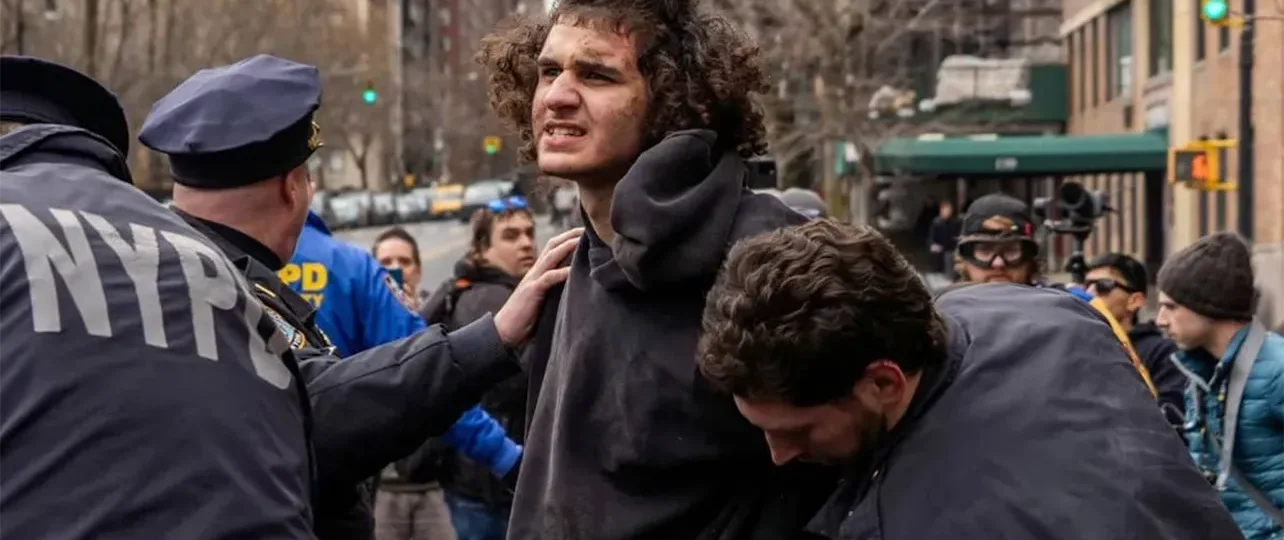

AT 12:15 on a cool Saturday afternoon in March, a crowd of protesters and counter-protesters traded insults outside Gracie Mansion, the official residence of New York City’s Mayor, on the leafy Upper East Side of Manhattan. Police barriers separated the two groups. NYPD officers stood watch. It looked, on the surface, like any other tense but manageable New York demonstration.
Then Emir Balat reached into his bag and pulled out a glass jar packed with nuts, bolts and a highly volatile explosive called TATP — known in bomb-making circles as the “Mother of Satan” — and lit the fuse.
The device exploded. Moments later, a second bomb detonated on the ground near a cluster of NYPD officers. By a combination of good fortune and the quick reflexes of the police, no one was killed. Balat, 18, was tackled to the ground as he vaulted a barricade. His alleged accomplice, Ibrahim Kayumi, 19, was arrested nearby seconds later.
What followed the arrests was, if anything, more chilling than the attack itself. In the hours, days, and weeks that followed, investigators would piece together a premeditated, meticulously planned plot for mass murder — one inspired by ISIS, months in the making, and, according to Balat’s own calculation, designed to kill between 8 and 60 people.
“What I have here is called TATP. It’s gonna kill about 8 to 16 people, or as many as 30 to 60 if the area is crowded.”
Emir Balat, on dashcam audio, morning of the attack
THE RIDE FROM PENNSYLVANIA
The dashcam fitted to the car Balat had borrowed from a relative may prove to be the most damning piece of evidence in the entire case. As the two young men drove from their homes in Langhorne and Newtown, Pennsylvania, to Manhattan on the morning of March 7, it captured nearly every word they spoke.
Kayumi, according to prosecutors, could be heard declaring: “All I know is I want to start terror, bro. I want to petrify these people.” Balat, the apparent operational lead, was already in tactical mode — running his accomplice through the mechanics of throwing a bomb, the importance of speed, and the signal to go: “3, 2, 1.”
They had done their reconnaissance on social media, hunting for the location of a specific individual they had named as a target. Balat described their goal as hitting “the government” and “civilians also.” He had, he said, already left behind a note. He spoke of “martyrdom.”
By the time they parked a few blocks south of Gracie Mansion, they had been on the dashcam for hours — unwittingly narrating their own prosecution.
| THE CHARGES AT A GLANCE |
| Conspiracy to provide material support to a foreign terrorist organisation — up to 20 years |
| Use/attempted use of a weapon of mass destruction — up to life in prison |
| Carrying explosive materials during a federal felony — mandatory 10 years, consecutive |
| Transportation of explosive materials — up to 10 years |
| Unlawful possession of destructive devices — up to 10 years |
| Both defendants face eight counts in total |
THE NOTEBOOK, THE STORAGE UNIT, THE FUSE
Inside the car, officers found a long coil of fuse, a notebook dense with handwritten instructions, and the dashcam memory card. The notebook read like a DIY terrorism manual: synthesis instructions for TATP — triacetone triperoxide — lists of required chemicals including hydrogen peroxide and sulfuric acid, warnings about moisture and friction sensitivity, and detailed steps for lighting and detonating a bomb with a burning fuse.
One page outlined a contingency plan for a vehicle-ramming attack. It listed ideal vehicle characteristics — “large in size,” “heavy in weight,” “load bearing.” It listed possible target categories: festivals, parades, protests, and celebrations. It contained instructions for making napalm.
A storage unit Balat had rented in Langhorne just days before the attack yielded what investigators described as a bomb-making laboratory in miniature: syringes, a digital scale, gloves, glass jars matching those used to build the devices, an open package of nuts and bolts, and a bottle of 12% hydrogen peroxide. On the floor, a handwritten note: “All praise is due to Allah!!! Die in your rage ya kuffar!”
TATP residue, confirmed by forensic analysis, was found in the unit. The same explosive was in the bombs Balat threw at the protesters and police officers on March 7.
“No, even bigger. It was only three deaths.”
Emir Balat, when asked if the Boston Marathon bombing was his inspiration
IN HIS OWN WORDS
En route to the NYPD precinct after his arrest, Balat reportedly told officers transporting him: “This isn’t a religion that just stands when people talk bad about our prophet. We take action!” Asked by investigators whether the Boston Marathon bombing had served as his model, he corrected them. Three deaths, he said, were not what he had been aiming for.
At the precinct, given paper and pen at his request, Balat wrote: “All praise is due to Allah, Lord of all worlds! I pledge my allegiance to the Islamic State. Die in your rage yu kuffar! Emir B.”
Kayumi, surrounded by bystanders after his arrest, was asked by someone in the crowd why he had done it. His single-word answer: “ISIS.” At the precinct, he told investigators he had watched “radical content” online.
Balat is 18 years old. Kayumi is 19.
THE INDICTMENT
On April 7, 2026, a federal grand jury in the Southern District of New York returned an eight-count indictment against both men. The indictment, announced jointly by U.S. Attorney Jay Clayton, FBI Director Kash Patel, and NYPD Commissioner Jessica Tisch, includes charges of conspiracy to provide material support to a designated foreign terrorist organisation, attempted use of a weapon of mass destruction, and unlawful possession of destructive devices.
Several of the charges carry a maximum sentence of life imprisonment. The mandatory 10-year sentence for carrying explosive materials during a federal felony must, by law, run consecutively to any other sentence imposed.
“They sought to murder multiple innocent victims in the name of ISIS,” U.S. Attorney Clayton said in a statement. “The brave women and men of the NYPD responded immediately, and Balat and Kayumi were arrested on site.”
The case has been assigned to U.S. District Judge Vernon S. Broderick. The investigation was led by the FBI’s Joint Terrorism Task Force, which draws on personnel from the NYPD and more than 50 federal, state and local agencies.
A WIDER WARNING
For African and Global South audiences, the New York attack carries a signal that should not be lost in the geography. ISIS, despite the territorial collapse of its so-called caliphate in Syria and Iraq, has demonstrated a persistent capacity to radicalise individuals remotely, across borders and cultures, through online content. The pattern here — two young men consuming extremist media, graduating to operational planning, sourcing materials, and executing an attack — is one that has played out from Paris to Nairobi, from London to Lagos.
The relative youth of the alleged perpetrators — one was still legally a minor when the planning began — underscores the urgency of digital radicalisation as a continental security concern. African governments that have watched the Sahel fall to jihadist insurgencies, or tracked the financing of al-Shabaab through illicit trade networks, will recognise the anatomy of this case, even in a Manhattan context.
What saved lives outside Gracie Mansion was, in the end, the imperfection of homemade explosives and the speed of the police response. It was not, investigators stress, any failure of the terrorists’ intent.