THE Israeli cabinet’s approval of a 334-million-dollar development plan for the occupied Syrian Golan Heights is not, by itself, the beginning of a new policy. It is the financial and institutional crystallisation of a dispossession that has been under construction since 1967. What is new – and what demands the world’s attention – is the scale of the ambition, the timing of the announcement, and the near-total silence of the powers best positioned to stop it.
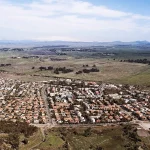
The plan, adopted by the Israeli government, earmarks funding to expand the settlement of Katzrin – founded in 1977 on Syrian land occupied in the 1967 war – into what officials are now calling the Golan’s “first city.” The stated target is 3,000 new Israeli settler families in the territory by 2030. To achieve that, the state will fund housing, roads, public services, a university campus, and specialist medical facilities. An Israeli government directorate established in 2024 will coordinate the delivery.
Human Rights Watch, which brought the decision to global attention, was unambiguous in its characterisation: this is a war crime. Under Article 49(6) of the Fourth Geneva Convention, the transfer by an occupying power of its own civilian population into territory it occupies is a grave breach of international humanitarian law. There is no interpretive grey area. The prohibition is categorical.
“Israel’s cabinet has put public money behind a war crime in Syria at the same time as it is turbocharging settlement expansion in the West Bank.” — Hiba Zayadin, Human Rights Watch
The Architecture of Permanent Occupation
The Golan’s legal status has never been in serious dispute among the international community. Israel occupied the territory in 1967 and in 1981 extended its own laws into it – a move the UN Security Council, in Resolution 497, declared null, void, and without international legal effect, affirming that the Fourth Geneva Convention continues to apply. The UN General Assembly has reaffirmed this position annually, most recently in December 2025.
The sole exception to this global consensus is the United States, which in 2019 recognised Israel’s purported annexation. That recognition has no standing in international law, but it carries enormous political consequence: it is the diplomatic scaffolding on which Israeli planners have built their confidence that the Katzrin expansion will proceed without meaningful sanction.
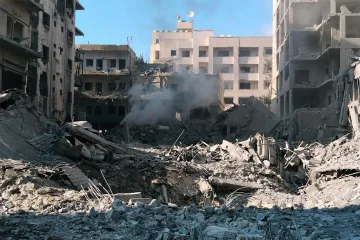
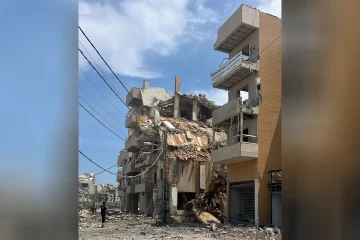
Since the fall of the Assad government in December 2024, Israel has moved aggressively to deepen its physical hold on Syria beyond even its existing occupation. Its forces have established military positions inside Syria beyond the 1974 disengagement line, conducted ground raids and air operations across Quneitra, Daraa, and Sweida, and – according to Human Rights Watch documentation — forcibly displaced Syrian residents from villages near the separation line, in some cases razing homes with bulldozers overnight. Farmland, orchards, grazing pastures, and water sources have been fenced off. Syrian civilians have been arbitrarily detained and transferred into Israel, held without charge.
The Katzrin plan, in this context, is not an isolated decision. It is the civilian-infrastructure layer of a military project whose logic is annexation by fact, regardless of what any resolution or convention might say.
The Displaced and the Dispossessed
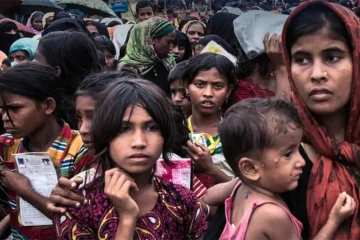
Absent from the cabinet deliberations – absent, indeed, from most Western coverage of the decision – are the Syrians whose dispossession the new “city” will make permanent. Since 1967, Israel has barred displaced Syrians from returning to their homes in the Golan. It has destroyed hundreds of villages and farms. The Syrian government estimates that those displaced, including their descendants, now number in the hundreds of thousands. They retain, under international law, the right of return. That right is what the $334 million plan is designed to extinguish.
The African Mirror notes that this dynamic – where the rights and voices of displaced Arab populations are structurally marginalised in international discourse – is itself a subject of journalistic and political accountability. To report on the Golan expansion without naming those whose return it forecloses is to reproduce, through omission, the logic of erasure.
The $334 million plan is the financial and institutional crystallisation of a dispossession under construction since 1967.
A Pattern of Impunity — West Bank, Golan, Lebanon
The Golan announcement did not arrive in isolation. Earlier in April 2026, the Israeli cabinet approved the construction of 34 new settlements in the occupied West Bank – the single largest batch of settlement approvals in Israel’s history. The current government, which took office in 2022, has now approved 102 new settlements, increasing the total number of illegal settlements by 80 percent, from 127 to 229.
According to the United Nations Office for the Coordination of Humanitarian Affairs, settler attacks now account for 75 percent of all displacements recorded in the West Bank in 2026. Israeli officials have been explicit that one purpose of settlement expansion is to foreclose any prospect of a Palestinian state.
In Lebanon, a parallel displacement is unfolding. Hundreds of thousands of people remain displaced following Israeli military orders issued from March 2026. Israeli forces continue to occupy villages along the southern border. Israeli Defence Minister Israel Katz stated publicly that Shia residents of southern Lebanon will be barred from returning for an indefinite period — a statement Human Rights Watch assessed as indicating intent to forcibly displace a civilian population on the basis of religion.
The pattern is unmistakable: military occupation, followed by displacement, followed by civilian infrastructure to consolidate the new demographic reality, followed by political assertions that the situation is irreversible. Each stage is documented. Each stage is condemned. None, so far, has been stopped.
Europe’s Tools, Unused
The European Union’s position on the Golan is legally unambiguous. The EU recognises the territory as occupied Syria, consistent with Resolution 497 and its own longstanding policy. In June 2025, an EU review found indications that Israel was in breach of Article 2 of the EU-Israel Association Agreement, which makes respect for human rights an essential condition of the bilateral trade relationship.
The European Commission proposed suspension of trade-related provisions in September 2025. Those provisions remain in force. The EU continues to trade with Israeli settlements – in the West Bank and, by extension, in the Golan. Only Spain has introduced a settlement trade ban. The remaining 26 member states have not.
Human Rights Watch has called on the EU and its member states, the United Kingdom, and other states with leverage to respond to the April 17 plan by suspending trade agreements with Israel, adopting a ban on settlement trade applicable to both the West Bank and the Golan, suspending arms transfers, and — where national laws permit — opening criminal investigations under universal jurisdiction against Israeli officials credibly implicated in the transfer of civilians into occupied territory.
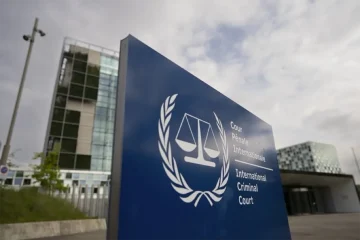
The organisation has also called on Syrian transitional authorities to accede to the Rome Statute of the International Criminal Court and to lodge a declaration under Article 12(3) accepting the court’s jurisdiction over crimes committed on Syrian territory, including those committed before the date of accession. Such a step would, at minimum, alter the legal landscape within which Israeli officials calculate the costs of their decisions.
The African Stake
For Africa, these events are not distant. The continent has direct institutional interests in the integrity of international humanitarian law and in the functioning of accountability mechanisms, including the ICC, which several African states helped build and to which many remain committed. The erosion of IHL norms in the Golan, the West Bank, and Lebanon weakens the same frameworks that African states invoke when seeking accountability for crimes committed on their own soil.
Equally, the Global South has a collective stake in the principle that the acquisition of territory by force is inadmissible. That principle, enshrined in the UN Charter and affirmed in countless resolutions, is not merely a matter of Middle Eastern geopolitics. It is the foundation on which weaker states – including African states with contested borders and unresolved colonial territorial inheritances – depend for their security.
The African Union’s longstanding support for Palestinian self-determination and its observer status at the Arab League are expressions of this understanding. The $334 million Katzrin plan is, in the most direct sense, a challenge to it.
Accountability or Impunity: The Coming Choice
The Israeli government, in approving this plan, has made a political calculation. It has assessed that the costs of proceeding – diplomatic, legal, economic – are lower than the benefits. That calculation is, at its root, a verdict on the international community’s willingness to enforce its own norms.
The EU has the tools. The ICC has jurisdiction, if Syria accedes. Third-country courts have universal jurisdiction where their laws permit. None of these mechanisms is self-executing. Each requires political will.
What the Katzrin announcement makes clear is that the window for meaningful deterrence is narrowing. Each new settler family that arrives, each piece of infrastructure that is built, creates a constituency and a physical reality that becomes progressively harder to reverse. This is the logic of facts on the ground. It is a logic that has operated, largely uncontested, for nearly six decades in the Golan.
The question before the international community is not whether the transfer of Israeli civilians into occupied Syrian territory is a war crime. International law has already answered that question. The question is whether anyone in a position to act will do so — or whether, once again, condemnation will be the ceiling of the response.