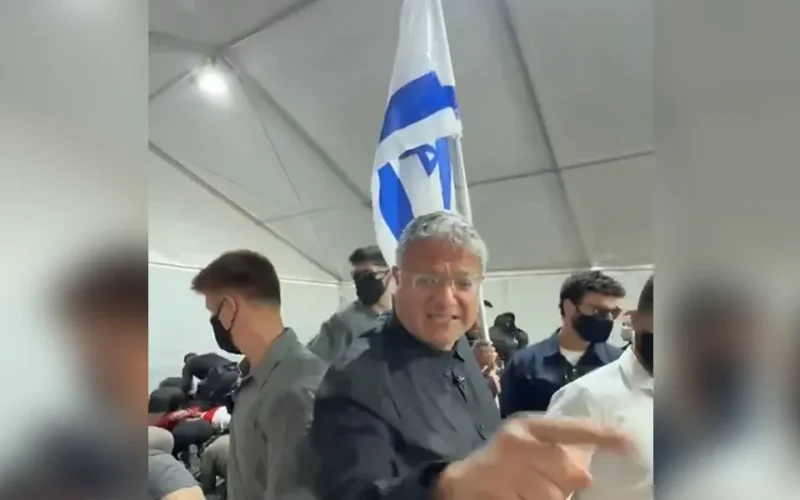
THEY came in peace, in lifejackets, aboard a flotilla of more than 50 boats, carrying a symbolic hold of humanitarian cargo and the moral weight of a world grown sick of watching Gaza burn. What they got in return was zip-ties, a concrete floor, and the sneering face of Itamar Ben-Gvir — Israel’s far-right National Security Minister — waving an Israeli flag above their bowed heads as the national anthem blared from a loudspeaker. The video Ben-Gvir posted on X, captioned with the words ‘Welcome to Israel’, may prove to be one of the most strategically self-destructive acts in Israel’s recent diplomatic history.
In the space of 24 hours, Israel managed to intercept and detain more than 430 pro-Palestinian activists from over 40 countries, strip them of their dignity in front of rolling cameras, and then watch as its own minister broadcast the spectacle to the world — triggering diplomatic summonsing across Europe, a rebuke from Prime Minister Benjamin Netanyahu himself, and a wave of international revulsion that no amount of hasbara will easily extinguish.
“Welcome to Israel.” — Ben-Gvir’s caption. The world saw something else entirely.
The Flotilla and Its Fate
The Global Sumud Flotilla — sumud being the Arabic word for steadfastness — was the largest coordinated maritime challenge to Israel’s blockade of Gaza in years. Led in part by the Turkish aid organisation IHH and joined by activists, lawmakers, and solidarity campaigners from across the globe, the flotilla set sail in May 2026 with more than 50 vessels and a cargo of hope, if not of significant material aid. Israel had made clear from the outset it would not be allowed through.
On Monday, 18 May, Israeli naval commandos intercepted the bulk of the flotilla in international waters off the coast of Cyprus — far from Gaza’s shores. A live feed from the flotilla’s own website captured the moment soldiers boarded the vessels, activists raised their hands, and the cameras mounted on the boats were systematically destroyed. By late Tuesday, Israel’s Foreign Ministry confirmed that all 430 activists had been transferred to Israeli naval vessels and brought to the port of Ashdod.
For more than 24 hours after their interception, the flotilla organisers said the 428 detained activists remained ‘unaccounted for’ — denied access to lawyers, cut off from consular services, their families left without information. Adalah, the Israeli legal rights centre for Arab citizens, said its lawyers were barred from meeting the detainees until they were transferred to Ketziot detention facility. The Israeli rights group B’Tselem confirmed the detentions. Israel’s Foreign Ministry, for its part, dismissed the entire exercise as ‘another PR flotilla’ that had ‘come to an end’.
Ben-Gvir’s Victory Lap — and Israel’s Self-Inflicted Wound
Had Israel processed and quietly deported the activists — as it had done with previous flotilla detainees — the incident might have generated a few days of unfavourable headlines before fading. Instead, Ben-Gvir chose spectacle.
The video he posted on Wednesday morning showed dozens of activists forced to kneel on the metal deck of an Ashdod port facility, their hands zip-tied behind their backs, foreheads pressed toward the ground. Masked Israeli security officers stood over them. When one handcuffed activist managed to shout ‘Free Palestine’ as Ben-Gvir walked past, he was immediately forced to the ground by security personnel. The minister, flag in hand, grinned. The anthem played on.
A second video, also posted by Ben-Gvir, showed him taunting the detainees directly — boasting that they had ‘come here all full of pride like big heroes’ and now look at them, and making a public appeal to Netanyahu to grant him permission to imprison them in Israel rather than deport them.
Italy, France, Spain, Portugal, Canada, the Netherlands, Belgium, and the UK all summoned Israeli ambassadors within hours.
The international backlash was swift and withering. Italy was among the first to respond. Prime Minister Giorgia Meloni — no friend of the Palestinian cause and certainly not a reflexively anti-Israel voice — issued a statement calling the images ‘unacceptable’ and ‘inadmissible’, demanding an apology for the ‘total disrespect’ shown to Italian citizens and saying Israel’s ambassador would be summoned. French Foreign Minister Jean-Noël Barrot summoned the Israeli envoy in Paris and condemned Ben-Gvir’s conduct as ‘unacceptable’, even while reiterating France’s opposition to the flotilla mission itself. Spain’s Foreign Minister José Manuel Albares went further, condemning what he called the ‘monstrous, undignified and humiliating treatment’ of detainees. Canada’s Foreign Minister Anita Anand demanded answers on behalf of Canadian nationals detained aboard the flotilla.
Within hours of Ben-Gvir releasing the videos, Italy, France, Spain, Portugal, Canada, the Netherlands, Belgium, and the United Kingdom had all summoned Israeli ambassadors. It was a diplomatic cascade of a kind rarely seen involving a single minister’s social media post.
Netanyahu’s Hollow Rebuke
Netanyahu, whose governing coalition depends on Ben-Gvir’s far-right Jewish Power party for its survival, found himself in an all-too-familiar bind. He issued what was described as a ‘rare rebuke’ of his cabinet minister, saying Ben-Gvir’s actions were ‘not in line with Israel’s values and norms’ — a formulation that rang hollow to critics who noted that Israel had been enforcing precisely this kind of blockade-and-detain policy for years, and that the Prime Minister had appointed Ben-Gvir to a senior security portfolio knowing full well his character and political instincts.
Netanyahu also announced that the activists would be deported ‘as soon as possible’, seeming to flatly reject Ben-Gvir’s call for their imprisonment. The Times of Israel noted acidly that Netanyahu had ‘once recognised the damage the far-right Jewish supremacist would cause as a minister — but gave him a key job nonetheless, and Israel is now being predictably shamed, harmed and weakened.’
For Netanyahu, the optics were catastrophic on multiple levels. Not only had his minister humiliated citizens of allied European nations on camera, but the incident arrived precisely as the United States was applying fresh diplomatic pressure around Gaza aid access and as Israel faced mounting scrutiny before international legal bodies. The Ben-Gvir video was not merely offensive — it was strategically ruinous.
Who Was on the Boats
This was not a flotilla of fringe militants. Among the more than 430 activists detained were lawmakers from across Europe, rights advocates, aid workers, and solidarity campaigners representing more than 40 nations. Irish President Catherine Connolly’s sister was reported to be among those aboard. The Global Sumud Flotilla had been organised with considerable care to ensure a broad, multi-national profile — precisely the kind of composition that makes unilateral Israeli detention diplomatically costly.
Previous flotilla attempts, including the notorious Mavi Marmara interception of 2010 — in which ten Turkish activists were killed by Israeli naval commandos — had already established a grim precedent. But the 2026 operation, and above all Ben-Gvir’s conduct in its aftermath, has crossed into territory that even some of Israel’s staunchest European defenders could not defend.
The Bigger Picture: Solidarity, Siege and the Spectacle of Power
Israel has consistently argued that the flotillas are cynical political theatre — ‘provocations for the sake of provocation’, as it put it — carrying a symbolic rather than substantive amount of aid, and that various countries have offered to deliver the goods through official channels. There is a measure of truth in this. The boats carried far less cargo than the scale of Gaza’s humanitarian crisis demands.
But to focus on the quantum of aid is to miss the point of what the flotillas represent and why they attract participants from across the globe. They are acts of witness. They are physical assertions — bodies on water — that the blockade of Gaza is neither just nor legal, that it amounts to collective punishment of a civilian population, and that the world’s silence is complicity. For the activists who sailed, the risks were known and accepted. Many had done it before.
What they could not have anticipated was that Israel would provide them with a more powerful image than any they could have manufactured themselves: their own ministers, crowing over bound human beings on a concrete floor, broadcasting the footage to the world as if it were a triumph.
Israel set out to stop a flotilla. It ended up handing the global solidarity movement its most resonant image in years.
The Palestinian solidarity movement has often struggled to make its moral case in the visual register — to find images that cut through the noise of competing narratives. Ben-Gvir, in his gleeful self-promotion, has done that work for them. Activists forced to kneel, hands bound, in front of a gloating minister holding a national flag — that image will travel. It has already reached government offices in Rome, Paris, Madrid, Ottawa, and London. It will reach classrooms, newsrooms, and parliaments for years to come.
The View from Africa and the Global South
For African audiences and Global South publics who have long viewed the Palestinian struggle through the lens of their own colonial histories, the images from Ashdod Port will resonate with a particular and visceral familiarity. The sight of bound and kneeling human beings, forced into submission before armed authority, is not an abstraction in societies that carry the memory of apartheid’s sjambok, of colonial detention without trial, of liberation activists processed through military installations with their hands tied.
The African Union has been increasingly vocal in condemning Israel’s conduct in Gaza. South Africa’s ICJ genocide case remains live. From Dakar to Nairobi, from Harare to Johannesburg, the image of those activists on their knees in Ashdod will harden what is already a near-universal consensus across the continent: that Israel is not merely conducting a military campaign against Hamas, but prosecuting a war in which the humiliation and subjugation of those who bear witness has become official policy — and, now, official entertainment.