SHE left Kobil village in Marakwet East on 4 April 2026, carrying the weight of a family’s hope and the promise of a master’s degree in accounting and auditing. Sheila Jepkorir Chebii, 26, fourth-born child of retired teacher Samuel Kiptanui Chebii and Linah Tanui, had graduated from Kabarak University with a first degree in accounting in 2024, added a CPA(K) qualification, and earned a place at a Sydney institution. Forty-three days after clearing immigration at Jomo Kenyatta International Airport, she was dead.
What happened in those six weeks – and more critically, in the final hours of Sunday 17 May 2026 – is the question that has turned a private family tragedy into a continental cause. The answers, or rather the stubborn absence of them, have drawn the Kenyan diaspora in Australia onto the streets, pressed a formal petition into the hands of the Kenya High Commission in Canberra, and compelled senior Kenyan legislators and governors to monitor a coroner’s investigation in a country ten thousand kilometres from home.
“My daughter left this country full of life, determination and dreams. She wanted to further her education and become a successful accountant.”
Samuel Kiptanui Chebii, Sheila’s father
THE FALL NO ONE WITNESSED
The bare facts, as conveyed to Sheila’s family, are these: she was working a part-time shift as a hotel housekeeper at a luxury Sydney hotel when she was found having fallen from the 19th floor of the building, landing on the 4th floor. NSW Police recorded her time of death as 12:30 pm. Authorities initially treated the matter as a workplace incident.
That is where agreement ends, and anguish begins.
Sheila’s relatives in Marakwet East say her injuries were inconsistent with a fifteen-floor fall. They describe only minor bruises and a small wound on her forehead — damage they argue no human body could sustain and survive even briefly after plunging the equivalent of eleven storeys. A fall of that distance, they note, should have produced catastrophic trauma. The contradiction, in their view, is not incidental; it is the story.
No witnesses have come forward. No colleague saw the fall. No guest reported an incident. The family says Sheila was last confirmed alive when she entered a room on the 19th floor. CCTV footage, they allege, captured her entering the 19th-floor hallway — but there is reportedly no camera coverage of the area on the 4th floor where her body was recovered.
The timeline is equally contested. Police records place the death at 12:30 pm. Yet the family contends that Sheila made a phone call and sent text messages at or around that very time — communications that, if verified, would fundamentally challenge the official reconstruction of events.
| Cameras reportedly recorded Sheila entering the hallway on the 19th floor — but there was no footage from the area where her body was discovered. |
THE SILENCE THAT BECAME A SCANDAL
Eight days passed before the Kenya High Commission in Canberra issued a single line of public communication. Eight days during which a young woman’s family in a rural Rift Valley village pleaded for information, the Kenyan diaspora in New South Wales circulated tributes and outrage in equal measure, and the hashtag #JusticeForSheila spread across Kenyan networks on multiple continents.

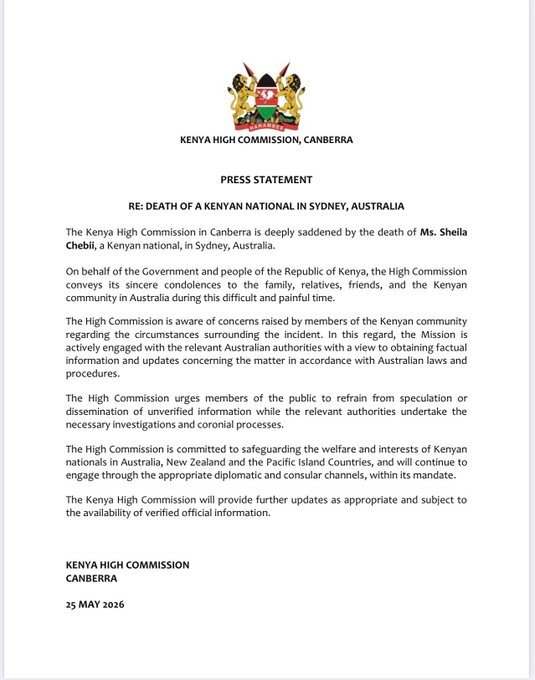
When the Mission did speak — on Sunday 25 May, the day before a planned peaceful procession to the Commission’s Canberra premises — the statement was brief. It expressed condolences and confirmed that the High Commission was working with Australian authorities to establish the facts, urging the public to refrain from speculation while investigations and coronial processes continued.
The diaspora was not appeased. Prominent community voices — Nanjira Damaris, Nyambura Nyambura, Gerard Kimuge, Elijah Mutai and Nehemiah Kiptoo Cheremei among them — publicly condemned what they characterised as eight days of institutional silence at a moment when a citizen’s family most needed their government. Some questioned whether the statement carried formal authentication. Others accused Ambassador Dr Wilson Kogo of failing to respond with the urgency and empathy the situation demanded.
The criticism crystallised a tension that African diaspora communities know well: the gap between the rhetorical warmth of diplomacy and the cold operational reality when a passport-holder dies in a foreign country under unclear circumstances. Kenya’s diplomats in Canberra were not the only ones being weighed. The Kenyan Foreign Ministry in Nairobi, senior senators and members of parliament, and county governors from the Rift Valley region had all been notified and were, organisers said, monitoring developments. Monitoring is not the same as acting.
A COMMUNITY MARCHES ON CANBERRA
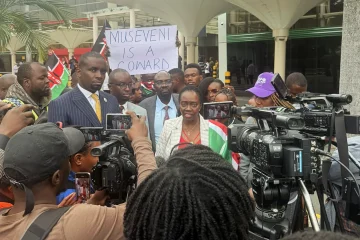
On Tuesday, 26 May, Kenyan community leaders in Australia had organised a peaceful procession to the Kenya High Commission, dressed in white — the colour of unity and grief — to deliver a formal petition demanding justice, transparency, and accountability in the investigation into Sheila’s death. The Australian Capital Territory Police and the High Commission were formally notified in advance.
The organisers framed their demands beyond Sheila’s individual case. Community leaders in New South Wales said their concerns encompassed broader failures of workplace safety enforcement, police first-response procedures in fatalities involving foreign workers, and the transparency of the Australian coroner’s processes when the deceased is an African migrant. The coroner’s process — which under New South Wales law is the mechanism through which unexplained deaths are examined — had not yet concluded its preliminary inquiries. An autopsy was expected once initial police procedures were complete.
The hotel where Sheila worked had, as of publication, issued no public statement.
“Losing a child with a promising future in a foreign country is too painful. My daughter left full of life, determination and dreams.”
Samuel Kiptanui Chebii
THE ANATOMY OF AFRICAN GRIEF ABROAD
Sheila Chebii is not, tragically, an isolated case. In the same week that the Kenyan diaspora mourned her death, it also mourned Biko Miregwa in Seattle. Within a fortnight, there was also Benina Jepkoech, presumed drowned in Canada. The Mwakilishi diaspora news platform, which has tracked Kenyan deaths abroad across years of reporting, carried simultaneous obituaries for multiple communities in multiple countries.
This is the unspoken arithmetic of African migration: families investing years of sacrifice and savings to purchase a child’s passage to the Global North, only to find themselves navigating repatriation logistics in an unfamiliar language, with no money for a flight they did not plan, dependent on harambees — community fundraising drives — to bring their dead home.
For Samuel and Linah Chebii in Kobil village, the coming weeks will involve far more than grief. There are Australian authorities to liaise with, a coronial inquiry to follow, a diplomatic mission whose responsiveness they have reason to doubt, funds to raise for repatriation, and the unbearable task of explaining to a community that the dream died before it began.
The Kenyan diaspora in Sydney has, reportedly, formed a committee to coordinate repatriation logistics. It has done so before, for other families. It will, in all probability, do so again.
WHAT JUSTICE WOULD LOOK LIKE
The family of Sheila Jepkorir Chebii has not alleged murder. They have alleged that the official account of how their daughter died is factually inconsistent with the evidence available to them. That is a demand not for vengeance but for truth — for a complete and credible investigation that examines the CCTV evidence in full, accounts for the timeline discrepancy between police records and the family’s communications data, reconciles the reported injuries with the physics of a fifteen-floor fall, and establishes whether the hotel’s workplace safety obligations were met.
Under Australian law, where a death occurs in the workplace or under circumstances that are not clearly explained, the matter is referred to the NSW State Coroner. Coroner’s inquests can compel testimony, examine physical evidence and subpoena records. They can, and sometimes do, produce findings that contradict initial police assessments. The process is not swift. It is not designed to accommodate the grief schedules of families ten thousand kilometres away.
The Kenya High Commission’s role in this process is formally circumscribed: it can monitor, advocate diplomatically, facilitate consular access, and relay information. It cannot compel Australian authorities. What it can do — and what it failed to do for eight days — is communicate. Its belated statement, released only as diaspora pressure peaked ahead of the Canberra procession, raises a question about the threshold of urgency required to activate Kenyan diplomatic machinery.
There is also a question for the Australian hotel industry and its regulators. A young African woman was on duty in a luxury Sydney hotel when she died under circumstances that remain unexplained. The employer’s silence is, at minimum, a failure of basic institutional decency toward a family in Marakwet East that deserves far better.
THE LARGER RECKONING
Sheila Chebii left Kenya seeking precisely what her continent too often cannot provide for its most qualified and ambitious young people: a credentialed future, a salary commensurate with qualification, and a career path that does not require extraordinary connections to navigate. She enrolled for a master’s degree. She took a hospitality shift to cover costs. She was doing what millions of African migrants do — working hard, planning carefully, contributing to an economy that was not her own.
She deserved the full protection of the law of the country that received her visa and her labour. She deserved an employer that met its duty of care. She deserved a diplomatic mission that treated her death as urgent the moment her family appealed for help. And she deserved — still deserves — a coroner’s finding that is honest, thorough, and transparent.
Whether she will get that justice depends, in significant measure, on how long the community in white keeps marching, how long the hashtag trends, and how long senior Kenyan officials sustain their attention beyond the emotional news cycle of this week.
Her father, a retired teacher who spent his career educating Marakwet East, said it plainly and without embellishment: “Losing a child with a promising future in a foreign country is too painful.”
There is nothing to add to that — except: find out what happened. And find out why.