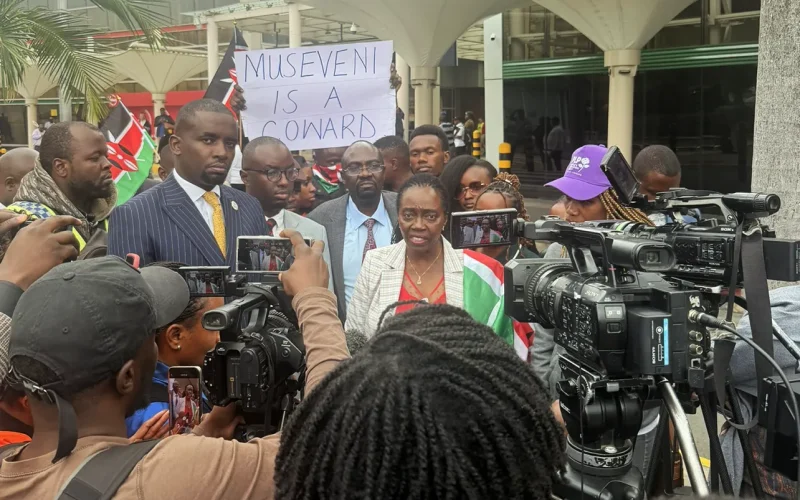
MARTHA Karua’s flight touched down at Entebbe International Airport on Monday morning with one purpose: to stand alongside two embattled colleagues, jailed opposition leader Dr Kizza Besigye and detained former Kampala Lord Mayor Erias Lukwago, as Uganda’s courts decided their fates. She never made it past the immigration desk.
Within minutes of landing, the Kenyan senior counsel and former Justice Minister was stopped, separated from her phone, and held incommunicado, before being marched back onto a return flight to Nairobi. No warrant was produced. No charge was laid. No reason was given. By Monday afternoon, one of East Africa’s most decorated human rights lawyers had been expelled from a fellow East African Community member state for the apparent offence of intending to practise law.
A LAWYER TURNED AWAY, A COLLEAGUE WAVED THROUGH
According to the Uganda Law Society, Karua — lead counsel for Besigye and his co-accused Hajji Obeid Lutale — was stopped on arrival at Entebbe and instructed to return to Kenya, with no official explanation offered by the Directorate of Citizenship and Immigration Control or the Ministry of Internal Affairs. What has unsettled the region’s legal fraternity even more than the expulsion itself is its selectiveness: Karua travelled in the company of Law Society of Kenya president Charles Kanjama, who was waved through the same checkpoint without incident. Kanjama himself has publicly questioned how one member of the same defence team, travelling for the identical professional purpose, could be admitted while another was turned back at the door.
Besigye’s defence team was blunter still. In a statement issued the same day, they condemned what they called the unlawful detention of a senior counsel “held incommunicado — denied all contact with counsel, with the defence team, and with her own family” while deportation proceedings were quietly set in motion. They argued that stripping the dock of one of its most formidable advocates, on the eve of a bail ruling for Lukwago and amid an unresolved treason case against Besigye and Lutale, was no bureaucratic accident but a calculated blow against the right to counsel itself. As the defence team put it, the episode amounted to an assault not on one person but on the administration of justice itself.
THE “RECTIFICATION CAMPAIGN”
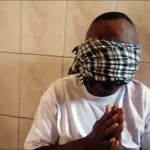
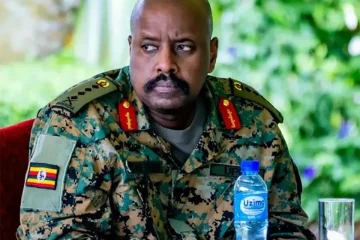
Besigye’s lawyers did not leave the motive to speculation. They pointed directly to a string of social media posts by Chief of Defence Forces Gen Muhoozi Kainerugaba, son and heir-apparent of President Yoweri Museveni, who has spent the past fortnight publicly claiming ownership of the crackdown on Uganda’s opposition lawyers. On 15 June, UPDF officers in unmarked vehicles seized Lukwago from his home in Wakaliga, holding him for nearly two days before he resurfaced, visibly weakened, at Kira Road Police Station. Muhoozi did not merely confirm the operation; he broadcast it, posting images of a blindfolded man he identified as Lukwago and boasting of the punishment he intended to inflict. Days later, with Lukwago charged with misprision of treason and remanded to Luzira Prison, the General vowed that his captive would never walk free.
By 19 June, Muhoozi had escalated further, describing Lukwago’s arrest as merely the opening salvo of what he styled his own Rectification Campaign and warning that further arrests of those he brands “traitors” were imminent. For a defence team already reeling from the loss of one lead counsel to a UPDF operation, the timing of Karua’s expulsion at Entebbe read less like a coincidence than a confirmation. “These are not idle words,” the defence team’s statement noted of the General’s posts. “They are a stated programme, now being executed at Entebbe International Airport.”
FROM ABDUCTION TO THE DOCK: THE LUKWAGO FILE
Lukwago’s ordeal has become the fulcrum of Uganda’s deepening rule-of-law crisis. The former Kampala Lord Mayor and acting president of the People’s Front for Freedom was seized, his lawyers say, just as he was preparing to personally serve Muhoozi with court summons in a separate suit over the General’s repeated threats against Besigye. He was charged with failing to report an alleged treason plot involving his own clients — an offence carrying a maximum sentence of life imprisonment, and one his lawyers argue criminalises the ordinary work of a defence advocate.
On Monday, as Karua was being escorted back onto her Nairobi-bound flight, Lukwago was driven under heavy escort to the Makindye Chief Magistrate’s Court, where armed personnel from the Joint Anti-Terrorism Task Force ringed the premises and hundreds of his supporters massed outside. His lawyers told the court he had suffered a hypertensive crisis and a recurrence of spinal complications in detention, seeking bail on medical grounds. State prosecutors countered that his political stature and seniority at the bar made him more, not less, likely to interfere with witnesses, and urged the magistrate to deny him release. As The African Mirror went to press, the court had yet to rule, with the bench seeking time to verify medical records and sureties — leaving Uganda’s most closely watched defendant suspended, once again, between courtroom and cell.
A PATTERN STRETCHING BEYOND UGANDA’S BORDERS
Monday’s expulsion was not Karua’s first taste of cross-border legal exile. Just over a year earlier, she was detained for three hours and deported from Julius Nyerere International Airport in Dar es Salaam, where she had travelled to observe the treason trial of Tanzanian opposition leader Tundu Lissu. On that occasion, too, no formal reason was given, and Karua’s own party denounced the episode as a violation of the East African Community Treaty’s guarantees of free movement, democracy and the rule of law.
Taken together, the two expulsions trace an unmistakable arc: across at least three East African capitals, lawyers willing to stand for opposition figures facing capital or life-sentence charges are finding themselves treated not as officers of the court but as security threats to be intercepted at passport control. For a regional bloc whose founding treaty promises citizens the right to move and work freely across borders, the pattern of selectively excluding specific advocates from specific courtrooms cuts to the heart of what the East African Community was meant to guarantee.
LAW SOCIETIES SOUND THE ALARM
The professional backlash was swift. The Uganda Law Society, which broke the news of Karua’s detention, has since announced a nationwide lawyers’ strike for 26 June in protest at what it regards as a coordinated campaign of intimidation against the legal profession. The East Africa Law Society added its voice in condemnation, framing Karua’s exclusion as part of a broader assault on advocates handling politically sensitive cases across the region. Besigye’s defence team went further still, invoking not only Ugandan constitutional protections but the East African Community Treaty and international conventions guaranteeing liberty, fair hearing, legal representation and consular access — and called on Ugandan authorities, the Law Society of Kenya, diplomatic missions and international human rights bodies to intervene before further damage is done.
“To detain an advocate at the airport, sever her from her family and colleagues, and expel her for the offence of doing her duty as a lawyer is an assault not on one person but on the administration of justice itself.”
Statement issued by Dr Kizza Besigye’s defence team, 22 June 2026
WHAT HAPPENS NOW
Karua was due to land at Jomo Kenyatta International Airport in Nairobi at around 4 pm East African Time on Monday, her second forced return home in just over a year for the crime, as her allies see it, of showing up. Her exclusion deprives Besigye and Lutale of their chosen lead counsel at a delicate moment in their treason case, deprives Lukwago of a visible show of professional solidarity as his fate hung in the balance at Makindye, and sends an unmistakable signal to every other East African advocate weighing whether to take on Uganda’s most politically charged briefs.
For Muhoozi Kainerugaba, the optics may matter less than the message: a Rectification Campaign that began with the seizure of a sitting Lord Mayor from his own bedroom has now reached across an international border to turn back a former Justice Minister at passport control. For Uganda’s courts, already under pressure to demonstrate that the rule of law survives the politics swirling around it, the Lukwago bail ruling — and whatever becomes of Besigye and Lutale’s treason trial — will now be watched by a region that has just been shown, in the starkest possible terms, what happens to the lawyers who turn up to defend them.