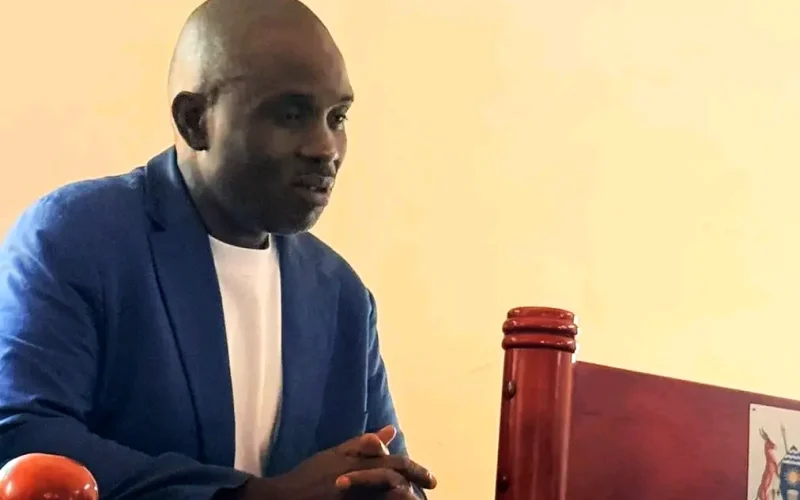
THERE is a particular kind of message a state sends when it charges the defence lawyer with the same crime as the defendant. It is not subtle, and it is not meant to be. On Wednesday, Erias Lukwago – former Lord Mayor of Kampala, acting president of the People’s Front for Freedom, and lead counsel for jailed opposition figure Dr Kizza Besigye – stood before the Makindye Chief Magistrate’s Court and was formally charged with misprision of treason. He denied it. He was remanded to Murchison Bay Prison in Luzira until 22 June 2026, when the court is due to rule on his bail application.
It is the same charge his client is facing. According to the charge sheet, Lukwago and others allegedly still at large – named alongside Besigye as Joel Wakayima, Frank Atukunda and Hajj Obeid Kamulegeya Lutale – knew, between 2021 and November 2024, of plans to commit treason in Kampala and Nairobi, and failed to report them to a minister, magistrate, administrative official or officer in charge of a police station, or to take reasonable steps to stop them. And it arrives by way of an arrest that the country’s most powerful military officer has already, publicly, taken credit for.
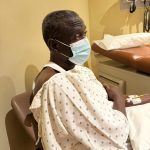
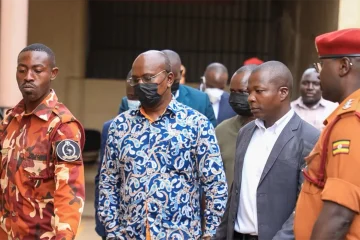
If the charge sheet is the state’s official account of what happened, Lukwago’s body has become the unofficial one. His defence team, led by Medard Lubega Sseggona, told the Makindye court that their client suffered a damaged spinal disk during his detention and was left in “excruciating pain” after his captors allowed him only twenty minutes to sleep on the floor of wherever he was being held. Photographs and footage from his court appearance showed a visibly thinner, shaven-headed Lukwago – a far cry from the man who had been preparing to walk into a television studio days earlier.
The magistrate, Sarah Basemera, did not dismiss the medical claims as a bail-application tactic. She directed prison authorities to take Lukwago’s condition into account and to permit his family to arrange delivery of an orthopaedic mattress in line with prison regulations – a request the prosecution itself did not contest. Tellingly, the court ordered him remanded specifically to Murchison Bay, the Luzira facility that houses Uganda’s national prison referral hospital, rather than to the general remand population. A defence lawyer too injured for an ordinary cell floor is now in the custody of the same state apparatus his lawyers say injured him.
On the substance of bail, Sseggona argued it as a constitutional entitlement rather than a favour: Lukwago has a known, permanent home in Wakaliga where he lives with his wife and children, a known profession as a practising advocate, and an undertaking to comply with whatever conditions the court imposed. His team offered three sureties – Gulu City Woman MP Betty Aol Ocan, Michael Lulume Bayigga, and Mukono Municipality MP Betty Nambooze Bakireke – a slate that reads as a deliberate show of cross-party and civic weight behind the application. The state’s response was not to oppose bail outright but to ask for more time, citing a need to verify both the sureties’ introduction letters and the medical documentation underpinning the mattress request. The prosecution has until Friday, 19 June, to respond in writing; the defence will file its rejoinder electronically on Saturday; the magistrate will rule on Monday.
That the state needed days to verify whether a sitting Member of Parliament’s introduction letter is genuine, while simultaneously declining to dispute that its own custody left a 60-something lawyer with a spinal injury, says something about where the actual contest in this case lies. It is not, at this stage, a dispute over facts. It is a dispute over time – over how many more nights the state can keep Lukwago inside Murchison Bay before Monday’s ruling forces its hand one way or the other.
A Confession Before a Charge
Strip away the legal language and the sequence of events is stark. In the early hours of Monday, 15 June, armed men dressed in Uganda People’s Defence Forces uniform scaled the perimeter wall of Lukwago’s home in Lubaga, forced entry, and seized him as he prepared to leave for a television appearance. According to an affidavit filed by his wife in a subsequent habeas corpus application, the operatives presented no warrant, gave no names, and stated no offence. He was bundled into an unmarked Toyota Hiace – the vehicle type now grimly nicknamed a “drone” in Kampala’s political vocabulary for its association with disappearances – and driven to a location his family would not be told for two days.
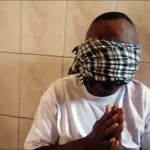
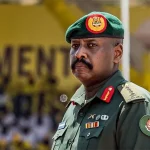
Within hours, Chief of Defence Forces General Muhoozi Kainerugaba removed any ambiguity about who was responsible. He did not deny the operation, distance himself from it, or refer journalists to a police statement. He claimed it. On his own social media account, the army chief confirmed he had ordered Lukwago’s seizure, posted images of a restrained Lukwago, and promised to inflict what he called “hurt and pain” on a man whose principal offence appears to have been attempting to serve the general with court papers.
Those papers were not incidental. Lukwago had been moving to hold Kainerugaba personally accountable, in court, for his role in the alleged abduction of Besigye from Nairobi in November 2024 and the subsequent treason prosecution that followed – a prosecution Lukwago has been defending against since the case was transferred to the High Court before Justice Emmanuel Baguma. The lawyer trying to summon the general was removed from his home by men under that same general’s command, less than 48 hours before he was due to do it.
Two days later, in a social media post crediting his wife Charlotte Kainerugaba’s intervention for the decision, the general announced Lukwago would be released – a release that was less an act of due process than an act of personal discretion, exercised by a soldier over a civilian’s liberty as casually as he had exercised it to take it. Lukwago was not freed. He was transferred from military custody to Kira Division Police Station and, from there, to a magistrate’s court, where the state had a charge sheet waiting.
The Charge, and What It Actually Means
Misprision of treason is a narrow, almost archaic offence: it does not require that a person plotted against the state, only that they knew of such a plot and failed to report it to lawful authority. It is, by design, a charge that criminalises silence rather than action – which makes it a peculiarly dangerous instrument when deployed against a defence lawyer, whose entire professional obligation is to receive a client’s account in confidence and use it for that client’s protection, not to relay it to the state’s prosecutors.
That timeframe – 2021 to November 2024 = spans almost the entire period Lukwago has been visible as one of Besigye’s principal lawyers, which is itself the quiet logic of the charge: prosecutors are not alleging Lukwago plotted anything. They are alleging that in the ordinary course of representing his client, he came to know things he was professionally and legally obliged to keep, and is now being told that obligation was itself a crime. The state’s underlying case against Besigye rests on a nine-page indictment alleging the veteran opposition leader travelled to Geneva in January 2024 to solicit foreign military, financial and logistical backing – a case Besigye has fought on procedural grounds as much as factual ones, arguing that his own removal from Kenyan soil in November 2024 was itself an extra-legal abduction dressed up after the fact as an arrest.
That argument now has a second, almost identical illustration sitting in Luzira Prison. If Besigye’s defence has spent months contending that Uganda’s security apparatus manufactures the appearance of legal process around acts of raw seizure, the state has just supplied, in the person of Besigye’s own lawyer, a textbook case study delivered by the army chief’s own hand and own timeline.
A Profession Pushed to the Edge
The Uganda Law Society did not treat this as an ordinary arrest, and its response has not been ordinary either. The body condemned the operation as an assault on the administration of justice itself – not merely on one lawyer – and has called a nationwide lawyers’ strike for 26 June. That is a significant escalation in a country where the bar has historically been cautious about direct confrontation with the security establishment. The reasoning is not difficult to follow: if the lawyer defending a man accused of treason can himself be seized without warrant, held incommunicado, and charged with the same offence his client faces, the principle of legal representation in political cases becomes, in practice, optional – contingent on the state’s tolerance rather than the constitution’s guarantee.
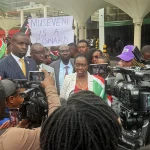
Lukwago’s wife, Zawedde Lukwago, invoked a darker register entirely, telling reporters that the manner of her husband’s seizure evoked the era of Idi Amin — a comparison Ugandans do not make lightly, given a dictatorship whose death toll human rights researchers place between 100,000 and 500,000. That a serving Lord Mayor’s widow-in-waiting felt compelled to reach for that comparison, rather than for the language of routine policing, speaks to how far outside recognisable legal process this operation is understood to have fallen, even by Ugandan standards already accustomed to a hard line against the opposition.
The Pattern Behind the Precedent
Kainerugaba’s basement boast was not improvised rhetoric invented for Lukwago. It echoes, almost word for word, the language he used in May 2025 when he claimed to be holding another opposition activist, Eddie Mutwe, the bodyguard of musician-turned-politician Bobi Wine, declaring he had captured him “like a grasshopper” and was keeping him “in my basement.” The general’s pattern is now established enough to analyse: claim the seizure publicly and proudly, taunt the opposition with the captive’s condition, hold the person outside any acknowledged detention facility for as long as suits him, then — if pressure mounts — release or transfer them on his own terms, framed as personal magnanimity rather than legal correction.
What changes with Lukwago is the target’s role in the system Kainerugaba is operating within. Mutwe was a bodyguard. Lukwago is an officer of the court, a former two-term Lord Mayor of the capital, and the lead lawyer in the single most consequential political prosecution currently before Uganda’s judiciary. Treating him identically to a political activist’s security detail is itself the message: in this arrangement, the courtroom and the basement answer to the same authority, and the distinction between lawful process and personal will is, for now, whatever the Chief of Defence Forces says it is.
What Comes Next
Lukwago remains in Murchison Bay Prison until at least 22 June, when Magistrate Basemera is due to rule on bail — the most immediate test of how far the courts are willing to assert independence in a case this politically charged. His own legal team is now defending the man who has spent recent months defending Besigye, in a case built on the same charge, arising from the same political conflict, and following an arrest, the alleged orderer has never bothered to deny. Observers in Kampala are already speculating that the indictment against Besigye could be amended to formally join Lukwago to that trial — collapsing lawyer and client into a single dock.
For the continent watching Uganda’s January 2026 election cycle and its long aftermath, the through-line is now unmistakable. A government does not need to outlaw a defence in order to neutralise it. It only needs to make defending an accused person costly enough — in liberty, in safety, in the certainty of due process — that the next lawyer thinks twice before picking up the file. Erias Lukwago picked up the file. He is now in the same prison system, facing the same charge, as the client he was defending. That is not an unfortunate coincidence of Ugandan criminal procedure. It is the demonstration the state appears to have intended all along.