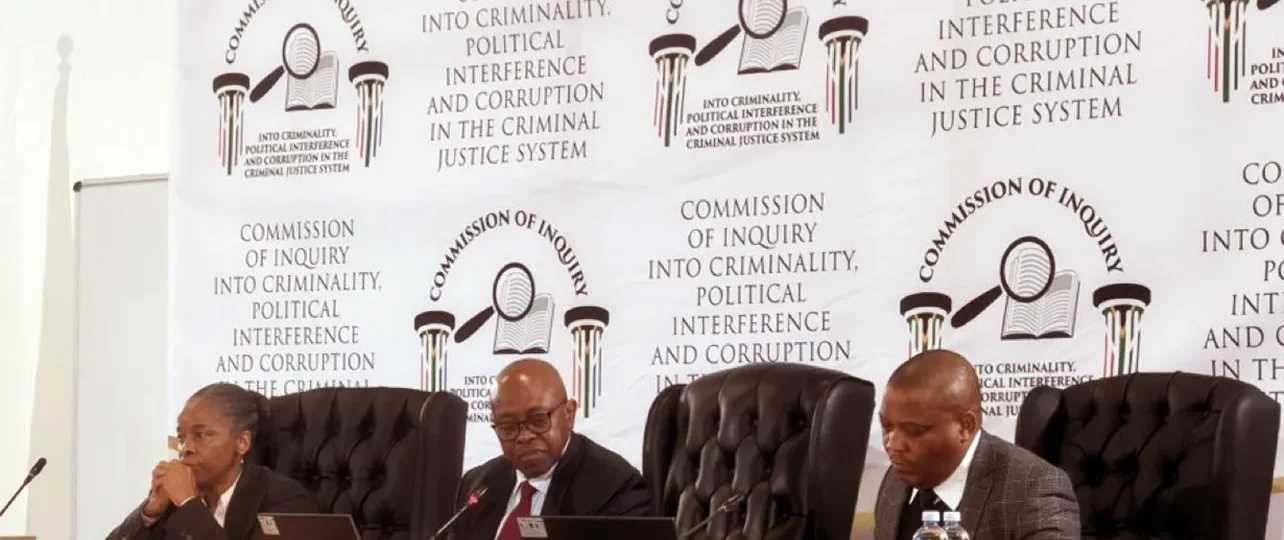

IN more than eighteen months of hearings that have already dismantled the myth of a clean South African policing establishment, the Madlanga Commission of Inquiry has this week produced testimony that may eclipse everything that came before it. A witness known only as Witness M – his identity concealed, his testimony heard entirely in camera – has told the commission that his evidence implicates heads of state, drug syndicates, crime families, terrorist organisations, politically connected individuals and law-enforcement officers in a single, interlocking network.
That is not hyperbole. It is the witness’s own characterisation of the evidence he was subpoenaed to give, offered in a sworn application to keep his testimony out of public view. He told the commission that disclosure of what he knows would endanger his life, his family’s safety and his business – and that, since his first contact with commission investigators, he has already detected surveillance vehicles outside his home and received calls from unidentified numbers. His wife has been moved to a secure location. Evidence leader Advocate Teboho Mosikili did not oppose the application; nor did anyone else in the room.
The bare outline of what Witness M is expected to address – the discovery of a drug shipment, his own surveillance of it, his relationships with law-enforcement officers and with the person behind the shipment, and his presence at the resulting drug bust — is, on its own, a serious story. Read alongside everything else the commission has heard in the past fortnight, it becomes something far larger: evidence of a criminal justice and intelligence apparatus in which narcotics, tenders and protection appear to move along the same channels, often through the same hands.
A pattern, not an incident
Witness M’s testimony does not arrive in a vacuum. It follows, by only days, the commission’s forensic dismantling of the finances of Major-General Feroz Khan, the suspended deputy head of Crime Intelligence, who is now emerging as a central figure – and quite possibly the wealthiest police officer in the country. Financial disclosure records tabled before the commission this week show that Khan purchased a fleet of thirty vehicles in a single year and holds a property portfolio conservatively valued at approximately R39 million, spanning luxury homes in George, Houghton and Umhlanga.
The commission has also heard that Khan owns a motor-spares business generating an estimated R3 million a year in profit — an enterprise, evidence leaders say, is bound up in the very tenders he is accused of manipulating from inside the police service.
None of this, evidence leaders have stressed, is remotely explicable on a senior police officer’s salary. And the paper trail behind it is not circumstantial. WhatsApp messages retrieved from Khan’s devices and read into the record — Khan himself absent from the hearings, recovering in hospital after being shot multiple times in what is widely regarded as an assassination attempt last month — show him allegedly using a contact inside National Treasury’s supply chain division, Lieutenant-General Molefe Fani, to obtain confidential, real-time information on the adjudication of a SAPS motor-spares tender before it was awarded.
That contract, worth more than R50 million over three years, was ultimately awarded to Kaizen Motor Spares Distributors, a company owned by businessman Ismail Vally. In exchange, evidence leaders allege, Khan received R150,000 in cash, a luxury watch and a V8 vehicle — on top of separate allegations linking him to a R280-million National Treasury contract and a further R54-million auto-parts arrangement.
The commission has also heard evidence — still being tested — of WhatsApp exchanges between Khan and an alleged tobacco smuggler that reference EFF leader Julius Malema, who has publicly denied any association with Khan. Whether or not that thread leads anywhere, it illustrates how far the commission’s evidence has already reached beyond the police service itself, into business, party politics and organised crime.
Why Witness M’s evidence changes the register
Financial corruption inside Crime Intelligence, however staggering, is a familiar South African story — another chapter in a two-decade record of hollowed-out oversight, dating back to the Zuma-era capture of the unit itself. What is different about Witness M is the scale and direction. Khan’s testimony, however damning, describes a mid-level officer monetising his proximity to procurement. Witness M’s application describes something structurally more dangerous: an alleged line running from a specific drug shipment, through law enforcement, up to unnamed heads of state.
If even a fraction of that framing survives cross-examination and corroboration, it repositions the Madlanga Commission’s work. This would no longer be simply an inquiry into criminal infiltration of the police. It would be testimony alleging that South Africa’s highest political offices — whether domestically or in partner states — are themselves implicated in the movement of narcotics through the country’s ports and borders. That is a different order of allegation, and it explains both the extraordinary security precautions around Witness M and the commission’s willingness to grant them without opposition.
It also echoes, uncomfortably, the pending and unresolved testimony of businessman Tumelo Nku, postponed indefinitely last week on identical safety grounds. Nku had begun describing his own role as a police informant in a 2021 interception of more than 700 kilograms of cocaine — worth an estimated R300 million — smuggled through Durban Harbour in a truck contracted to a legitimate logistics operator. His account named the late former deputy defence minister Kebby Maphatsoe as a connector into the network and pointed to extensive contacts inside Transnet’s shipping infrastructure. Two witnesses, two applications for protection, two accounts converging on the same terrain: the porousness of South Africa’s ports, and the police officers positioned to look away.
What is now at stake
For a commission established to examine criminal infiltration of the criminal justice system, the convergence of the Khan and Witness M evidence in the same week is not coincidental so much as cumulative. Khan supplies the documentary proof of what unexplained enrichment inside Crime Intelligence actually looks like — the mansions, the fleet of cars, the tender trail with names, dates and rand values attached. Witness M supplies the far more combustible claim that the same ecosystem reaches into the shipment and sale of narcotics, and beyond the police service into political office.
The test now facing Chairperson Mbuyiseli Madlanga and his evidence leaders is whether the commission’s mandate and protective architecture are equal to the testimony of this magnitude. An in-camera process protects a witness, but it also delays public accountability and invites the very speculation it is designed to prevent. South Africans — and the region watching a commission with implications well beyond one country’s borders — will now be waiting to see whether Witness M’s claims are substantiated, and whether the heads of state he references are named, tested and, if the evidence holds, held to account.
What is already beyond dispute is this: the Madlanga Commission has moved past documenting individual greed. It is now probing whether the machinery meant to police South Africa’s borders, tenders and drug trade has itself become an extension of the networks it was built to stop.