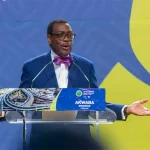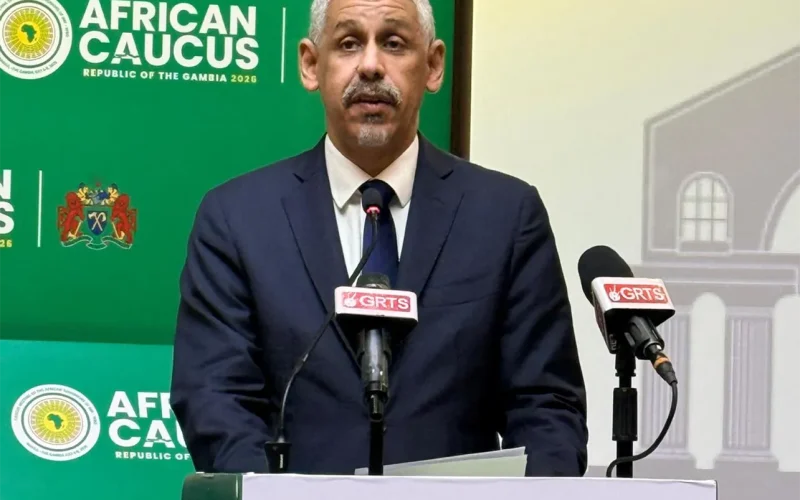
STRIPPED of its diplomatic courtesies, the address Sidi Ould Tah delivered to the IMF/World Bank Group African Caucus in Banjul on 6 July carried a blunt message for a continent accustomed to appealing for help: Africa’s problem is no longer only a shortage of money. It is a shortage of the institutions, instruments and political will needed to deploy the money that is already sitting in African accounts.
That framing matters because it lands at a moment when the old assumptions of African development finance are under strain. Aid budgets in Washington, London and Brussels are shrinking. Borrowing costs remain punishing for African treasuries still carrying the debt scars of COVID-19, the Ukraine war and the Gulf shipping disruptions the AfDB chief grouped together as the “Hormuz” shock. Against that backdrop, Ould Tah’s caucus address reads less like a courtesy speech to development partners and more like an internal memo to Africa’s own finance ministers, delivered in front of the IMF and World Bank as witnesses.
FOUR PARADOXES, NAMED PLAINLY
The core of the address rested on four paradoxes that Ould Tah argued define Africa’s position in the global economy, and each is a rebuke aimed as much at African governments as at the international system.
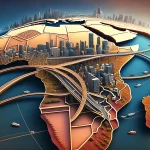
The first is a paradox of scale without power: a continent holding an estimated 18 percent of the world’s population, more than 30 percent of global mineral reserves and over 60 percent of the world’s uncultivated arable land, yet commanding barely 3 percent of global trade and GDP.
The second, and perhaps the most politically explosive, is the financing paradox. Africa’s transformation agenda requires more than $400 billion a year, while over $4 trillion sits inside African banks, pension funds, insurers and sovereign wealth funds — largely undeployed on the continent that needs it most.
The third is an investment paradox: Africa offers some of the highest-return opportunities anywhere — energy, infrastructure, agriculture, critical minerals — yet still attracts only around 6 percent of global foreign direct investment, held back chiefly by perceived risk and an estimated $50 billion guarantee gap.
The fourth is fragmentation. A single African market of 1.4 billion people and over $3 trillion in combined GDP still trades with itself at a rate of just 16 percent, compared with roughly 60 percent in Asia and 70 percent in Europe — the exact failure the African Continental Free Trade Area was built to fix.
THE “CARDINAL POINTS” RESPONSE
Ould Tah’s answer is a strategy already endorsed by AfDB governors in Brazzaville in May, built around four responses mapped directly onto the paradoxes: mobilising Africa’s own capital at scale rather than relying on multilateral balance sheets to close a $400-billion gap alone; consolidating a financial architecture currently splintered across more than 100 national and regional development finance institutions whose combined weight is barely 1 percent of global DFI assets; investing in the roughly 60 percent of Africans under 25, whom he cast as either the continent’s greatest asset or its greatest risk; and pushing value addition so raw materials leave the continent processed rather than raw.
The consolidation push has a name — NAFAD, the New African Financial Architecture for Development, which emerged from what Ould Tah called the Abidjan Consensus. Whether NAFAD becomes a genuine merger of overlapping DFIs or another coordination forum layered on top of existing ones is likely to be the real test of this agenda in the coming year.
THE ATIDI TEST CASE
The most concrete ask in the speech concerned the African Trade Insurance Agency (ATIDI), which Ould Tah wants transformed into a full continental guarantee mechanism to close that $50-billion gap. The AfDB has already increased its own ATIDI stake fivefold to become its largest shareholder, and Ould Tah is now pressing the 24 African governments that already hold shares to increase their contributions, while inviting the roughly 30 African states that have not yet joined to do so.
That is a useful marker for accountability journalism going forward: a specific, countable commitment — 24 shareholders asked to increase, 30 non-members invited to join — against which AfDB’s Banjul rhetoric can be measured in the months ahead.
THE ASK TO WASHINGTON
Even while urging African self-reliance, Ould Tah did not let the IMF and World Bank off the hook. He asked the Fund for greater flexibility, fresh concessional resources and further channelling of Special Drawing Rights to African countries, invoking IMF research suggesting that every dollar spent on conflict prevention saves up to $103 in later costs. To the World Bank, he welcomed Ajay Banga’s reform agenda and the new “mutual reliance” arrangement between the two institutions, while asking for support in recapitalising ATIDI.
That dual message — self-reliance for Africa, continued obligation for its partners — is a needle African multilateral leaders have tried to thread before, from the AU’s own financing reforms to the “Bridgetown Initiative” pushed by other developing-economy blocs. Ould Tah’s speech notably endorsed South Africa’s “Borrowers’ Club,” an initiative to coordinate debtor countries’ positions in global finance talks, signalling continuity with Pretoria’s own push for a stronger collective African voice in multilateral reform.
THE HARDER QUESTION
What the speech does not resolve is the question that has dogged African continental initiatives for a generation: implementation. The AfDB has produced ambitious strategic visions before. NEPAD, Agenda 2063 and the AfCFTA itself all carried similarly sweeping diagnoses of African fragmentation, with mixed records of delivery. The specificity of the ATIDI ask, and the trackable list of laggard shareholder states, offers one of the few near-term benchmarks by which Ould Tah’s tenure — and this Banjul address — can be judged.
For African finance ministries and readers watching the continent’s positioning ahead of further IMF and World Bank engagement this year, the Banjul Caucus address is best read not as a speech to the multilaterals, but as a challenge issued to Africa’s own governments: the capital exists. The instruments are being proposed. What remains untested is whether the political will to act, at the scale Ould Tah described, actually exists, too.