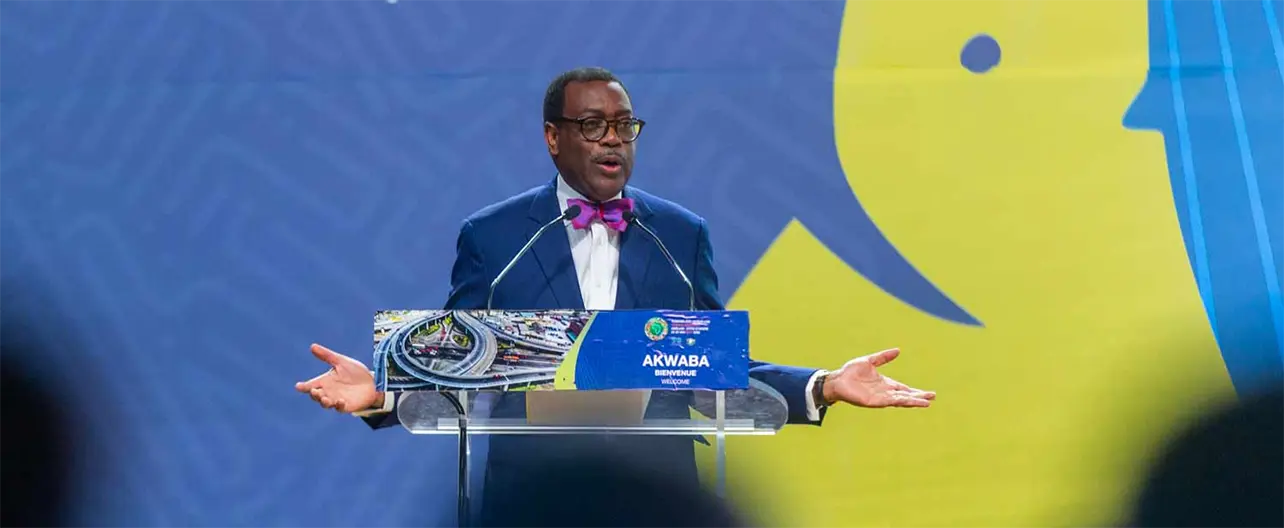

I AM immensely proud that over the past decade, the African Development Bank (AfDB) has served as an accelerator of Africa’s development. The Bank’s High 5s – to light up and power Africa, feed Africa, industrialise Africa, integrate Africa, and improve the quality of life for Africa’s people – have been truly transformational for our continent.
In the past ten years, the AfDB’s work has directly impacted the lives of 565 million people. This extraordinary reach includes 28 million people gaining access to electricity, 104 million achieving food security, 121 million accessing improved transport, 128 million receiving enhanced health services, 67 million gaining improved access to information and communication technology, 63 million securing access to clean drinking water, and 34 million obtaining access to sanitation.
Unprecedented Scale of Investment
The AfDB has accelerated regional integration through massive infrastructure support for the African Continental Free Trade Area. Over my ten-year presidency, the AfDB provided a total of $102 billion in support to Africa, representing 46% of all the Bank’s financing since its establishment in 1964.
The AfDB financed over $55 billion in infrastructure support, spanning roads, railways, airports, seaports, digital communications, health facilities, water systems, and sanitation projects.
Right here in our host country, Côte d’Ivoire, nearly all the major urban infrastructure you see in Abidjan received Bank support. Under my presidency, the African Development Bank’s financial support to Côte d’Ivoire grew by 500% over the last decade. To put this achievement in perspective: the total lending by the AfDB to Côte d’Ivoire from 1964 to 2014 – spanning 50 years – was €2.3 billion. From 2015, when I was elected, to the present, the Bank’s financing for Côte d’Ivoire stands at €3.6 billion – 1.6 times more than what had been approved in the previous five decades.
This includes the now-famous Henri Konan Bédié Bridge in Abidjan. Through the Projet de Transport Urbain de la ville d’Abidjan (PTUA), the Bank financed the iconic 1,400-meter-long Fourth Bridge linking Yopougon to Adjamé, along with 88 kilometres of city highways and 89 intersections. It encompasses all the beautiful highways leading to the new Alassane Ouattara Stadium, where Côte d’Ivoire won the 2023 African Cup of Nations.
Continental Impact: Connecting Africa
The impact of the AfDB Group is tangibly felt across Africa. In Tanzania, we are supporting the $3.2 billion standard gauge railway connecting Tanzania to the Democratic Republic of Congo and Burundi. We supported the transport corridor linking Addis Ababa to Nairobi and Mombasa, which has reduced travel time from three days to one day and expanded trade between both nations by 400%.
The Bank’s Last Mile Connectivity Project in Kenya helped increase the number of Kenyans connected to the national electricity grid from 2.42 million households in 2014 to 9.7 million households in 2024. This achievement helped the country increase electricity access from 36% to 76% over the same period.
The Lake Turkana wind project in Kenya stands as the largest operational wind power facility in Africa. As President Ruto of Kenya said when he conferred upon me Kenya’s highest national honour, Chief of the Order of the Golden Heart – a great recognition of the AfDB’s work: “I am proud of the journey we started together ten years ago; I can see its fruits. Kenyans can feel its benefits.”
Today, the Kazungula Bridge connecting Zambia to Botswana, Zimbabwe, and Namibia is expanding regional trade in southern Africa. Since 1974, the collective dream of the people of Senegal and The Gambia has been to have a bridge connecting both countries. That dream was realised by the AfDB and the African Development Fund. The impressive Senegambia Bridge and the 24-kilometre road leading to it have cut travel time from two days to less than 10 minutes.
Transforming Infrastructure Across the Continent
The Port Autonome de Lomé in Togo has been expanded and transformed into a major transit port. In Comoros, we supported road construction linking the islands. In Egypt, the Bank supported the Gabal El Asfar wastewater treatment plant, which serves 12 million residents and is now the largest water treatment facility in Africa, set to serve 17.5 million people by 2040.
The Bank supported the Noor Ouarzazate solar complex in Morocco, which was the world’s largest concentrated solar power plant at the time of its completion. We launched the Lagos to Abidjan highway corridor, for which the African Development Bank is supporting feasibility studies, and we have mobilised $15 billion in investment interest.
In Nigeria, we are implementing the development of special agro-industrial processing zones in eight states and the Federal Capital Territory, having mobilised $2.9 billion to support the establishment of these zones in 28 additional states.
Standing with Countries in Crisis
We have stood by countries under sanctions to clear their debt arrears to the Bank, including Somalia and Sudan. Today, thanks to support from the African Development Fund, Somalia is showing recovery and greater resilience.
Thanks to the African Development Fund and the Bank’s Technology for African Agricultural Transformation (TAAT), Sudan – even amid conflict – is showing remarkable progress toward achieving wheat self-sufficiency. With our support, it achieved 50% self-sufficiency in wheat in 2023 and 85% by 2024.
We are also standing with Zimbabwe to clear its arrears to the Bank and other creditors. As champion of the debt arrears process, working with former President Chissano, we have supported Zimbabwe in making significant progress. I am pleased that the IMF Staff Monitored Program will be concluded this month.
Navigating Multiple Crises
The past ten years were filled with unprecedented multiple and simultaneous crises—from COVID-19 to geopolitical tensions emanating from the Russian war with Ukraine, which triggered a global food crisis, alongside a global debt crisis and devastating climate change that posed untold hardships and challenges.
In the midst of these polycrises, the AfDB Group stood strong and innovatively supported Africa as it navigated each crisis. Africa survived. Africa was resilient. Africa grew through them all. And Africa is still standing – standing tall.
We stood up for Africa when it mattered most: during the COVID-19 crisis. Africa, the continent with the least room to manoeuvre, was effectively left alone amid the most challenging global crisis it had faced in decades – no vaccines, no medicines, no oxygen, no masks, no gloves.
As developed countries received second and third COVID-19 vaccine booster shots, Africa was scrambling for just one shot for its population. The AfDB swung into bold action and launched a $3 billion social bond – the largest ever in world history at the time – to support Africa. We established a Crisis Response Facility for up to $10 billion in counter-cyclical support for countries.
Working away from home, Bank staff were exemplary, and we delivered more for Africa. Today, the AfDB Group is implementing a $3 billion program for quality health infrastructure and a $3 billion program for developing local pharmaceutical manufacturing capacity in Africa.
We created a new institution, the African Pharmaceutical Technology Foundation, to enable Africa to gain access to intellectual property rights and protected technologies and processes for manufacturing medicines and vaccines.
Feeding Africa: From Crisis to Self-Sufficiency
We have strongly supported African agriculture and, in the process, increased Africa’s capacity to feed itself. In ten years, our work allowed 104 million Africans to achieve food security and provided 13 million farmers with access to improved agricultural technologies.
I see the impact of our work in supporting Africa to avoid the looming food crisis predicted when the war between Russia and Ukraine broke out. News headlines were filled with predictions of food crisis in Africa, as the continent would lose 30 million tons of food—wheat, maize, and oilseeds—imported from Russia and Ukraine.
The AfDB swung into action with its $1.5 billion Emergency Food Production Facility. Our Feed Africa plan worked! In just two years, our support allowed 14 million farmers across 30 countries to access improved seeds and fertilizers. They produced 44 million tons of food—116% above target—worth $17.3 billion.
Thanks to the Bank’s support, Ethiopia increased its agricultural areas producing heat-tolerant wheat varieties from 5,000 hectares when we started in 2018 to over 650,000 hectares by 2023, allowing the country to become wheat self-sufficient within four years.
The landmark Feed Africa Summit, held in Dakar, brought together over 30 heads of state and government who signed Food and Agriculture Delivery Compacts to accelerate food production and food sovereignty in their countries, unanimously approved by the African Union. We mobilised $72 billion globally for Africa’s food security.
Powering Africa’s Future
The inspiration from the Feed Africa Summit informed our next bold action to achieve universal access to electricity in Africa. To fast-track electricity access, the AfDB and the World Bank jointly launched Mission 300 in Dar es Salaam, aiming to connect 300 million people in Africa to electricity by 2030.
At the Africa Energy Summit in January this year, we organised, hosted, and co-chaired—along with Her Excellency President Samia Suluhu Hassan—a historic gathering of over 48 African countries, where leaders unanimously endorsed the Dar es Salaam Declaration on Energy Access, with full African Union support. The Declaration marks an unprecedented continental commitment to accelerate energy access through coordinated national actions, regional interconnections, and enhanced investment in renewables and grid expansion.
In total, we mobilised $55 billion in support of these national energy compacts.
We also advanced universal access to clean cooking for women in Africa with a successful Africa Clean Cooking Summit in Paris, co-chaired with President Samia Suluhu Hassan, that mobilised $4 billion for clean cooking. The AfDB launched the Alliance for Green Infrastructure in Africa (AGIA), supported by the G7, to mobilise $10 billion for climate-resilient infrastructure in Africa.
Empowering Women and Youth
We strongly supported youth and women. The Bank’s Affirmative Finance Action for Women in Africa (AFAWA) approved $2.5 billion in support of over 24,000 women-owned businesses in Africa, expanding women’s business access to finance through 185 financial institutions in 44 countries.
In support of youth and to help unleash their potential, the Bank launched Youth Entrepreneurship Investment Banks, which will expand access to finance to create youth-based wealth across Africa.
We expanded the voice and participation of civil society in Bank projects and instituted an annual civil society forum to interact and engage more transparently. Today, rather than being adversaries, we are partners.
Strengthening Africa’s Financial Architecture
We significantly strengthened the financial architecture in Africa. Thanks to our African Development Fund donors, we raised $8.9 billion for ADF16—the largest ever in the Fund’s history since 1973. We innovated and developed a new financial framework that will allow the ADF to mobilise $27 billion from global capital markets.
The Bank’s shareholders showed extraordinary support and confidence in our leadership and management. When I was first elected President in 2015, the Bank’s capital stood at $93 billion. From 2015 to 2025, we have grown the Bank’s capital from $93 billion to $318 billion.
We put this expanded capital to remarkable use with unprecedented financial support to all African countries. For perspective, let me explain: Since the AfDB’s establishment in 1964 until 2014, its total approvals were $118 billion. However, in the past ten years alone under my presidency, our total approvals were $102 billion, representing 46% of all approvals in the AfDB Group’s history.
We have also ramped up our disbursements. The total disbursements of the Bank Group in the past ten years alone—at $59 billion—represent almost half of all disbursements in the African Development Bank Group’s history.
These are not just numbers. Thanks to your collective support, this represents a new dynamism, scale, and transformative impact of the AfDB greater than at any point in its history. We provided significant financial support to African financial institutions—from commercial banks to regional development financial institutions to multilateral development finance institutions—boosting their capital bases.
Building New Institutions and Partnerships
Under my presidency, we built Africa50 from scratch into what it is today: a first-rate private equity infrastructure investment platform with portfolio companies worth over $7 billion. We worked very closely with and strongly supported the African Union, including providing $11.5 million in institutional support, over $17 million to the African Continental Free Trade Area, and over $27 million to the African Centre for Disease Control.
The African Investment Forum, launched by the Bank and its partners in 2018, has since mobilised $225 billion in investment interest in Africa across several projects.
The AfDB has strongly supported several African countries in tackling climate change effects. The African Adaptation Acceleration Program (AAA-P), with financing commitments of $25 billion from the Bank and in partnership with the Global Centre for Adaptation, is today the world’s largest climate adaptation program.
Global Leadership in Financial Innovation
Over the last decade, the AfDB has become a global leader in financial innovations that have enabled us to stretch our balance sheets and deliver exceptional impact. The Bank led globally with the use of synthetic securitisation in 2015, becoming the first multilateral development bank in the world to do so.
The African Development Bank also launched a $750 million hybrid capital on the global capital market in 2024, becoming the first multilateral financial institution in the world to do so, opening up a new asset class for investors globally.
The African Development Bank spearheaded, together with the Inter-American Development Bank, the framework to allow re-channelling of IMF Special Drawing Rights (SDRs) to multilateral development banks, which we can leverage by 4–8 times to provide much-needed concessional financing at scale.
The image, respect, and global confidence in the Bank have soared through our active and unprecedented participation in G7 and G20 summit meetings.
A Legacy of Excellence
As my mandate as President of the Bank draws to a close, I am extremely proud of the work we have done and the incredible impact the Bank has had on the daily lives of millions of Africans. This has been a collaborative effort that we can all take great pride in.
We maintained the stellar AAA credit ratings of the Bank for ten consecutive years with all three global credit rating agencies—Fitch, Moody’s, and Standard & Poor’s—even during turbulent periods of COVID-19 and multiple challenges confronting several shareholder countries.
The independent review of the AfDB’s governance systems by our Governors in 2020 was completed two months ago. The review showed that the African Development Bank is very well governed, respects the independence of its oversight organs, and is on par with all its peers globally.
In view of all that transpired in 2020, I feel vindicated and enormously happy. I am exceptionally proud of the African Development Bank Group that I lead.
We developed a new institution, the African Financial Stability Mechanism, unanimously approved by the African Union, to support Africa in refinancing its debt on global capital markets, reduce contagion effects of economic shocks, and serve as Africa’s first financial safety net.
Global Recognition and Achievement
The African Development Bank is today globally recognised and respected. The African Development Bank was ranked as the Best Multilateral Financial Institution in the world by Global Finance.
For two consecutive years, the African Development Bank was ranked as the most transparent financial institution globally by Publish What You Fund, scoring 98.8% on the transparency index last year—the highest ever in the global transparency index’s history.
In 2024, the Bank achieved its highest income ever in its 60-year history.
The African Development Fund—the concessionary financing institution of the African Development Bank—was ranked second-best in the world and higher than all 55 bilateral financing organisations in all developed countries of the Organisation for Economic Cooperation and Development (OECD).
A Foundation for the Future
As I complete my two five-year terms as President of the African Development Bank, I am proud of the legacy we are leaving behind—for my successor, for the Bank, and for Africa.
We have built a world-class financial institution that will continue to advance Africa’s position within a rapidly changing global development and geopolitical environment.
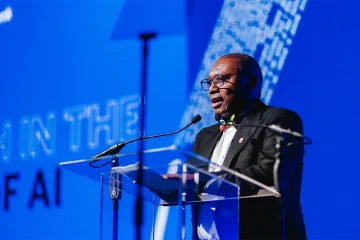
- This is an edited version of a keynote by Dr. Akinwumi A. Adesina, President and Chairman of the Boards of Directors of the African Development Bank, at the Formal Opening Ceremony of the 2025 Annual Meetings of the African Development Bank Group in Côte d’Ivoire. Dr. Adesina stepped down after two transformative terms leading the bank.