
I AM grateful to God that I was created and born as an African. I will always work to advance Africa’s interests and expand possibilities and opportunities for our continent. I will live as an African. I will die as an African. And on the resurrection day, if it is possible, I hope God will let me come back as an African.
I dreamed that one day I would have the opportunity to serve the continent. That opportunity came on May 28, 2015, when I was elected President of the African Development Bank Group right in this hall. From the very first day I worked, I carried the weight of the development of the continent on my shoulders. I can tell you that in the last 10 years, as your President, I had no life. I was always thinking Africa, dreaming for Africa, inspiring Africa and delivering for Africa.
A Mission, Not Just a Job
Many may still wonder why I am so passionate and driven in all I do. Let me tell you: since your time is coming, you should be working. I was elected on September 1, 2015, and you know how you pass the baton in a relay race—you don’t pass the baton while standing; you keep running.
I came to the bank with a mission. I did not take a job. Nothing could have been more important to me than being given the mandate, the resources, the support, and the platform to change Africa, the continent of my birth.
Defining Our Purpose
The mission started with being clear about what I wanted the bank to be known for. I wanted us to be known not just as a great bank, but as Africa’s most trusted development financier. I wanted us to be known for accelerating Africa’s development. I wanted us to be known as a listening bank that understands the needs of countries, shareholders, and stakeholders. I wanted us to be known as a bank that delivers impactful results. I wanted us to be known as a bank that moves beyond finance to make a visible and tangible difference in the lives of the people of Africa.
And today, that is what we have become.
The Greatest Honour
Serving as the President of the African Development Bank has been the greatest honour and privilege of my entire professional life. Ten years ago, we embarked on that journey together—a journey of transformative growth for our bank and for our continent.
Our Greatest Asset: The People
What I would miss the most is the Bank’s exemplary staff. You are the bank’s greatest asset. Without a doubt, you are an exemplary showcase of Africa’s very best to the world. The truth I’ve always carried with me every day is that this isn’t my triumph. It’s not a personal triumph. It is our collective triumph. Every milestone, every breakthrough, every late-night strategy session.
For 10 years, I have seen you in action. From cleaners to drivers to security to protocol officers. I’ll tell you one thing about protocol officers. Musa, where’s Musa? He’s not here. Musa is exemplary. He’s a protocol officer, but he also doubles as my medical doctor. Whenever we travel and I have malaria or something, one day when I’m in Paris, Musa walks straight into the pharmacy and says something special: “President.” I said, “No, you can’t.” And he said, “I am the president’s doctor.”
I remember one day we were travelling so much—I think we had gone to more than five continents in about eight or nine days. I completely forgot where we had gone, much less where we were going. We got into the elevator, and I told Musa, “Musa, where are we coming from?” And Musa said to me, “Mr. President, where are we going?” Then he said, “Mr. President, just follow me.”
The High Fives Strategy
Whether you’re supporting our missions or negotiating with and supporting governments, you work tirelessly, come rain or shine. Our town hall meetings were productive gold mines and crucibles of innovation. Together, we made the High Fives of the Bank one of the most distinctive drivers of Africa’s development. It became our purpose for Africa: to Light up and Power Africa, to Feed Africa, to Industrialise Africa, to Integrate Africa, and to Improve the quality of life of the people of Africa.
In just 10 years, our High Fives impacted the lives of 565 million people. Now that is incredible if you think about it, because that represents 43% of the total population of Africa. What an amazing feat.
Setting Bold Goals
I remember when I came to the boardroom for the first time, and I said, “We are called African Development Bank. We don’t just run a bank—what we need to do is the development part. And so, we have to be accountable for accelerating African development.”
I remember when my friend Ajay Banga, the President of the World Bank, when he was a nominee, came to see me. In fact, they told him in Washington, “Don’t go anywhere in the world, just go and see Akin first.” We talked quite a lot. I told the President-elect—I think he was a nominee at the time—that I wanted us to do three things: Africa must have 100% electricity access; Africa must feed itself with pride; and we must make sure our young people have quality jobs.
Today, I’m excited about the partnership we have with them. As you know, we have Mission 300, to connect 300 million people to electricity.
But as he walked out of my office, he looked back and said, “Akin, I want to tell you something. The best thing you’ve done for the African Development Bank is your High Fives. They make you so distinct from all the multilateral financial institutions in the world. Whatever you do, never lose that.”
Building Financial Strength
We succeeded in building a world-class financial institution that has become a source of pride for Africans globally. It shows in the trust that our 81 shareholders, African and non-African, have for our work, putting wind behind our sails to accelerate Africa’s development. Thanks to them, we increased the capital of the bank from $93 billion when we took office in 2015 to $318 billion—the highest in the history of the bank since 1964.
I remember we were in the boardroom, and one of the executive directors looked at me and said, “Why are you so passionate? Do you think you can solve Africa’s problems so fast? You are asking for a capital increase.” He said, “If you’re a pilot and you’re running out of fuel, what you need to do is slow down the plane.”
I looked at him and said, “My dear executive director, the day you fly a plane, I will not be in that plane.” He’s a friend of mine. I said, “Because when you run out of fuel in a plane, you do an emergency landing. You refuel and then you continue.”
Record Investment in Africa
In 10 years, with my staff and our Board of Directors, we provided over $102 billion in support for Africa. We invested $55 billion in infrastructure all across Africa—from energy to water to sanitation, to transport corridors, to transmission lines, to seaports, to railways, and to airports. In fact, we became the largest financier of infrastructure in Africa and the leading regional infrastructure financier across the continent.
When the Secretary-General of the African Continental Free Trade Area came to see me, we said, “Please take credit for the African Continental Free Trade Area, because without the African Development Bank, the African Continental Free Trade Area would have died.” I’m very pleased about that.
I’m pleased to see Dr. Alain Ebobisse. We have Africa 50 with an exceptional CEO—the best decision I made for Africa 50 last year. They have done exceptional work. We see that from the new corridor we’re doing, linking Bangui in the Central African Republic to Brazzaville in the Republic of Congo.
We have mobilised $16.2 billion for the Lagos-Abidjan Highway. I remember the pressure I had because the late President Ouattara and President Alassane Ouattara told me two different things. One president said, “Mr. Adesina, if you do not deliver on the corridor linking Abidjan to Lagos, then you have to move to Lagos.” When I spoke to the other president, he said, “Adesina, if you don’t do that corridor, stay in Abidjan.” So my Vice Presidents always remind me, I’m between two presidents.
Crisis Response During COVID-19
We were there for Africa during its most challenging period—the COVID-19 pandemic. When all that was going on in 2020, I can tell you that was not what was worrying me. What was on my mind was how to make sure that 3.5 million Africans don’t die based on the projections, and how to ensure we have a facility that can allow us to respond.
We responded. We had a crisis response facility of up to $10 billion very fast. We raised a social impact bond of $3 billion globally. It was the largest social impact bond in world history at that time. That’s because I’ve always said, your neighbour may help you, but it is not the job of your neighbour to send your kids to school. Africa must develop, but it must develop with pride.
I want to thank Vice President for Agriculture, Beth Dunford, Vice President Solomon Quaynor, and also the Vice President for Regional Development for all your great work.
The One Bank Approach
I am proud that we introduced the One Bank approach for the way we work. It wasn’t easy, but I was convinced that we must operate seamlessly across the institution, supported by digital technology and presence in all the countries we serve.
That’s why I started our annual work planning week. I found out when I came to the bank that the bank wasn’t planning together—it was all silos, not talking to each other. We started the annual work planning week, the first ever in the history of the bank. We talked, we argued, we reflected, we mapped our directions.
I’m happy today to say that the organisational culture of the bank has changed. Teamwork is exceptionally strong from sector policies and complexes through regional and client-facing business units, from the back office to the front office, from those making disbursements to social and environmental safeguards, to task managers, to frontline directors and managers, director generals and country managers, from the translators and the interpreters sitting here—we all work together.
The Gari Rule
I started with what my mother taught me, called the “Gari Rule.” Does anybody know about the Gari Rule? The Gari Rule required that we meet 50% of the lending targets of the bank before the board went to recess. If you look at how the bank normally worked, we would do very little during the year, and then at the last board meeting, we would rush everything in.
So I said, my mother taught me something which I’m going to apply. In secondary school, my mother said, “Never come back home during short vacations.” I said, “OK.” Then one day, I ran out of gari. My senior brother and I put our money together for me to go back home to get more gari to return to school. But I wrote to my mother and said what she told me. She said, “What did I tell you? I told you never to come home during short vacations.” I didn’t have lunch. I lost my money. She asked me to go back. It was a poor decision, because I was hungry.
I learned at that time that when you are given a deadline, it’s a deadline. So I instituted the 50% rule. But I’m so proud of my staff—they exceeded it. Well done, because I said you are not going to have vacations otherwise. Just think, last year our total approval was historic—$11 billion, the highest in the history of the bank.
So the lesson is, keep using the Gari rule. And maybe my dear brother, the incoming president—you know he’s from Mauritania. Mauritanians don’t eat gari, but eat couscous. So maybe the new president will adapt it to a couscous rule.
Promoting Our People
In Ghana, I was at the airport and I met Mr. Bekale Ollame. He said, “Mr. President, I used to be General Staff. But today, thanks to the Presidential Directive and your support, I am now the Country Program Officer.” In Benin, Mrs. Jamila Hedhli moved from General Service Staff to Professional Level Grade 4.
Advancing Women’s Leadership
I made a deliberate decision to promote women to positions of leadership. Senior Vice President Marie-Laure Akin-Olugbade said this in her excellent speech. Let me just, for full transparency, which I am always doing—when we did the interviews, I asked HR, “Where are the women?” There were only 8 instead of 37. I said I run an inclusive bank. No bird can fly with one wing. My decision was to make sure that we promote women in this bank as part of our inclusive culture. We don’t do statistics for statistics.
So I moved it up to 68%. The reason is not because they’re not good, but because you haven’t given them space before. They haven’t gained experience in various big positions. So I created new positions for Deputy Director Generals, and I promoted all the women into those positions.
When I called the men—I think some of them are here—I said, “Please note, you are supposed to mentor them, support them, encourage them, and prepare them, because they are going to replace you.”
I am very delighted. The number of women Vice Presidents in this bank increased from 14% in 2015 to 44% in 2025. They are excellent and high achievers. I’m proud of them.
In fact, at one American event, I was standing there, and I was the only man. I remember Hassatou saying, “Mr. President, give room for the women.” I stepped aside, took all their photos, and then I came back in. I am so proud of what you all have done, both men and women, but I’m especially proud of what our women Vice Presidents have done.
Global Recognition and Excellence
The African Development Bank is now a better place to work for staff. I’m delighted that we were ranked in the 90th percentile of global institutions to work for. In fact, that means we are among the 10 best institutions to work for in the world. That’s thanks to the great work of our human resources team, as well as managers who support and inspire staff.
We have made the African Development Bank the best multilateral financing institution in the world. The African Development Fund, which is our concessional financing window that supports the 37 low-income countries, was also ranked as the second-best concessional financing institution in the world, above all 55 concessional financing institutions in all of the advanced countries of the OECD. That’s your bank.
Leading in Transparency
We run a very transparent bank, and I’m proud of it. The African Development Bank was ranked for the last two consecutive years as the most transparent financial institution in the world by Publish What You Fund Index, scoring 98.9%. That’s the highest in the history of that particular index.
Setting Global Standards
We set new global standards. We led the development of the framework for rechanneling Special Drawing Rights of the IMF to multilateral development banks in partnership with the Inter-American Development Bank. This framework was approved by the IMF in a landmark reform of the global financial architecture. A $20 billion allocation to multilateral development banks will allow us to leverage it eight times—that will become $160 billion, and your bank was at the forefront of that innovation globally.
Mission 300, as you know, we’re trying to connect 300 million people to electricity together with the President of the World Bank.
Climate Leadership
We were mindful of climate change. We developed the African Climate Adaptation Acceleration Programme, a $25 billion program. In fact, it is the largest climate adaptation program in the whole world.
The African Investment Forum, which we developed with all of our partners, African financial institutions and others, mobilised $225 billion of investment interest for Africa in just eight years.
A Farewell with Pride
As I conclude my time as your President, I do so with a sense of pride in what we have accomplished together. I leave with great appreciation for you all for supporting me so well, and for coping with my workaholic nature.
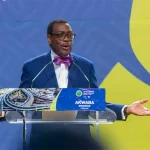
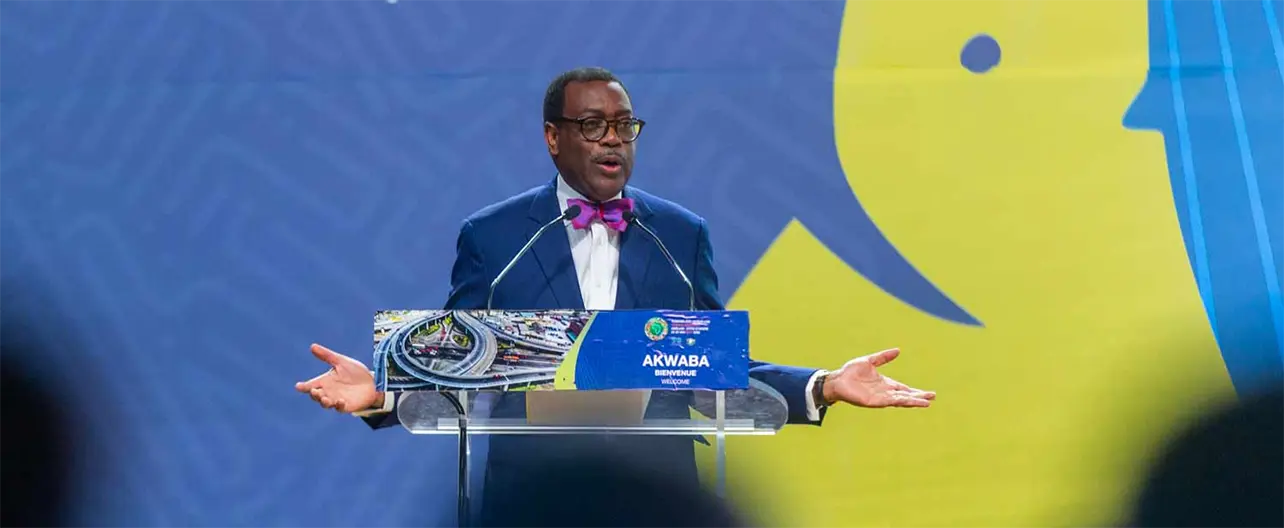
This is an edited version of a farewell speech by Dr. Akinwumi A. Adesina, President of the African Development Bank Group, delivered at the Send-Forth Ceremony organised by the Staff of the African Development Bank Group.