
Eleven days before nationwide protests demanding accountability for one of the deadliest episodes of state violence in Tanzania’s post-independence history, President Samia Suluhu Hassan’s government has torn up its own reform record and outlawed every political rally in the country – a decision that opposition leaders, lawyers and press freedom advocates say confirms what many had long suspected: that Tanzania’s brief democratic opening was never more than a pause.
Home Affairs Minister Patrobas Katambi announced the blanket suspension in Parliament, instructing Police Inspector General Camillus Wambura to withhold rally permits from every political party “until further notice.” The government has framed the ban as a security necessity, citing intelligence of individuals allegedly stockpiling weapons and using social media to incite unrest ahead of Saba Saba Day — 7 July, the anniversary of the founding of the independence movement TANU, and the date activists have chosen for a new round of nationwide demonstrations.
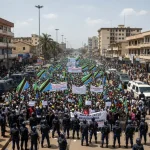
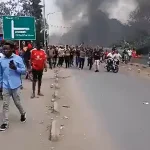
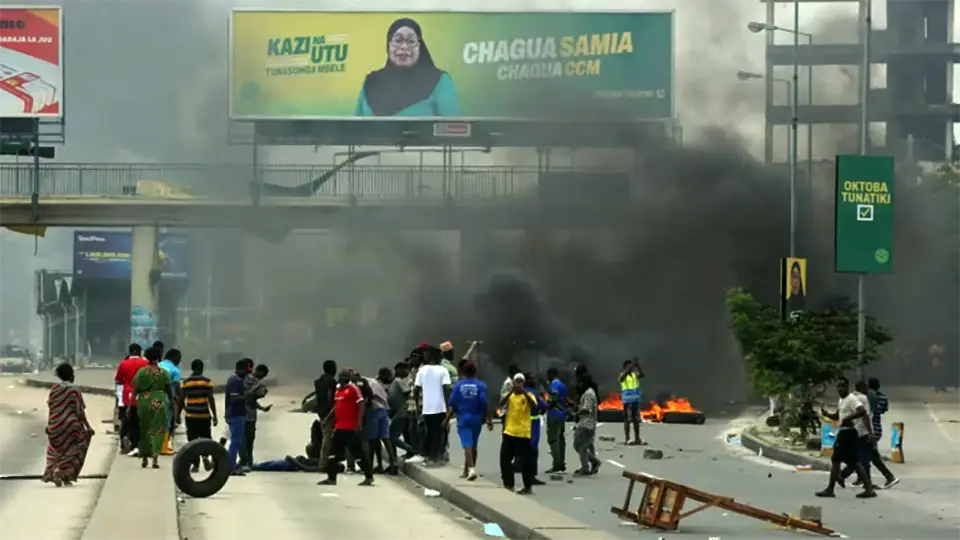
But the timing tells its own story. The ban lands almost exactly eight months after Tanzania’s 29 October 2025 general election, in which the electoral commission declared Hassan the winner with a startling near-98 per cent of the vote — a result the African Union’s own observer mission and international monitors have refused to certify as credible. The announcement of that result triggered protests across the country, and what followed was, by any independent accounting, a massacre.
“The gap between 518 and 10,000 is itself a political instrument.”
A government-appointed commission of inquiry, the Chande Commission, later acknowledged that at least 518 people died from what it termed “unnatural causes,” including 197 shot dead by security forces, and pinned much of the blame on unnamed “foreign agitators.” Independent human rights researchers and monitors with links to the International Criminal Court dispute that figure entirely, placing the true death toll at closer to 10,000 — making it, by that reckoning, the bloodiest crackdown in Tanzania’s multiparty era. The state also imposed a ten-day nationwide internet blackout in the aftermath, cutting the country off from the world as the killing continued.
Opposition parties have rejected the Chande Commission’s findings outright. Chadema has described the inquiry as a mechanism to shield the perpetrators rather than name them, while ACT Wazalendo has called it a vehicle for concealment rather than accountability. Neither party has named a single security officer or official as responsible for a death, despite the scale of the bloodshed — a silence that has itself become a rallying grievance for the Saba Saba organisers.
At the centre of the crisis sits Tundu Lissu, Chadema’s chairperson and the man widely regarded as Hassan’s most credible challenger. Lissu was arrested in April 2025 after addressing a peaceful rally calling for electoral reform. More than fourteen months later, he remains in detention on treason charges that carry the death penalty, with no conviction and no trial concluded. Tanzania’s electoral authorities have separately barred Chadema from participating in elections until 2030, gutting the party’s capacity to contest power through any formal channel.
It is against this backdrop that Thursday’s rally ban lands with such force. Political rallies in Tanzania are not merely campaign theatre; they are, as democracy researchers who have studied the country for years point out, the organisational lifeblood of opposition politics — the mechanism through which Chadema built a nationwide movement, town by town, over more than a decade. Hassan lifted the previous six-year ban, imposed by her late predecessor John Magufuli in 2016, in January 2023, and the move was held up internationally as proof of genuine reform. That reputation now lies in ruins.
Chadema’s leadership has called the new ban unconstitutional. The party’s chief legal counsel, Rugemeleza Nshala, said the directive was designed to muzzle political freedom, while ACT Wazalendo has vowed to challenge the suspension in court, arguing that the right to public assembly is guaranteed under Article 20 of Tanzania’s constitution and cannot be withdrawn by ministerial decree. The Tanzania Law Society has gone further, asserting that the government simply has no legal authority to prohibit lawful political meetings. Even Bishop Benson Bagonza, a prominent religious leader, has publicly questioned both the legality and the process behind the announcement.
The government has held its ground. Prime Minister Mwigulu Nchemba, addressing the public in Singida days after the ban was announced, insisted the measure was about protecting lives rather than suppressing rivals, telling Tanzanians that their safety was the government’s first priority. Officials say individuals have already been arrested for allegedly planning violence and recruiting youth for paid unrest, and police have warned that no constitutional right extends to demonstrations they characterise as a pretext for criminality.
The crackdown has not gone unnoticed beyond Tanzania’s borders. The European Parliament has adopted a resolution condemning the post-election violence by a vote of 539 to zero, and its foreign affairs and development committees have twice blocked a proposed €156 million annual EU funding package over the government’s failure to address the killings and its refusal to admit a European human rights delegation. In Washington, a bipartisan Senate bill introduced by Senators Jeanne Shaheen and Ted Cruz would authorise sanctions against Tanzanian officials implicated in abuses and condition the restoration of US assistance on genuine democratic reform.
For ordinary Tanzanians, the ban arrives atop grievances that go well beyond the killings of last October — a stalled cost of living, deep youth unemployment, and long-simmering tension between the mainland and Zanzibar. It is a decentralised, largely leaderless network of young activists, organising outside Chadema’s battered formal structures, that is now expected to test the government’s resolve on Saba Saba Day. Whether they succeed in bringing Tanzanians into the streets, or whether fear of a repeat of October’s violence keeps the country’s cities quiet, the ban itself has already delivered its verdict on the state of Tanzanian democracy: eight months after the deadliest election in the country’s history, the government’s answer to its people’s grief is silence, enforced.