
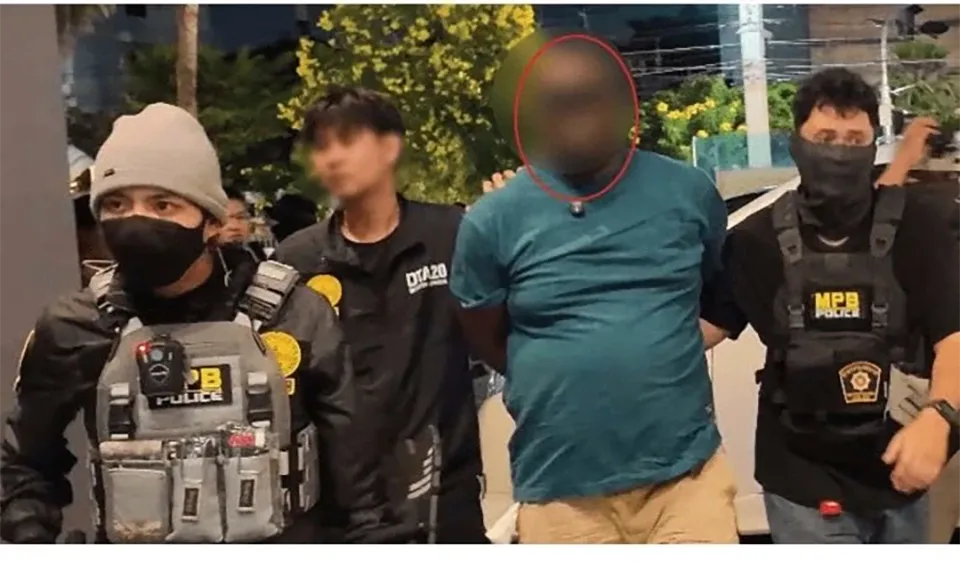
FOR seventeen years, Nwaiwu Ifeanyi Placid moved through Bangkok with a confidence that borders on audacity. He had a Thai wife – or what passed for one – a residence visa, a mobile phone loaded with encrypted group chats, and an alias, Patrick, that kept his real name off the lips of the street-level distributors who kept his empire humming. On the night of Saturday, 19 April 2026, near Silom Soi 1 – the crackling nerve centre of Bangkok’s expatriate nightlife – that empire came undone in the blue flash of Metropolitan Police Bureau torches.
The 46-year-old Nigerian national was arrested following what Thai authorities describe as a painstaking digital infiltration of his cocaine distribution network, a syndicate that had allegedly colonised the kingdom’s most lucrative nightlife corridors — Silom, Sukhumvit, the tourist-dense strips where hard currency and harder drugs flow in parallel streams. When officers finally laid hands on Placid, he did not come quietly. He had to be physically restrained before, police say, he subsequently confessed to the charges.
The seizures told their own story: approximately 30 grammes of cocaine, 1.5 million baht in cash (approximately $43,800 USD) — a portion of it stashed in the ceiling of his bathroom — foreign currency worth 15,000 baht (approximately $438 USD), jewellery valued at 400,000 baht (approximately $11,680 USD), and an impounded vehicle. In the context of the broader crackdown, which followed related earlier raids, total asset seizures associated with the network exceeded 7 million baht — roughly $204,500 USD.
“He had lived in the kingdom for at least 17 years using a sham marriage as cover — a calculated act of institutional deception that places this arrest in a category far beyond routine drug policing.”
A NETWORK BUILT ON ENCRYPTION AND EVASION
The architecture of Placid’s alleged operation speaks to the evolving sophistication of West African trafficking networks in Southeast Asia. Thai investigators say he ran a ‘middleman-free’ cocaine supply chain, coordinating directly with buyers through encrypted chat groups — platforms that law enforcement struggled to penetrate until they succeeded. The absence of intermediaries was a deliberate design choice: fewer human links in the chain mean fewer points of vulnerability, fewer potential informants, and a cleaner operational security profile.
Metropolitan Police Bureau chief Pol Lt Gen Sayam Boonsom confirmed that officers managed to infiltrate the encrypted groups, gaining real-time visibility into Placid’s movements before closing in on Silom Soi 1. Three co-accused were simultaneously detained: Thomas Giubibini, a Swiss national, and two Thai men — Thanayot Asawamethi, 35, and Nattawat Wangkitjinda, 34 — all charged with drug possession.
The multiethnic character of the network is significant. A Nigerian kingpin, a European national, two Thai locals: it is the template of modern transnational narco-commerce — globally networked, locally embedded, deliberately borderless. It is also, analysts note, a model that has proved remarkably resilient across the region’s entertainment districts, where high expatriate concentrations, tourist anonymity, and weak digital surveillance have historically provided ideal operating conditions.
THE SHAM MARRIAGE: IMMIGRATION AS INFRASTRUCTURE
Perhaps the most strategically damning detail in the Thai authorities’ account is not the drugs or the encrypted chats — it is the sham marriage. Placid is alleged to have secured a Thai family visa through a spousal arrangement with a Thai national that police suspect was fabricated solely to provide legal cover. This is not criminal improvisation; it is institutional capture. A fraudulent marriage transforms a foreign national with no licit reason to remain in the country into a lawful resident with residential rights, a paper trail of normalcy, and immunity from routine immigration scrutiny.
That this deception reportedly held for seventeen years raises pointed questions about the robustness of Thailand’s immigration monitoring systems, about corruption risk within administrative processes, and about the broader phenomenon of criminal networks that exploit legal infrastructure as deliberately as they exploit any other resource. Placid’s longevity in the country — nearly two decades, spanning successive Thai governments and multiple law enforcement crackdowns — suggests a network with genuine institutional roots.
A PATTERN, NOT AN ANOMALY: NIGERIA, THAILAND, AND THE NARCOTICS NEXUS
The arrest of Nwaiwu Ifeanyi Placid does not occur in a vacuum. It follows the October 2025 detention of nine Nigerian suspects linked to a Nana-based drug network in a related Thai police raid — and comes less than three months after the arrest of another Nigerian national, Ukoma Nuzbech, who had allegedly fled an ongoing trial related to cocaine trafficking in Koh Pha Ngan, having first been apprehended in March 2025 after selling 25.71 grammes of cocaine to an undercover officer.
The broader pattern has deep historical roots. West African trafficking networks — Nigerian syndicates in particular — emerged as major actors in Southeast Asian heroin markets as far back as the early 1990s. Their operational model, documented extensively by the US Drug Enforcement Administration and the United Nations Office on Drugs and Crime (UNODC), rested on disaggregated courier networks, exploited immigration pathways, and an evolving narco-logistics sophistication that has since migrated from heroin to cocaine as market demand has shifted.
Thailand sits at the confluence of these pressures. It borders the Golden Triangle — the Myanmar-Laos-Thailand nexus that remains one of the world’s most prolific drug-producing zones — while simultaneously hosting one of Asia’s most active entertainment economies, a vector that generates consistent retail demand for cocaine among wealthy domestic consumers and international tourists alike. For transnational criminal entrepreneurs, it is both a transit hub and a lucrative end market.
“A fraudulent marriage transforms a foreign national into a lawful resident with residential rights and immunity from routine immigration scrutiny — criminal networks that exploit legal infrastructure as deliberately as they exploit any other resource.”
AFRICA’S REPUTATIONAL BURDEN
Every such arrest generates a reputational reverb that reaches well beyond the individual accused. Nigeria’s authorities — including the National Drug Law Enforcement Agency (NDLEA), which has in recent years mounted aggressive domestic interdiction campaigns — are acutely aware that high-profile trafficking arrests abroad reinforce a narrative that the country and the continent struggle to escape. The optics of successive Nigerian nationals being arrested in Thailand for narcotics offences is a liability that African diplomatic missions in Bangkok, Abuja’s foreign affairs apparatus, and pan-African media institutions must contend with.
It would, however, be a category error to reduce this story to a Nigerian problem. The cocaine allegedly flowing through Placid’s network originated, in all probability, from Latin American cartel supply chains — most likely routed through West Africa as a transshipment zone before onward distribution into Southeast Asian consumer markets. The UNODC’s World Drug Report 2025 specifically identifies a surge in significant cocaine seizures across non-traditional markets in Africa, Asia, and Eastern Europe, tracing routes that now arc from the Andean producing regions through West African coastal states and into Asia’s rapidly expanding middle-class cocaine market.
In that framing, Nwaiwu Ifeanyi Placid is not simply a Nigerian drug dealer operating in Bangkok. He is, if the allegations hold, a node in a genuinely global architecture of narco-capitalism — one that connects South American producers, West African transit infrastructure, and Southeast Asian consumer demand into a seamless, encrypted, and extraordinarily profitable supply chain.
WHAT THE CEILING HID
The detail that has captured imaginations across social media — the 1.5 million baht (approximately $43,800 USD) discovered hidden in the ceiling of Placid’s bathroom — is more than a colourful flourish. Cash concealment at that scale, in a fixed residential location, indicates a trafficking operation with substantial cash turnover, inadequate money-laundering infrastructure, and the kind of operational exposure that typically precedes an arrest. It also speaks to a trafficker whose confidence in his own cover — the family visa, the alias, the encrypted network — had perhaps begun to calcify into complacency.
That complacency was his undoing. Thai investigators infiltrated the chat groups. They tracked his movements. And on a Saturday night in Silom, Bangkok’s neon never dimmed as the Metropolitan Police closed the net around a man who had spent seventeen years believing himself invisible.
IMPLICATIONS AND OUTLOOK
The charges Placid faces under Thai narcotics law are serious. Thailand maintains some of the world’s most stringent drug penalties, and while the death penalty for trafficking has been subject to moratoriums, lengthy imprisonment is almost certain for a conviction at this level. His Swiss co-accused, Giubibini, and the two Thai nationals face possession charges whose severity will turn on quantities and prosecutorial discretion.
More immediately, the operation raises the question of what remains of the network beyond the four arrested. The Bangkok cocaine retail scene — if its reported sophistication is accurate — is unlikely to have been wholly dismantled by a single operation, however well-executed. Syndicate structures of this kind are designed to survive the loss of their leadership nodes; encrypted group chats can be reconstituted; new aliases are easy to acquire. Thai law enforcement will be watching the succession carefully.
For Africa, the story is a reminder that the continent’s engagement with the global narcotics economy is no longer confined to the role of passive transit zone or victim of supply-side flooding. African criminal entrepreneurs — a vanishing minority of the continent’s diaspora, but a visible and consequential one — have become active architects of transnational trafficking infrastructure. Addressing that reality honestly, without retreating into either defensiveness or stigma, is a challenge for African governments, regional bodies, and the pan-African press alike.