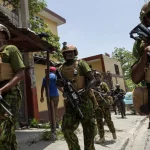

FOR 56 days, a classroom’s worth of children and their teachers existed only as a rumour: alive, somewhere, in the bush country outside Ogbomoso, held by an armed group that had already shown it was willing to kill. On Friday, that silence broke. Nigerian troops, police and the Department of State Services (DSS) stormed the gang’s hideout in Oriire community, Oyo State, freeing every pupil and teacher still in captivity, arresting eight of their captors and killing several more, according to a Presidency statement issued by presidential spokesman Bayo Onanuga.
For President Bola Tinubu, under mounting pressure over a kidnapping crisis that has defined the security narrative of his administration, the operation is being presented as vindication — hard evidence that the machinery of state can still outmanoeuvre Nigeria’s abduction gangs when it is given the time and the will to do so.
“This successful military operation has ended the siege and standoff of over 50 days and has brought relief to the entire nation.”
President Bola Tinubu
“I am profoundly happy that our security forces successfully rescued the abducted pupils and teachers from Orire, Ogbomoso in Oyo State today after a military, police and intelligence-driven operation that neutralised some of the terrorists who perpetrated the evil act and led to the arrest of eight of them,” Tinubu said in the statement. “On behalf of the country, I express my gratitude to the officers and men of our armed forces, the intelligence agencies and the police for the safe rescue of the children and their teachers.”
A Victory Shadowed by a Grave
The relief in Ogbomoso is real, but it is not unqualified. The abductors murdered one of the seized teachers, identified in Nigerian press reports as Mr Oyedokun, during the standoff — a killing Tinubu invoked directly in vowing that “my government will get justice for these children and their teachers and for the family of Mr Oyedokun, who the terrorists gruesomely murdered.” The President also thanked the Oyo State Government under Governor Seyi Makinde for cooperating throughout the rescue effort and directed that emergency agencies now provide medical and psychosocial support to the freed victims.
Tinubu used the moment to press Oyo State to harden security around its schools — an instruction that lands against a backdrop of a national school-safety architecture, built around the Safe Schools Initiative, that critics say has repeatedly failed to keep pace with the gangs it was designed to deter.
The Numbers Tinubu Would Rather Not Discuss
Set against Nigeria’s longer record, Friday’s rescue reads less as a turning point than as one bright data point inside a darkening trend. Nigeria’s era of mass school abductions dates to the 2014 Chibok kidnapping of more than 200 girls in Borno State; more than 2,300 students and teachers have been seized nationwide in the years since. Analysis by Premium Times shows that trend is accelerating sharply on Tinubu’s watch: in the three years since his administration marked its anniversary on 29 May, Nigeria has recorded 13 mass school-kidnapping incidents involving 674 students and staff — more than five times the three incidents and roughly 120 victims recorded during the first three years of his predecessor, Muhammadu Buhari.
That arithmetic is the uncomfortable context in which the Presidency’s celebratory language has to be read. The operation that freed the Oriire victims took the better part of two months of negotiation, surveillance and military planning — a timeline the government frames as patient, casualty-free professionalism, and one that critics of Nigeria’s security posture will read instead as a measure of how deeply entrenched armed groups have become in the country’s rural interior, able to hold hostages in a fixed location for nearly two months without being dislodged sooner.
What the Presidency Is Signalling
Politically, the messaging out of Aso Rock is calibrated to answer that critique directly. By stressing that the rescue came “without any collateral damage,” that eight suspects are now in custody, and that “others” were “neutralised,” the Presidency is asserting not just that the hostages came home, but that the security services degraded the gang’s operational capacity in the process — an argument aimed squarely at critics who accuse Tinubu of treating each kidnapping as an isolated incident rather than confronting a networked criminal economy built on ransom.
Education Minister Tunji Alausa amplified that framing on Saturday, calling the rescue “a strong indication of the Federal Government’s commitment to safeguarding the lives of Nigerian children” and linking it to Tinubu’s Renewed Hope Agenda. Alausa also renewed calls for parents, host communities and school administrators to cooperate more closely with security agencies — an appeal that implicitly acknowledges how much of Nigeria’s counter-kidnapping strategy still depends on community-level vigilance rather than blanket state protection.
A Single Battle, Not the War
Nigeria’s security establishment has now notched a win it badly needed to publicise. But the Oriire operation does not, on its own, resolve the structural question hanging over Tinubu’s second half of his term: whether a government that has now presided over more mass school abductions than any of its recent predecessors can convert isolated tactical successes like this one into a durable reduction in the kidnapping economy itself. For the families reunited this weekend in Ogbomoso, and for the family burying Mr Oyedokun, that is a debate for another day. For the rest of Nigeria, it is the one that will determine whether Friday’s rescue is remembered as a turning point — or as one relieved exhale in a crisis that keeps recurring.