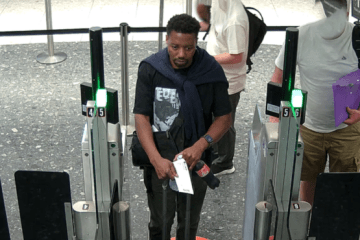
UGANDAN security agencies have detained more than 1,000 foreign nationals, the overwhelming majority of them Chinese, in what officials privately describe as the country’s largest ever operation against an alleged transnational cybercrime syndicate. The scale of the sweep and the political tremors it has already triggered inside President Yoweri Museveni’s inner circle mark it as a defining test of Uganda’s capacity to police the digital underworld quietly metastasising across East Africa.
The joint operation, led by Uganda’s Criminal Investigations Directorate (CID) working with immigration and other security agencies, targeted multiple sites in Kampala and neighbouring Wakiso District. Security sources familiar with the investigation, speaking on condition of anonymity because they were not authorised to discuss it publicly, said roughly 430 suspects were arrested at Kingdom Resort Katomi in Wakiso, a property associated with former Vice President Gilbert Bukenya. Hundreds more were rounded up from three neighbouring apartment blocks, with further arrests made in the Kampala suburbs of Naguru and Kansanga, pushing the total past the 1,000 mark. Detainees are being held at a secure facility in Namanve, Wakiso District, as investigators process the arrests and catalogue evidence.
INSIDE THE SYNDICATE
Preliminary findings suggest the network operated a sophisticated online scam and fraudulent call centres, targeting victims both inside Uganda and beyond its borders. Investigators believe the group breached telecommunications and utility company systems, triggering service disruptions and enabling unauthorised deductions from customers’ accounts — a level of technical penetration that goes well beyond the petty SIM card fraud Ugandan police have periodically busted in past years. Authorities are examining evidence that the operation generated billions of Ugandan shillings in illicit proceeds, though no official estimate of financial losses has yet been made public.
Investigators are also probing allegations that some members of the network were involved in producing online adult content, and are scrutinising the immigration status of those detained after establishing that a significant number lacked valid travel documents altogether — no passports, no permits, in some cases no verifiable identity at all. That absence of paperwork, officials say, points to a deliberately opaque operation built to survive under Uganda’s regulatory radar.
POLITICAL UNDERCURRENTS
What distinguishes this raid from Uganda’s earlier cybercrime busts is the political weight it has already attracted. According to security sources, associates of the detained suspects sought the intervention of Michael Nuwagira, popularly known as ‘Toyota’, President Museveni’s brother, in an apparent bid to secure the release of those held. The sources say Museveni, on learning of the alleged crime, ordered that the investigation proceed without fear or favour and that anyone found culpable — regardless of standing — be brought to book. His aide, Lt. Gen. Edith Nalweyiso, was reportedly instructed to ensure the probe faced no interference.
For a country whose politics has long been shadowed by accusations of elite protection rackets, the episode is instructive on two fronts at once. It signals that a syndicate of this scale calculated, correctly or not, that it could purchase its way out of trouble through proximity to power. And it places Museveni’s public assurance of a clean investigation on record — a benchmark against which Uganda’s editors, opposition and civil society will now measure the case’s outcome, from prosecutions through to any deportations.
NOT UGANDA’S FIRST BRUSH WITH SCAM COMPOUNDS
This is far from an isolated incident. In late April, Ugandan authorities detained 231 foreign nationals — including Pakistani, Indian, Bangladeshi, Ghanaian, Myanmar, Ethiopian, Sri Lankan, Cambodian and Malaysian nationals — in coordinated raids on a fortified apartment complex in Kampala’s Bukoto-Ntinda suburb and on a separate Nigerian-linked operation in Adjumani District. Officers described a tightly controlled compound with restricted movement, its own internal services, and halls filled with networked computers and telephony equipment rather than ordinary household items — the now-familiar architecture of the region’s emerging scam factories.
Uganda’s exposure to Chinese-linked telecom fraud specifically also predates this week’s raid by several years. In one earlier case, police detained nine Chinese nationals and a Ugandan in the Kampala suburb of Bugolobi over an alleged scheme built around 500 mobile phones and SIM cards fraudulently registered in Ugandan names, intended to route messages and financial transactions through Chinese platforms. That case, like others before it, ended in deportation rather than prosecution — a pattern critics say has done little to deter the networks from regrouping.
A CONTINENTAL WARNING SIGN
The bust lands amid growing concern that organised fraud networks long associated with Southeast Asia — where trafficked and coerced workers have been documented running scam compounds across Myanmar, Cambodia and Laos — are migrating operations toward East Africa, drawn by relatively low costs, expanding digital infrastructure and regulatory gaps that syndicates can exploit before the law catches up. For a continent racing to expand mobile money, digital banking and e-government services as the backbone of its economic future, that is a governance problem, not merely a policing one.
The alleged hacking of telecom and utility systems, in particular, strikes at infrastructure that hundreds of millions of ordinary Africans now depend on daily for payments, remittances and basic services. Every unauthorised deduction from a customer’s mobile money account is not an abstract cyber statistic; it is money taken from households already navigating currency pressure and the cost-of-living strain being felt across the region. Where such networks can also draw on political cover, however fleeting or unproven, the threat compounds: weak enforcement becomes an advertisement to the next syndicate scouting its next base of operations.
WHAT HAPPENS NEXT
Much remains unresolved. Investigators have not disclosed an estimated financial toll, nor confirmed how many of the more than 1,000 detainees will face prosecution as opposed to deportation as undocumented migrants. The probe into the syndicate’s alleged links to the production of online adult content is at an early stage. And the immigration status review under way — examining how so many foreign nationals came to be living and working in Uganda without passports or permits — will likely raise uncomfortable questions about the landlords, agents and officials who made that possible.
For now, the case stands as a marker of intent: a president publicly instructing that the investigation run its course despite alleged attempts at political interference, and a security establishment moving at a scale rarely seen in Uganda’s recent history. Whether that intent survives the slower, less dramatic work of prosecution — and whether it extends to any Ugandans found to have enabled or protected the network — will determine if this becomes a genuine accountability moment or another cybercrime bust remembered mainly for its opening headline.