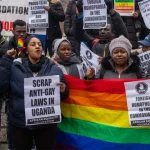
ON the morning of 18 February, two women in their early twenties – Wendy Faith, 22, a dancer who performs under the name Torrero Bae, and Alesi Diana Denise, 21 – were arrested in Arua City, a provincial capital in Uganda’s northwestern West Nile region. The charge: kissing. Their neighbours had been watching. Someone had a camera. The police were called.
That simple, intimate act – a kiss between two young women – now carries the weight of Uganda’s Anti-Homosexuality Act of 2023, a law that prescribes life imprisonment for consensual same-sex conduct and reserves the death penalty for what it terms “aggravated homosexuality.” As of the time of writing, the women have been released on police bond, but their case remains open, and their futures are uncertain.
Their arrest, documented by Human Rights Watch on 10 March 2026, is neither an aberration nor an accident. It is the logical endpoint of a machinery of surveillance, legislation, and state-sanctioned social terror that has been under construction across the African continent for the better part of a decade – and which, in 2026, is accelerating with alarming confidence.
“It only just happened that the local newspaper was able to capture this particular story. Otherwise, there are very many unwritten stories like that that normally die away. In some instances, people even actually end up getting killed.” — John Grace, Uganda Minority Shelters Consortium
THE ARCHITECTURE OF FEAR
The arrest of Wendy and Alesi was not random. Human rights defenders with the Uganda Minority Shelters Consortium described to investigators a system of organised community vigilantism that preceded the police intervention. Neighbours had been actively surveilling the women’s home in Ayivu West Division. When local media reported the arrest, the area’s Assistant Resident District Commissioner, Job Richard Matua, publicly celebrated it – announcing plans to send the women for “rehabilitation and spiritual intercession” and amplifying anti-LGBT rhetoric in online exchanges with a Pentecostal pastor.
The state, in other words, did not merely respond to community hostility. It cheered it on.
Edward Mwebaza, Executive Director of the Human Rights Awareness and Promotion Forum (HRAPF), confirmed that the pattern is structural and recurring: arrests based on suspicion or community pressure, charges filed without corroborating evidence, victims losing their homes, their jobs, and often their families. A 2024 attack on HRAPF paralegals forced the organisation to evacuate its own staff from the field.
The passage of the Anti-Homosexuality Act in 2023 both reflected and supercharged this environment. HIV testing in Uganda dropped by an estimated 31 percent in its aftermath — a public health catastrophe masked by political triumphalism. Clinics that served communities at risk have been emptied by terror. Doctors fear that treating LGBT patients exposes them to criminal liability for “promoting homosexuality.” UNAIDS has warned that the law is dismantling two decades of progress in the fight against AIDS in a country once held up as a model for the continent.
The law also mandates that citizens report any “reasonable suspicion” of homosexual conduct to authorities —a provision that has effectively deputised every neighbour, every landlord, every jealous acquaintance as an agent of state persecution. When a kiss can be photographed and handed to the police, no one is safe.
“The consequences for these two individuals are severe. They are already being judged and condemned by society, and cases like this send a chilling message to LGBTQ+ people across the country that their safety and dignity are under threat.” — Frank Mugisha, Sexual Minorities Uganda
GHANA: THE BILL RETURNS
Uganda’s trajectory has become, explicitly, a template. As Arua’s police were processing Wendy and Alesi’s fingerprints, the parliament of Ghana was receiving a revived piece of legislation that its architects made no secret of modelling on Kampala’s example.
On 17 February 2026, the Ghanaian parliament formally received the Human Sexual Rights and Family Values Bill — a reintroduction of legislation that first passed parliament in February 2024 before lapsing without presidential assent when then-President Nana Akufo-Addo declined to sign it. His successor, President John Dramani Mahama, who returned to office in January 2025, has indicated he supports the bill. Parliament is moving accordingly.
The stakes are enormous. The revived bill would criminalise not just same-sex conduct — already illegal in Ghana under a colonial-era law that has been on the books since the 1860s — but the act of identifying as LGBT. Simply claiming a queer identity would become punishable by up to three years in prison. Advocacy for LGBT rights could result in a decade behind bars. The bill would legalise conversion therapy and compel intersex persons to undergo what it calls “gender realignment” surgery against their will.
Ghana’s own Commission on Human Rights and Administrative Justice has warned parliament that the bill violates fundamental constitutional guarantees. Cardinal Peter Turkson — a senior figure in Ghana’s Catholic Church — has publicly urged that LGBT people must not be criminalised. Yet the legislative momentum appears unstoppable, propelled by a coalition of conservative Christian, Muslim, and traditional leaders who frame the bill as a defence of African cultural values against foreign imposition.
That framing deserves scrutiny. As Cardinal Turkson himself pointed out in a BBC interview, the Akan language of Ghana contains words describing same-sex conduct — illustrating that homosexuality is not a Western import but a reality inherent to human societies, including African ones. The laws criminalising it, on the other hand, are straightforwardly colonial: Britain introduced Ghana’s original anti-sodomy statute in the 1860s. Today’s legislators are preserving Victorian-era prohibitions while presenting them as ancestral wisdom.
Ghana’s parliament is set to host the fourth African Inter-Parliamentary Conference on Family and Sovereignty in Accra in May 2026 — a platform with documented ties to US-based far-right advocacy groups. Previous editions promoted Uganda’s Anti-Homosexuality Act as a model for other African legislatures.
SENEGAL AND THE DOUBLING DOWN
The regional pattern extends west. In Senegal, Prime Minister Ousmane Sonko went before parliament on 24 February 2026 to urge passage of a draft law that would double the maximum prison sentence for same-sex relations from five to ten years. For any same-sex act involving a person under 21, the full maximum would apply — accompanied by fines of up to 10 million CFA francs, approximately $17,960. This is a country where same-sex conduct has already been criminalised for decades and where enforcement is routine and brutal.
In Nigeria — home to over 230 million people, making it the continent’s most populous nation — the Same-Sex Marriage Prohibition Act of 2014 remains in force, delivering up to 14 years’ imprisonment in the south and the death penalty by stoning under Sharia law in 12 northern states. Blackmail and extortion of gay men by criminal networks — a practice known as “kito,” in which victims are lured, entrapped, and robbed — has escalated in the years since the law’s passage, with perpetrators exploiting their victims’ terror of the authorities to ensure silence.
Human rights defenders across Nigeria report that the SSMPA did not reduce same-sex conduct; it drove it underground, put it in the hands of criminals, and made it lethal.
COLONIAL LAW, FOREIGN FUNDING
The historical irony that hangs over this entire regional crisis is rarely named plainly enough: the laws that African governments are now doubling down on, celebrating as expressions of African tradition, and building upon with ever greater severity, were written by British colonial administrators in the 19th century. Uganda’s Penal Code Act, which predates the 2023 law and under which the Arua arrests were made, derives directly from Victorian-era criminal codes transplanted wholesale into East Africa. Ghana’s anti-sodomy statute dates to the 1860s. Nigeria’s Criminal Code Act of 1916 introduced the prohibition on “carnal knowledge against the order of nature.”
Pre-colonial African societies were not utopias of sexual freedom, and the historical record is complex. But the claim that criminalising gay people is an African value, rather than an inherited colonial imposition now being weaponised for political advantage, is not supported by the evidence. What is supported by evidence is the involvement of well-funded American evangelical and far-right organisations — including those affiliated with the World Congress for Families — in drafting and championing these laws across the continent. The International Organisation for the Family, an affiliated body, has explicitly defended its Africa engagement while dismissing critics as agents of “neo-colonialism.” The irony of American culture warriors funding African laws to combat American cultural influence appears to be lost on all involved.
Ghana will host the fourth African Inter-Parliamentary Conference on Family and Sovereignty in Accra in May 2026. Previous editions promoted Uganda’s Anti-Homosexuality Act as a legislative model. The conference has documented ties to US-based far-right advocacy groups. The infrastructure of continental repression, in other words, has international backing, coordination, and financing.
THE CONTINENT DIVIDES
Against this tide, the picture is not entirely bleak, though the forces of regression currently have the greater momentum. South Africa remains constitutionally committed to protecting LGBT people — the only country on the continent to do so at the constitutional level — and continues to offer asylum to persecuted individuals from neighbouring states. Angola, Botswana, Mozambique, and Seychelles have decriminalised homosexuality in recent years. Cabo Verde is considering anti-discrimination legislation with enhanced protections.
But these exceptions underscore the rule. In 31 of Africa’s 54 countries, consensual same-sex conduct between adults remains a criminal offence. The African Union has no official position protecting LGBT people from discrimination. The African Commission on Human and Peoples’ Rights, which has at times affirmed that the African Charter guarantees equal protection to all regardless of sexual orientation, has been inconsistent in applying that standard — and has bowed to state pressure in rejecting observer status applications from LGBT-focused organisations.
The regional architecture that might constrain this persecution — human rights bodies, constitutional courts, international obligations — is either silent, contradictory, or actively hostile. ECOWAS, the West African regional bloc, has taken no meaningful action on the Ghana bill. The East African Community has said nothing about Uganda’s law. The AU has not spoken.
In 31 of Africa’s 54 countries, consensual same-sex conduct between adults remains a criminal offence. The infrastructure of regional persecution has international backing, coordination, and financing — and the bodies that might constrain it are either silent or complicit.
THE WOMEN OF ARUA
Wendy Faith and Alesi Diana Denise have been released on police bond, but their lives have been comprehensively destroyed in ways that cannot be reversed by a bail agreement. They cannot return to their home in Ayivu West Division. Their families and friends are distant. Their identities have been made public in local media. Their names now exist in the legal record of a country that would send them to prison for life for what they are.
Frank Mugisha, Executive Director of Sexual Minorities Uganda and one of the continent’s most prominent LGBT rights defenders, has noted that the Anti-Homosexuality Act has triggered a surge in extortion by criminal actors who prey on LGBT people, knowing their victims are too terrified to seek help from authorities. “Even criminals are now using this law as a weapon to prey on the LGBTQ+ community,” Mugisha said. The state has not merely failed to protect gay Ugandans; it has made them available to every predator willing to exploit their legal vulnerability.
Meanwhile, in January 2026, ahead of Uganda’s general elections, multiple human rights organisations supporting LGBT Ugandans were forced to shut down, including Chapter Four Uganda. The election cycle is being used to clear the field of dissent.
In Arua City, two young women kissed and became, briefly, an international headline. Within weeks, the world moved on to other crises. But they remain: stateless in their own country, subject to a law their government built over decades to ensure that a kiss like theirs could never go unpunished.
Across East and West Africa, thousands share their condition. And the law is still being written.