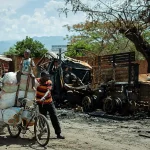
THE blood had dried on the walls of two houses on the same street. In the first, a father stood in the room where his 16- and 18-year-old sons were executed. M23 fighters and Rwandan soldiers had broken down the door, found them sheltering inside, and shot them dead. Metres away, four more young men – aged 16 to 23 – were killed trying to hide behind a curtain. Their younger brother survived, badly wounded. A neighbour confirmed what everyone on that street already knew: none of these men were fighters. They were civilians. Their blood still marks the walls.
This is what Human Rights Watch found when it arrived in Uvira in March 2026 — the first major city in eastern Democratic Republic of Congo from which the M23 has withdrawn since the group’s deadly resurgence began in 2021. What the investigation uncovered was not the fog of war but its cold, deliberate aftermath: mass graves, missing men and boys, sexual violence against women who ventured out to find food, and the systematic use of terror as an instrument of control.
The M23 entered Uvira on December 10, 2025. For just over a month, the strategic South Kivu port city on Lake Tanganyika — with its critical border crossing to Burundi — was under the occupation of a rebel group whose advances have been underwritten by Rwandan troops, artillery, and logistics. Kigali has long maintained the fiction of self-defence. The evidence in Uvira tells a different story.
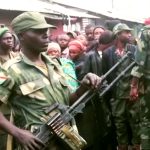
Human Rights Watch researchers conducted scores of interviews with survivors and witnesses. The pattern that emerged is damning: door-to-door searches, men and boys accused without evidence of affiliation with the Wazalendo militias allied with the Congolese army, and executions or abductions that followed. Many of those taken have not been seen since. Researchers visited three confirmed burial sites and were informed of many more. At least several dozen people are confirmed killed during the occupation. The true number may be substantially higher.
The Rwandan military’s direct role in the occupation’s most violent opening days is no longer a matter of dispute. Researchers found evidence that Rwandan forces were present at, and complicit in, the early abuses. This is not peripheral involvement. Rwanda’s backing has been, in the words of HRW itself, “decisive” in M23 advances across North and South Kivu — including the fall of Goma and Bukavu, the two provincial capitals. Uvira was the latest domino.
The sexual violence dimension demands its own reckoning. M23 fighters assaulted women and girls who left the city to find food on their farmlands — isolated, vulnerable, and deliberately targeted. Most received no medical care. This is not incidental abuse in a war zone. It is conflict-related sexual violence as a weapon, deployed with apparent impunity, in a region where support for survivors has collapsed even as attacks have escalated.
Accountability, however, cannot be selective. The Wazalendo — the Kiswahili-named “patriot” militias fighting alongside the Congolese army — have their own history of abuse, including harassment and assault of civilians in Uvira, particularly members of the Banyamulenge community, the Congolese Tutsi from South Kivu who were specifically targeted in the militia’s pre-occupation conduct. The South Kivu governor has moved to arrest some Wazalendo fighters for threatening and shooting at civilians, and that is to be acknowledged — but the effort falls well short of what justice demands.
The geopolitical choreography around the DRC crisis has been elaborate and, so far, largely theatrical. In early December 2025, US President Donald Trump brokered the “Washington Accords” between Congolese and Rwandan leadership — a framework for security cooperation, noninterference, and mineral deal-making. In March 2026, the United States went further, imposing sanctions on the Rwandan army and senior commanders in response to Uvira’s capture. These are meaningful signals. They are not, on their own, solutions.
The European Union and the United Kingdom have not followed the American lead. That gap is a scandal. Both powers have the leverage and the legal frameworks to impose targeted sanctions on abusive M23 commanders and Rwandan military figures. The failure to act is a political choice — and a morally indefensible one when mass graves are still being mapped in South Kivu.
The UN Commission of Inquiry on the situation in North and South Kivu must deploy to Uvira immediately. Evidence preservation is urgent. Forensic support for the exhumation of mass graves is not optional — it is the foundation on which any future accountability rests. The International Criminal Court’s investigations into eastern Congo must be supported, not managed from a distance. Domestic proceedings in both Rwanda and the DRC must follow.
The M23 has withdrawn from Uvira, but it has not gone far. It holds positions north of the city in the Ruzizi Plain and in the Hauts Plateaux highlands to the southwest. Fighting continues. Human rights defenders who documented M23 crimes during the occupation are now living under the threat of reprisal — from M23 agents in the city, or from a potential return. Their vulnerability is a measure of how thin the peace remains.
The families of the six young men shot dead on one street in Uvira — and the dozens of others still missing, still unburied in unmarked places — are not waiting for the world to find the right diplomatic language. They are waiting for justice. The question is whether the international community, the African Union, the ICC, and the governments with the power to act will finally move with the urgency this moment demands.
The blood on the walls of Uvira has not dried quietly. It is an indictment — of the M23, of Rwanda’s military machine, of a diplomatic community that has moved too slowly and spoken too softly. It demands an answer.