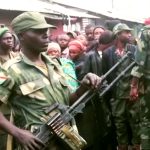
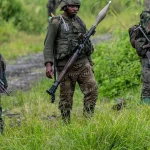
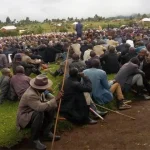
THEY came door to door. Armed, methodical, and merciless. When M23 rebels and Rwandan military forces swept into Uvira on 10 December 2025, they did not merely seize a city – they turned it into a killing field.
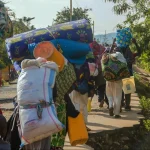
One man fleeing with his family on that first terrible morning watched four relatives fall as soldiers opened fire on them. “It was chaos,” he told investigators later. “We had small bags that we threw off, and we ran. I wasn’t hit, so I just ran to the lake. I saw my brother, his wife, and two of his children fall.”
That occupation of Uvira, the second largest city in South Kivu province, lasted until 17 January 2026 – a month in which M23 fighters and Rwandan soldiers shot fleeing civilians, summarily executed more than 50 people during door-to-door searches, raped at least eight women, and forcibly disappeared at least 12 people.
Those are not statistics. They are the measure of a rampage.
The findings are contained in a 23-page report released this week by Human Rights Watch, titled “We Are Civilians!”: Killings, Sexual Violence, and Abductions by the M23 and Rwandan Forces in Uvira, Democratic Republic of Congo. The report, the first field research into abuses in Uvira during the occupation, is based on over 120 interviews conducted in March and April 2026. HRW wrote to the government of Rwanda and to M23 head Bertrand Bisimwa to provide preliminary findings. Neither responded.
Their silence is telling.
A Rebellion With a Sponsor
The M23 did not emerge from nowhere. First formed in 2012 as a rebellion against the Congolese government, the group reemerged in late 2021 with documented support from Rwanda. Since then, the conflict has consumed eastern Congo with a ferocity that the international community has repeatedly failed to match with decisive action.
Fighting between the M23 and Rwandan forces on one side, and Congolese armed forces along with allied Wazalendo militias on the other, has displaced hundreds of thousands of people in North and South Kivu. The warring parties stand accused of unlawful killings, rape, forced recruitment and forced labour — a catalogue of war crimes that has become almost numbingly familiar to observers of this conflict, yet no less catastrophic for those living inside it.
What makes Uvira a particularly sharp indictment of regional and global inaction is its timing. M23 and Rwandan forces took control of Uvira beginning on 10 December 2025 — days after the signing of the United States-brokered Washington Accords. The ink was barely dry on a peace framework when the bullets began flying in Uvira’s streets. The Accords offered, as HRW had noted at the time, promises but little more.
The Anatomy of an Atrocity
The HRW report reconstructs, in granular and harrowing detail, how the occupation unfolded. As M23 and Rwandan forces moved to consolidate control, they began systematic door-to-door operations targeting men and boys, accusing them of ties to the Wazalendo and executing many on the spot. Human Rights Watch documented the summary execution of 53 civilians by the M23 and Rwandan forces, most of them on 10 December alone.
Sexual violence was deployed as a weapon of war. Eight documented rape cases paint only a partial picture of a broader pattern — investigators acknowledge they may have only scratched the surface. Survivors described the near-total collapse of accessible healthcare services during the occupation, particularly the absence of timely post-exposure prophylactic treatment to prevent HIV infection, and the lack of adequate care for injuries and infections resulting from sexual violence.
At least a dozen civilians were abducted. Their whereabouts remain unknown. Communal graves remain scattered across Uvira.
The Question of Accountability
Philippe Bolopion, HRW’s executive director, was direct: “After taking control of Uvira, M23 fighters and Rwandan forces went door-to-door to summarily kill men and boys and committed rape and abductions. Human Rights Watch documented numerous horrific abuses, but may have only scratched the surface. Criminal investigations are needed, including by the International Criminal Court, to ensure these crimes do not go unpunished.”
On 2 March 2026, the US government imposed sanctions on the Rwandan army and its commanders for their role in the capture and occupation of Uvira. That was a meaningful step — but sanctions alone do not bury the dead, heal the violated, or return the disappeared. They do not constitute justice. They are, at best, a signal that the international community retains some moral awareness of what is happening in eastern Congo — even if it has consistently stopped short of the hard interventions required to end it.
HRW’s demands are clear and non-negotiable: Rwanda must cease its support for the M23. The Congolese government must conduct prompt, transparent, and impartial investigations into violations of international humanitarian law. International partners of both Congo and Rwanda must support the Independent Commission of Inquiry on the Human Rights Situation in the South and North Kivu Provinces, mandated by the UN Human Rights Council in 2025. And governments must sanction M23 and Rwandan commanders implicated in serious violations, while reviewing military and security assistance to Rwanda to ensure it is not fuelling further atrocities.
Impunity as Strategy
The deeper horror of Uvira is not simply what happened there. It is that it keeps happening. Eastern Congo has for three decades been a theatre of serial atrocity, where accountability has been the exception and impunity the rule. Every time a ceasefire is signed, another village burns. Every time a peace accord is brokered, another column of fighters moves on a new city. The pattern has the grim logic of a system that works — for the perpetrators.
What breaks that system is not more diplomacy conducted in comfortable capitals. It is a criminal investigation. It is prosecution. It is the knowledge, made real through consequence, that ordering the summary execution of civilians in Uvira carries a personal cost.
The ICC has jurisdiction. Rwanda’s commanders are known. The evidence, as HRW’s report demonstrates, is on the record. What is missing is the political will of the international community to treat the men and women of Uvira as fully human — as people whose suffering demands the same urgent response that atrocities elsewhere in the world routinely receive.
“Victims and their families in Uvira seek justice and an end to the impunity that drives these crimes,” Bolopion said. “Congo’s supporters need to step up to support these efforts.”