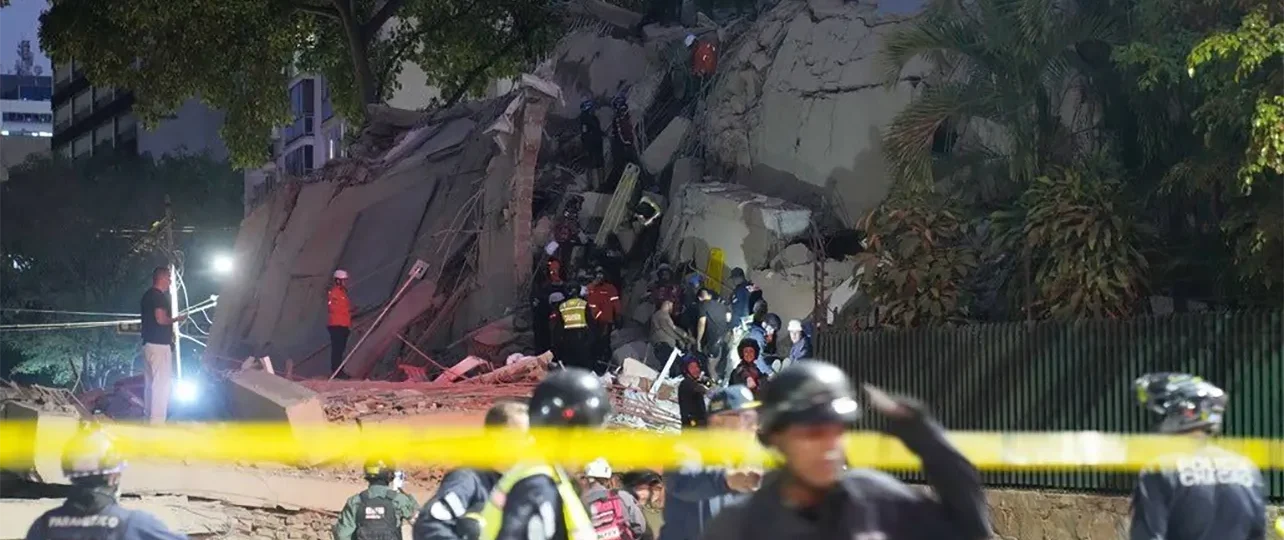

ON a public holiday meant to celebrate the 1821 Battle of Carabobo, the earth itself turned on Venezuela. Two ferocious earthquakes tore through the country’s central Caribbean coast on Wednesday evening, toppling buildings in the capital Caracas and sending residents fleeing into the streets in scenes witnesses likened to a horror film.
The United States Geological Survey said the first quake, measuring magnitude 7.2, struck roughly 160 kilometres west of Caracas near the town of Morón, at a depth of about 22 kilometres. Just 39 seconds later, an even more powerful magnitude 7.5 “mainshock” ruptured nearby. Together they rank among the strongest earthquakes to hit Venezuela in more than a century, with tremors felt as far away as Colombia and Brazil’s Amazon basin, some 1,700 kilometres from Caracas.
By Thursday morning, acting President Delcy Rodríguez said her government had confirmed at least 32 deaths and more than 700 injuries, warning the toll would almost certainly climb. Crucially, those figures excluded La Guaira state, home to the capital’s main airport, which Rodríguez described as a disaster zone bearing the brunt of the destruction. She declared a nationwide state of emergency, telling state television that rescue crews were working to “save as many lives as God allows us to save.”
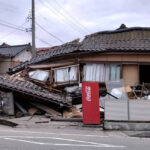
In Caracas itself, the Altamira and El Paraíso districts were among the hardest hit, with entire structures reduced to rubble. In the Baruta district, the local mayor reported three deaths after two buildings came down; in neighbouring Chacao, mayor Gustavo Duque said one person had died as four buildings collapsed completely. Interior Minister Diosdado Cabello urged residents, particularly the elderly and children, to stay outdoors as aftershocks — at least 20 of them by Thursday — continued to rattle the capital.
For ordinary Caraqueños, the night unfolded in terror. Maria Romero, an 80-year-old pensioner in southern Caracas who lived through the deadly 1967 quake, said this one felt “even worse than the one in 1967.” Police had to help her out of her shaking home. Elsewhere, a 41-year-old publicist described residents pouring down stairwells as screams rang through her building, while another resident recalled jugs crashing out of her refrigerator in a tremor unlike anything she had felt before.
The scale of the disaster has been compounded by what the quakes struck: a nation already hollowed out by years of economic collapse, where infrastructure is fragile, hospitals are stretched thin, and many buildings — especially in poorer districts — are unreinforced brick and masonry, particularly vulnerable to shallow, high-magnitude shaking. The USGS issued its highest “red alert” designation, warning that high casualties and extensive damage were probable and modelling a meaningful chance that fatalities could eventually run into the thousands. The agency stressed these were statistical projections meant to guide emergency response, not confirmed casualty counts.
The damage has paralysed the capital. Simón Bolívar International Airport at Maiquetía was shut after sustaining damage, Caracas’s metro and natural gas services were suspended, and classes were cancelled nationwide as hospitals doubled up night-shift staff to cope with the wounded.
Washington moved quickly to respond. The US State Department said it had mobilised a disaster assistance team, while officials confirmed all embassy staff in Caracas were safe.
The disaster has reopened old wounds in a country no stranger to seismic catastrophe. Venezuela sits astride the boundary between the Caribbean and South American tectonic plates, a fault network that produced an 1812 earthquake estimated to have killed 30,000 people in Caracas and Mérida, and another that killed roughly 240 people in Caracas in 1967. As rescue teams dug through the night searching for survivors, families across the capital faced an agonising wait — not knowing whether loved ones trapped beneath collapsed concrete would be found alive, or at all.