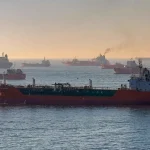
FOR thirteen consecutive nights, American warplanes pounded Iranian territory in a campaign designed to break Tehran’s grip on the Strait of Hormuz, the narrow channel through which roughly a fifth of the world’s seaborne oil passes each day. On Monday, that campaign fell silent – not because Iran capitulated, but because, according to a U.S. official and widespread American media reporting, military commanders told the president they were running out of targets to hit.
General Dan Caine, chairman of the U.S. Joint Chiefs of Staff, is reported to have raised a further, more sobering concern: the depletion of air-defence stocks protecting American bases across the Gulf. It was, in other words, not a negotiated pause but an operational ceiling – the campaign had exhausted its own logic before it exhausted Iran’s resolve.
The human and material toll of the campaign was severe. Scores of people were killed inside Iran as bridges, tunnels and military infrastructure across the country’s south were reduced to rubble. Washington did not escape unscathed: four U.S. service members were killed when Iran struck back at American bases in neighbouring Arab states, while Tehran also struck civilian infrastructure in Gulf states, which it characterised as retaliation for American strikes on civilian targets.
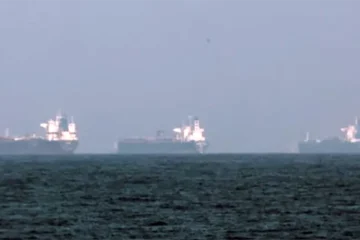
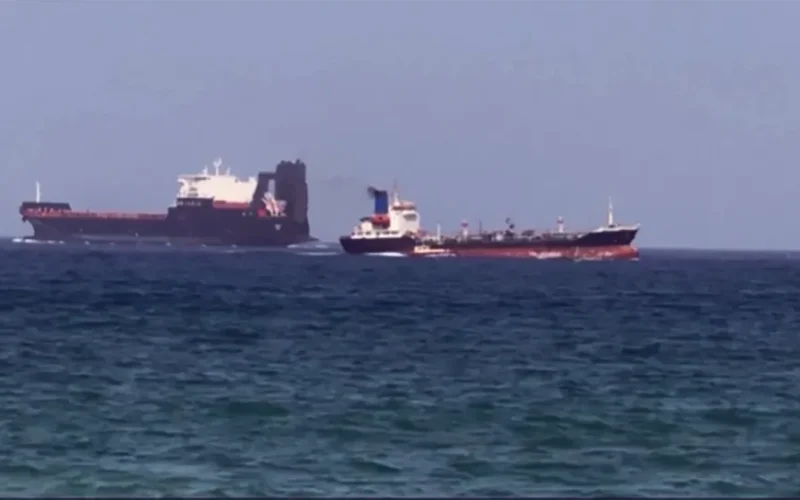
Yet for all that destruction, the strategic objective behind the bombing – prising open Iranian control of Hormuz – was not achieved. On the very day the pause took effect, Iranian state media reported that six vessels attempting to cross the strait without Tehran’s permission had been turned back, one of them after what was described only as “an accident”. Whatever the precise truth of that claim, the signal Tehran wished to send was unambiguous: the strait remains Iran’s to police.
“The traffic route in the Strait of Hormuz is the route specified by Iran, and other routes are contaminated and have no way out.”
Attributed to an informed source, Iranian state media
Iran’s Foreign Ministry spokesperson, Esmail Baghaei, used a televised briefing on Monday to underline that Tehran was not, contrary to suggestions from Washington, seeking a return to the negotiating table. That posture directly contradicted comments a day earlier from Mike Waltz, the U.S. ambassador to the United Nations, who said Trump had paused the bombing specifically to create room for talks. The gap between those two readings of the same pause is, in itself, the clearest evidence yet that this is a ceasefire of exhaustion, not of agreement.
At the heart of the standoff lies a dispute over the meaning of a framework agreement reached between Washington and Tehran in June, under which formal talks on Iran’s nuclear programme and related issues were meant to conclude by the end of August. The two sides cannot even agree on what that framework says about Hormuz: the United States insists it obliges Iran to permit unimpeded transit; Iran insists the same language grants it authority to supervise and regulate passage through the waterway.
Iran is now working to entrench that interpretation diplomatically rather than militarily, pursuing an arrangement with Oman, which controls the opposite shore of the strait, to formalise joint oversight of transit. A senior Omani delegation held talks in Tehran over the weekend on precisely this question, while the foreign ministers of Qatar, the UAE and Saudi Arabia each held calls with Oman’s foreign minister on the strait’s future – a flurry of Gulf diplomacy that suggests the region’s oil producers are quietly hedging against a protracted standoff rather than waiting for Washington to resolve it by force.
Global oil markets responded to the halt in bombing with evident relief. Brent crude, which had briefly breached the symbolically significant $100-a-barrel mark last week for the first time since May, fell by roughly 7.8 percent to trade just under $90 by Monday morning — a sharp correction that reflects hope, rather than certainty, that disrupted supply routes will normalise.
That optimism should be treated with caution. Iran’s Houthi allies in Yemen last week threatened to widen the disruption beyond Hormuz by announcing a blockade targeting Saudi Arabia’s oil industry via the Red Sea – a second chokepoint that, if activated, would compound rather than relieve the pressure on global energy logistics. For a market that has spent a fortnight pricing in the risk of a closed strait, the underlying vulnerability has not been resolved; it has merely been paused alongside the bombing.
WHY THIS MATTERS FOR AFRICA
For African economies, the stakes in this standoff are not abstract. The continent’s net oil importers — from Kenya and South Africa to much of West and Central Africa — remain acutely exposed to Brent price volatility, with every dollar swing in the benchmark rippling through fuel subsidies, transport costs and inflation targets already strained by currency pressures. The brief spike above $100 a barrel last week will have tightened import bills across the continent even before it showed up at the pump; the subsequent pullback offers only provisional relief.
Africa’s own oil producers face the mirror-image dilemma. Nigeria, Angola and Algeria stand to benefit from sustained higher prices in the near term, but a prolonged closure or contested status for Hormuz — one of the arteries through which Gulf crude reaches Asian and European markets — could also scramble global shipping routes and insurance costs in ways that complicate Africa’s own crude exports and refined product imports alike. A continent still rebuilding refining capacity and energy security after successive shocks can ill afford a third major disruption to global maritime trade in as many years.
There is a strategic dimension too. As Gulf states hedge through direct diplomacy with Oman and Iran rather than deferring to Washington, African governments and regional blocs will be watching closely for what this signals about the durability of U.S. security guarantees in strategic chokepoints – a question with direct relevance to the continent’s own maritime corridors, from the Bab-el-Mandeb to the Mozambique Channel, where great-power rivalry is already testing the limits of multilateral maritime governance.
The question hanging over the Gulf this week is not whether the guns have fallen silent – they have, for now – but where this uneasy pause actually leads. Trump’s decision to stand down was born of military necessity rather than diplomatic breakthrough, and Iran has used the lull to demonstrate, rather than concede, its operational control of Hormuz. Israeli Prime Minister Benjamin Netanyahu, who joined Trump in launching the war in February but has stayed outside the U.S.-Iran negotiating track, is due in Washington early this week – a meeting likely to test whether the pause holds or whether it was merely a tactical reload.
Absent a genuine settlement on the legal status of the strait, the current calm looks less like the end of the crisis than an intermission in it. For African economies and policymakers alike, the prudent course is to plan for renewed volatility, not to bank on a peace that neither side has yet agreed to seek.