
I. THE ALARM FROM BOTSWANA
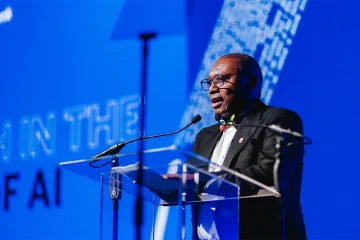
In a blunt warning that has sent tremors through southern Africa’s landlocked economies, Botswana’s President Duma Boko has cautioned that the country has fewer than nine days of fuel reserves remaining — and that without emergency resupply, transportation systems, food supply chains, emergency services, and cross-border commerce face imminent paralysis.
The immediate triggers are structural. Botswana, a landlocked nation of 2.6 million people, sources virtually all its petroleum products through South Africa, with smaller volumes arriving through Mozambique and Namibia. Its state-owned Botswana Oil Limited (BOL) holds the dominant import mandate, having taken over 90 percent of fuel procurement quotas from private oil marketing companies in 2024 — a policy shift that exposed deep gaps in government procurement networks and sourcing relationships.
“Fuel shortages can affect everything from public transport and food delivery to emergency services and cross-border trade.” — Economists on Botswana’s nine-day fuel window
Compounding the structural fragility, South Africa’s domestic refining capacity has sharply declined due to aging facilities and the cost of upgrading them to produce cleaner fuels. The NATREF refinery — the sole regional producer of the unleaded 93 petrol grade that Botswana’s low-income households and businesses depend on — was already under pressure before the 2026 Strait of Hormuz crisis erupted. Now, with global crude supply in severe disruption, Botswana’s position has become critical.
But Botswana is not alone. Across the 54 countries of the African Union — home to more than 1.4 billion people — the 2026 Strait of Hormuz crisis is exposing the continent’s profound oil dependency and its vulnerability to a choke point that lies nearly 6,000 kilometres from its shores.
II. THE CHOKEPOINT THAT CONTROLS THE WORLD
On 28 February 2026, the United States and Israel launched Operation Epic Fury — a coordinated campaign of airstrikes targeting Iran’s military installations, nuclear sites, and senior leadership, resulting in the killing of Supreme Leader Ali Khamenei. Iran’s response was swift, devastating, and strategically aimed at the global economy’s most exposed nerve: the Strait of Hormuz.
The Strait of Hormuz is a narrow waterway — just 55 kilometres across at its widest — separating the Islamic Republic of Iran from Oman, connecting the Persian Gulf to the Arabian Sea and, through it, to the world. At its tightest navigable point, tankers traverse a two-mile-wide inbound and outbound channel. Through this corridor, in 2025, an average of 20 million barrels of crude oil and petroleum products flowed every day — approximately one-fifth of total global petroleum consumption and more than one-quarter of all seaborne oil trade.
“Even a short-lived closure of parts of the strait in early 2025 led to a six percent jump in oil prices.” — The Conversation, March 2026
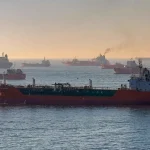
Within days of the strikes, tanker traffic had fallen by approximately 70 percent. Over 150 ships are anchored outside the strait to avoid Iranian drone and missile attacks. Major shipping companies — Maersk, CMA CGM, Hapag-Lloyd, and MSC — suspended transits entirely. By 1–2 March 2026, no vessels at all appeared in the strait. Brent crude, which had been trading at just over $73 per barrel on the eve of the conflict, surged to $83 per barrel within days. Analysts from Eurasia Group warned that a prolonged disruption could see crude cross $100 per barrel.
The producers trapped behind the closure are enormous. Saudi Arabia, which alone accounts for 37 percent of all Hormuz crude flows — approximately 5.5 million barrels per day — faced immediate export disruption. Iraq, which produces over 4 million barrels per day and relies on the strait for between 85 and 90 percent of its national output, saw production cut by an estimated 1.4 to 1.5 million barrels per day within days. The country’s southern port at Basra, through which almost all Iraqi crude exits, became a stranded inventory.
The bypass alternatives are painfully inadequate. Saudi Arabia operates the Abqaiq-Yanbu East-West Pipeline to Red Sea ports at Yanbu, while the UAE has the Abu Dhabi Crude Oil Pipeline to Fujairah. Together, these routes can redirect approximately 2.6 to 5.5 million barrels per day — less than a third of the Hormuz volume under normal conditions. Iran, Iraq, Kuwait, Qatar, and Bahrain have no meaningful pipeline alternatives whatsoever.
KEY STRAIT OF HORMUZ STATISTICS
| INDICATOR | FIGURE |
| Daily oil/product flow (2025) | ~20 million barrels per day |
| Share of global seaborne oil trade | >25% |
| Share of global oil consumption | ~20% |
| Share of global LNG trade | ~20% (primarily from Qatar) |
| Saudi Arabia’s share of Hormuz flows | 37% (~5.5 mb/d) |
| Tanker traffic decline post-crisis | ~70% within days; near-zero by 1-2 March |
| Brent crude price change | $73 → $83+ per barrel; analysts forecast $100+ |
| Pipeline bypass capacity (SA + UAE) | ~2.6–5.5 mb/d (fraction of normal flows) |
III. AFRICA’S OIL: THE PRODUCER’S PARADOX
Africa is not simply a passive victim of Middle Eastern geopolitics. The continent is, in its own right, a major oil-producing region — and yet its citizens pay some of the highest effective fuel costs in the world, and its governments remain structurally dependent on imported refined products.
Africa produces close to 10 million barrels of crude oil per day, representing approximately 10 percent of global production. Its proven reserves stand at approximately 125.3 billion barrels, with Libya alone holding 48.4 billion barrels — the largest reserves on the continent and the ninth-largest in the world. Nigeria follows with 36.9 billion barrels, Algeria with 12.2 billion, and Angola with 7.8 billion.
The Top African Producers
Nigeria remains Africa’s largest oil producer, averaging 1.5 million barrels per day in 2025, though chronic infrastructure challenges, oil theft, and pipeline vandalism have historically suppressed output well below its potential. Oil accounts for 90 percent of Nigeria’s export revenue and the overwhelming share of government receipts.
Angola has reclaimed its position as one of Africa’s oil giants, with consistent offshore and deepwater production averaging 1.1 million barrels per day. Oil contributes more than 60 percent of Angola’s GDP and 94 percent of its total exports — making it one of the most oil-dependent economies on Earth. Its principal buyer is China. Algeria, despite OPEC quota constraints, is averaging approximately 940,000 to 950,000 barrels per day in 2025, with hydrocarbons accounting for 95 percent of the country’s export revenue. Libya, despite persistent political instability, sustained average production above 1.3 million barrels per day in late 2025, with ambitions to reach 1.6 million barrels per day by 2026.
AFRICA’S TOP OIL PRODUCERS (2025)
| COUNTRY | PRODUCTION (BPD) | PRIMARY EXPORT MARKETS |
| Nigeria | ~1.5 million | Europe, India, US, Asia |
| Angola | ~1.1 million | China (dominant), Europe |
| Libya | ~1.3 million | Italy, Spain, France, Germany |
| Algeria | ~940,000–950,000 | Europe (Spain, Italy, France) |
| Egypt | ~600,000+ | Mediterranean, Asia |
| Congo (Brazzaville) | ~250,000 | China, Europe |
| Ghana | ~135,000 | US, Europe, Asia |
| Chad | ~125,000 | China |
The Cruel Paradox: Producing Oil, Importing Fuel
The central irony of Africa’s energy position is this: the continent exports crude oil in vast volumes — yet imports the refined products its people actually use at enormous cost and vulnerability. For decades, Nigeria was the world’s most glaring example, shipping raw crude overseas while buying back gasoline and diesel at premium international prices. This drained an estimated tens of billions of dollars from the Nigerian economy annually and left ordinary Nigerians paying some of the highest effective fuel prices on the continent.
This is beginning to change. The Dangote Refinery in Lagos — with a processing capacity of 650,000 barrels per day, the largest in Africa and among the largest in the world — opened in September 2024 and reached 610,000 barrels per day in its first year. At 60 percent capacity, it can supply all of Nigeria’s domestic fuel needs, with the remainder available for export. Plans exist to expand to 1.4 million barrels per day by 2028, which would make it the world’s largest refinery. But even here, a cruel irony persists: Nigeria’s national oil company, the NNPC, has committed much of its crude output to repaying financial lenders, forcing the Dangote Refinery to import crude from the United States to operate.
Algeria, Libya, and Egypt export primarily to Europe through pipelines and Mediterranean shipping, largely bypassing Hormuz exposure in terms of their own exports. But as crude importers — for domestic processing — and as nations whose economies are intertwined with globally priced oil, they are far from immune.
“Africa is a net exporter of crude oil — yet a net importer of petroleum products. The Hormuz crisis lays bare this structural paradox with brutal clarity.”
IV. HOW THE HORMUZ CRISIS HITS AFRICA’S 54 NATIONS
The Price Shock Transmission
Africa does not import significant volumes directly through the Strait of Hormuz. The Strait’s oil flows are overwhelmingly destined for Asian markets: in 2024, 84 percent of all crude and condensate transiting Hormuz went to China, India, Japan, and South Korea. The continent’s two largest crude importers from the Middle East — South Africa and Morocco — receive Saudi Arabian crude primarily through the Cape of Good Hope route, not directly through the strait.
But global oil is priced globally. When the Strait of Hormuz is disrupted, Brent crude rises everywhere, for everyone. And because Africa’s already limited refining capacity means most of its nations buy finished petroleum products — diesel, petrol, jet fuel, LPG — on spot markets priced off global benchmarks, a surge in Brent crude immediately translates into pump price increases across the continent.
South Africa, which imports approximately 46 percent of its crude from Nigeria and 33 percent from Saudi Arabia, faces a compound exposure. Saudi Arabia’s primary export terminal at Ras Tanura on the Persian Gulf — already damaged in a drone attack early in the conflict — routes crude through the strait or, partially, through the Yanbu pipeline to the Red Sea. Any disruption to Saudi volumes tightens the global market into which South Africa must buy.
The Rerouting Burden — And Africa’s Double Exposure
There is an additional dimension to this crisis that is profoundly ironic for Africa: ships that cannot pass through the Strait of Hormuz, or that are now avoiding the Red Sea and the Bab el-Mandeb Strait amid resumed Houthi attacks, are being rerouted around the Cape of Good Hope — Africa’s southern tip. This adds weeks to transit times and substantially increases shipping costs, which are passed through to consumers everywhere.
For Africa, this creates a unique double exposure. Longer transit routes increase global shipping costs for all oil imports, raising prices across the continent. At the same time, the rerouting surge adds traffic, strain, and port congestion to South African and East African maritime infrastructure — creating potential bottlenecks in the very supply chains through which landlocked nations like Botswana, Zimbabwe, Zambia, and Malawi receive their fuel.
“Ships unable to transit Hormuz or the Red Sea are rerouting around Africa’s Cape of Good Hope — adding weeks to delivery times and raising costs for the very nations least able to absorb them.”
Sub-Saharan Africa: No Buffer, No Strategic Reserves
The most acute vulnerability lies in sub-Saharan Africa’s non-producing, landlocked, and import-dependent nations. Countries like Botswana, Lesotho, Eswatini, Malawi, Rwanda, Burundi, and Landlocked portions of the Sahel import every drop of petroleum they consume. They hold minimal strategic reserves — Botswana’s nine-day supply window is typical rather than exceptional. They have no capacity to draw on domestic production to cushion price shocks. And their currencies are weak relative to the US dollar in which oil is priced, meaning any global price increase is magnified in local currency terms.
For countries where average monthly formal sector wages hover around the equivalent of $400–$550 per month, and informal sector earners make far less, fuel price increases of even 10–20 percent carry immediate consequences. They raise the cost of public transport — the primary means of getting to work. They raise the cost of transporting food to markets, directly driving up food prices. They raise the cost of running businesses, from bakeries to hospitals, from cold storage to construction.
In Botswana specifically, the state-owned Botswana Oil Limited has been attempting to build strategic reserve capacity — a 181-million-litre depot at Tshele Hills, expansion of the Francistown depot to 95 million litres, and a planned facility in Ghanzi linked to Namibia. None of these projects is complete. The country is exposed.
East Africa: Saudi Dependency and LNG Vulnerability
East African nations — Kenya, Tanzania, Ethiopia, Mozambique, Uganda — face a different but related exposure. Many source crude and petroleum products from the Arabian Gulf, with Saudi Arabia and the UAE being primary suppliers. The LNG exposure is also significant: Tanzania and Mozambique are themselves emerging LNG producers, but their offtake agreements are priced against global markets that are being severely disrupted by the Qatar LNG shutdown.
Qatar, one of the world’s two largest LNG exporters, halted production at Ras Laffan Industrial City and Mesaieed Industrial City after Iranian drone strikes. LNG tanker freight rates jumped more than 40 percent on the first Monday of the conflict. European natural gas futures leapt 30 percent. This has global implications for the price of any natural gas-linked energy supply, and for the development economics of East African LNG projects that were counting on stable global demand and pricing.
North Africa: The Export Earner Caught in a Price Vice
For North Africa’s oil exporters — Algeria, Libya, Egypt — the Hormuz crisis presents a paradox. Higher global oil prices, in theory, boost their export revenues. Algeria, which derives 95 percent of export revenue from hydrocarbons, and Libya, which relies on oil for more than 56 percent of GDP, stand to benefit in dollar terms from elevated crude prices.
But the reality is more complex. Both countries are also significant importers of refined petroleum products — Libya in particular, despite its enormous reserves, lacks domestic refining capacity commensurate with its production and must import diesel and gasoline for domestic consumption. Egypt’s refinery capacity is substantial but not fully self-sufficient, and the country subsidises fuel prices domestically, meaning a global price spike strains the treasury even as crude export revenues rise. Meanwhile, the broader economic slowdown triggered by a global energy crisis — suppressing demand from Europe, Africa’s main trading partner — will, in time, reduce commodity revenues.
West Africa: The Producer’s Dilemma
Nigeria finds itself in a pivotal but uncomfortable position. As Africa’s largest producer and an OPEC member, it is a net beneficiary of elevated crude prices in revenue terms. But Nigeria is also one of Africa’s largest importers of refined petroleum products — a structural failure that the Dangote Refinery is still in the process of addressing. Higher crude prices have historically fed through directly to Nigerian pump prices, devastating low-income households and fuelling the kind of fuel subsidy battles that have convulsed Nigerian politics for decades.
Ghana, with its Jubilee and TEN offshore fields producing around 135,000 barrels per day, is in a similar position — an earner that remains a net refined product importer. Angola, despite its enormous offshore production, is highly reliant on oil revenue that now flows disproportionately to Chinese lenders under oil-backed loans, leaving ordinary Angolans exposed to domestic fuel price inflation.
V. FOOD, TRANSPORT, AND THE HUMAN COST
Energy crises rarely stay confined to fuel pumps. In Africa, where cold chains are fragile, road transport is the dominant freight mode, and food security is perennially precarious across multiple subregions, the consequences of a sustained fuel price shock cascade rapidly and severely through daily life.
Diesel is the engine of African agriculture and food distribution. It powers the trucks that carry maize from Zimbabwe’s farmlands to Harare’s markets, the refrigeration that keeps fish viable in Accra’s ports, the generators that keep hospitals functioning in Kinshasa during load-shedding. When diesel prices rise 20 percent, food prices follow within weeks — not months. The UN Food and Agriculture Organisation has consistently identified energy costs as one of the primary drivers of food price volatility across sub-Saharan Africa.
“When diesel prices rise, food prices follow within weeks. For households spending 60–70 percent of income on food, a fuel price shock is a nutrition shock.”
For sub-Saharan African households that spend between 60 and 70 percent of their income on food — a figure that applies to hundreds of millions of people — a fuel-driven food price shock is, functionally, a nutrition shock. It deepens existing hunger, erodes real purchasing power, and forces households to trade off food against other necessities, including school fees and healthcare.
Public transport is the second major transmission channel. In Botswana, as across much of the continent, the vast majority of urban and peri-urban workers rely on minibuses and taxis powered by petrol or diesel. Operators will pass through fuel price increases within days. For workers earning Botswana’s average formal sector wage of approximately 7,400 pula per month — less than $600 at current exchange rates — even a 15 to 20 percent transport cost increase represents a material deterioration in real income.
Cross-border trade — a lifeline for landlocked economies — faces additional strain. The supply corridors that connect Botswana to South African supply networks, or Zimbabwe and Zambia to the port of Durban and Beira, depend on diesel-powered trucking. Higher fuel costs raise freight rates, slow goods movement, and reduce the volume of trade that smaller economies can sustain. For nations running persistent current account deficits and holding limited foreign exchange reserves, the compounding effect of higher import costs, weaker currencies, and reduced trade volumes constitutes a macroeconomic crisis-in-waiting.
VI. WHAT THE CRISIS DEMANDS OF AFRICA
The 2026 Strait of Hormuz crisis is not the first disruption to expose Africa’s structural energy vulnerability — but it may be the most instructive. The continent has known for decades that its dependence on imported refined products, inadequate strategic reserves, and underdeveloped downstream refining capacity constituted a systemic risk. The question is whether this crisis finally catalyses structural change.
Build Strategic Reserves
The most immediate imperative is the acceleration of national and regional strategic petroleum reserve infrastructure. Most African nations hold days, not weeks or months, of strategic fuel reserves. Botswana’s partially constructed depot network is typical of a continent that has consistently deferred investment in energy security infrastructure. The African Energy Commission and regional economic bodies, including SADC, ECOWAS, and the EA,C must treat strategic reserves as a regional public good, pooling investment to build shared buffer capacity.
Accelerate Downstream Refining
The Dangote Refinery represents a model — albeit an imperfect one — of what is needed across the continent. Africa cannot afford to continue exporting crude oil and importing refined products. Senegal is planning a second refinery at an estimated cost of $5 billion. Several East African nations are exploring refinery development to process Uganda’s new production. These projects must be accelerated, and regional oil supply agreements must be structured to ensure that African refineries can access African crude on commercially viable terms — rather than watching it shipped to Asia and Europe before being bought back as diesel.
Diversify Supply Sources
African nations importing from the Middle East must urgently diversify their crude and product supply sources. Nigeria and Angola — both politically committed to Pan-African solidarity and south-south cooperation — are well-positioned to supply neighbouring nations at preferential terms. Intra-African oil trade remains dramatically underdeveloped relative to the continent’s production capacity. The African Continental Free Trade Area must develop energy trade protocols that incentivise regional sourcing over global spot markets.
Accelerate Energy Transition — For the Right Reasons
The long-term answer to Africa’s exposure to global oil price shocks is not simply more of Africa’s own oil. It is a managed energy transition that reduces the continent’s dependence on liquid fossil fuels for transport and electricity, while ensuring that the transition does not impose energy poverty on populations already struggling. Solar energy, green hydrogen, and regional electricity grid integration offer pathways to reduced oil dependency — but only if financed at an appropriate scale and on terms that do not repeat the debt traps of oil-backed lending.
VII. CONCLUSION: A CONTINENT WATCHING THE STRAIT
From the fuel queues forming at petrol stations in Gaborone to the boardrooms of Abuja and the treasuries of Algiers, Africa is watching the Strait of Hormuz crisis with a mixture of alarm, resignation, and long-overdue clarity. The continent that holds some of the world’s largest proven oil reserves — and some of its most fuel-insecure populations — has been caught, once again, exposed.
Botswana’s nine-day fuel warning is a microcosm of a continent-wide failure of planning, infrastructure investment, and political will. The Hormuz crisis did not create Africa’s energy vulnerability. It simply illuminated it, with the kind of harsh, clarifying light that only a global emergency can provide.
Whether Africa uses this moment to build the strategic reserves, the downstream refining capacity, and the intra-continental energy trade frameworks that could insulate it against the next Hormuz — or the next Houthi blockade of the Red Sea, or the next pipeline sabotage in the Niger Delta — will define the continent’s economic trajectory for decades to come.
“The Strait of Hormuz crisis did not create Africa’s energy vulnerability. It simply illuminated it — with the harsh clarity only a global emergency can provide.”