TOO often across the developing world, we have seen roads built without industrial corridors, ports expanded without manufacturing zones, and energy infrastructure developed without alignment to industrial demand.
The result is infrastructure that is underutilised, economically inefficient, and unable to generate the growth required to sustain long-term returns.
Infrastructure delivers its greatest economic impact when it supports production, trade, manufacturing, mining, agriculture, and exports.
That is why President Cyril Ramaphosa is calling on all of us to shift from infrastructure-led development to development guided by industrial priorities.
The key question is not simply: what infrastructure can we build? The real question is: what productive economic system are we trying to support?
If we begin there, infrastructure becomes more targeted, more bankable, more growth-enhancing, and ultimately more investable.
The government’s infrastructure commitment is substantial. Over the next three years, public sector infrastructure expenditure will amount to approximately R1.07 trillion, much of it executed through state-owned companies and public entities to support strategic infrastructure networks.
Yet despite this commitment, the financing gap remains daunting. A joint study by the DBSA and the World Bank, Beyond the Gap, estimates South Africa’s infrastructure financing shortfall at approximately R13 trillion. Public resources alone will not be sufficient. Private capital must play a far larger role in financing South Africa’s next phase of infrastructure development.
Encouragingly, investor appetite exists. In 2025, the government issued its first sovereign infrastructure and development finance bond, raising R11.8 billion at favourable rates — a clear demonstration of market confidence in South Africa’s infrastructure programme and its long-term investment potential. Importantly, these funds are ring-fenced for strategic infrastructure projects.
One of the most important determinants of infrastructure investment is the macroeconomic environment, and here South Africa’s story has genuinely improved. We have achieved a primary budget surplus for three consecutive years, exited the FATF grey list, and, during the 2026/27 budget, revised GDP growth projections upward for the first time in many years.
These developments matter to investors because capital is priced on risk. Banks, pension funds, insurers, and asset managers allocate capital based on their assessment of stability, liability profiles, predictability, and returns. When risk declines, the cost of capital falls. Lower inflation, stronger public finances, and improved growth prospects reduce financing costs not only for the government but across the entire economy.
We are also closely monitoring global geopolitical developments — including the potential implications of the Iran conflict — and their possible effects on inflation, commodity markets, and capital flows.
But macroeconomic stability alone is not enough. We must also actively de-risk infrastructure investment.
Some infrastructure projects are exceptionally large and carry elevated construction, regulatory, or demand risks. Energy transmission is one such example. South Africa plans to build approximately 14,000 kilometres of transmission lines at an estimated cost of R450 billion — one of the largest infrastructure opportunities currently available in any emerging market.
To crowd in private capital, the government has designed a Credit Guarantee Vehicle to reduce risk exposure for investors in transmission projects. The initial target is to mobilise R10 billion from development finance partners, with National Treasury providing first-loss capital support of 20 percent, beginning with an initial US$100 million commitment. The vehicle is expected to become operational by July 2026, and may, over time, be extended beyond transmission infrastructure into logistics and water.
In parallel, structural reforms in rail and ports are underway to expand private sector participation, improve operational efficiency, and strengthen access to network infrastructure — creating investable opportunities in freight and port infrastructure.
Another critical reform addresses metropolitan trading services. Many municipalities collect substantial service revenues yet chronically underinvest in maintaining and expanding infrastructure networks. South Africa faces an estimated R36 billion annual municipal infrastructure maintenance gap. The Metro Trading Services Reform seeks to address this by ring-fencing revenues from water, electricity, and waste services, ensuring those revenues are reinvested directly into infrastructure and operations. The government has already mobilised R54 billion in performance-linked incentives to support these reforms, which are expected to unlock more than R100 billion in investment opportunities across metropolitan municipalities.
Infrastructure investment also requires the right type of capital. Because returns are generated over extended periods, these projects require long-term, patient capital — making pension funds and institutional investors natural partners. However, institutional investors must also manage liquidity obligations and liability-matching requirements. The challenge is mobilising long-term savings into long-duration assets while preserving liquidity and prudential discipline.
One solution lies in pooled investment vehicles capable of aggregating long-term institutional capital for infrastructure. Many in this room are well-positioned to help shape such mechanisms. We are also examining whether existing prudential regulations unintentionally constrain infrastructure investment.
Following the 2008 global financial crisis, Basel III reforms significantly strengthened banking resilience — but stricter capital and liquidity requirements also increased the cost of long-term infrastructure finance, particularly in emerging markets. The National Treasury and the Prudential Authority are therefore reviewing whether current regulatory frameworks appropriately reflect the actual risk profile of infrastructure assets. The objective is to maintain financial stability while ensuring that regulation does not unnecessarily inhibit productive long-term investment. This review is expected to conclude by late 2026.
Although fiscal constraints are real, the primary obstacle to infrastructure delivery in South Africa has not been a shortage of capital. South Africa has deep, sophisticated, and globally connected capital markets.
The larger challenge, historically, has been project preparation. Too many infrastructure projects entered the pipeline without credible feasibility studies, robust cost-benefit analysis, or realistic implementation frameworks. Poorly prepared projects do not attract sustainable capital — they create delays, cost overruns, and execution failures. That is why we are placing increasing emphasis on strengthening project preparation capability across government and public institutions. Bankable projects are the foundation of scalable infrastructure investment.
Infrastructure is fundamentally about building the productive capacity of an economy — lowering the cost of doing business, improving competitiveness, supporting industrialisation, creating jobs, and expanding economic opportunity.
South Africa does not lack capital. The capital exists — in the world, and in this room.
What matters is whether we can collectively create the right policy environment, regulatory certainty, institutional capability, and risk-sharing mechanisms to channel that capital into productive infrastructure investment at scale.
The challenge before us is not whether infrastructure can be financed. The challenge is whether we can organise ourselves to finance it effectively, sustainably, and at the scale our country demands.
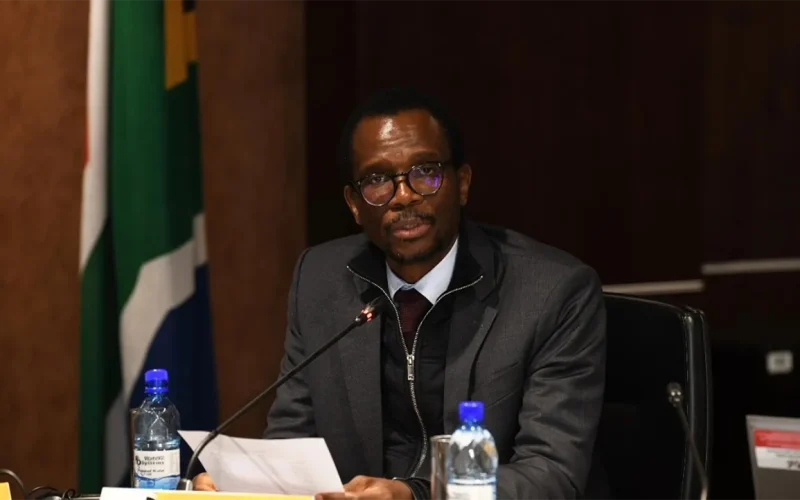
- This is an edited version of an address by David Masondo, Deputy Minister of Finance, to the BlackRock Infrastructure Summit held in Cape Town.