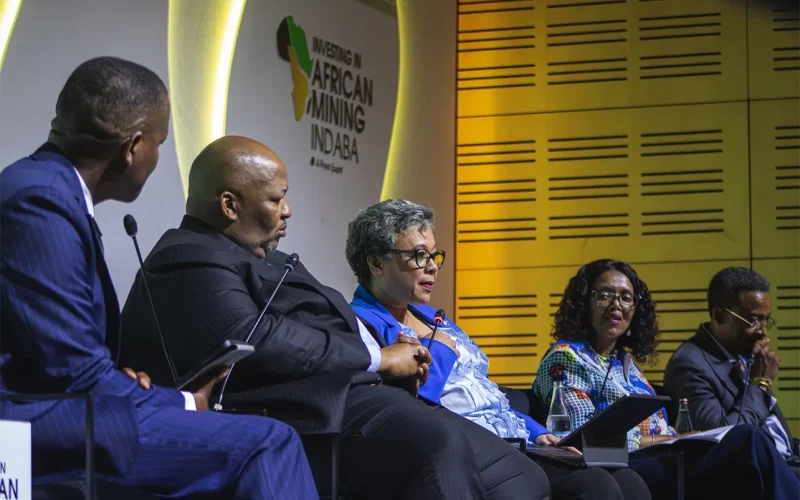
In a striking reversal of fortune, Transnet is experiencing a transformation that’s breathing new life into South Africa’s mining sector and broader economy. Group Chief Executive Michelle Phillips, speaking at the Mining Indaba, painted a picture of an organisation that has fundamentally reimagined its relationship with customers, employees, and the private sector.
“We’ve had to really go back to customers, rebuild the relationships,” Phillips explained, reflecting on the stark contrast between Transnet’s current standing and its position just a few years ago. The shift has been palpable. “The reception is a lot more positive. I have people saying to me, you know, since we’ve come to Cape Town, talking to us about a key account manager in a particular terminal who treats them in a certain way and how happy they are.”
From Crisis to Collaboration
The turnaround wasn’t accidental. Phillips describes a deliberate strategy focused on two critical pillars: re-engaging Transnet’s 50,000-strong workforce and rebuilding trust with customers. “People are very proud to be part of Transnet, but we needed that to come back because they were being bashed in the newspapers and we needed them to feel that they mean something again,” she noted.
This cultural transformation has translated into measurable results. When the current leadership took over, Transnet was moving 149 million tons annually. “We’ve surpassed the 150s. We are now into the 160s,” Phillips revealed, before adding with determination: “And the message again is don’t look back.”
Embracing Partnership Over Monopoly
Perhaps the most significant shift has been Transnet’s embrace of private sector collaboration. “We come from a history where we are used to, or we certainly got used to, we got very comfortable in being a public monopoly,” Phillips acknowledged candidly. “Transnet is now – not only have we embraced the reforms that the country is undergoing, but we’ve also embraced and worked on these relationships.”
The practical benefits are already visible. On the coal and ore corridors, Transnet now works hand-in-hand with mining customers to solve infrastructure challenges. “We share with them everything that is a problem on that line,” Phillips explained, describing how customers provide resources and equipment to accelerate rail repairs, reducing downtime and improving reliability.
Recent milestones include the Pier 2 transaction, operational as a private terminal from January 1st, and the conditional award of licenses to 11 private train operators. “We will see these private operators also making use of the network, and we’re hoping that as a country we can get to the 250 million tons by 2030,” Phillips said of the ambitious national target.
A Customer-Centric Revolution
The emphasis on relationships extends beyond contracts and commerce. “This business is about relationships. We can solve and resolve any problem if you have a relationship with your customers and your stakeholders,” Phillips emphasised. “You can’t collaborate if you have a bad relationship or a toxic relationship with a person.”
This openness represents a fundamental departure from the past. “We are not too scared to go and ask for help,” Phillips stated. “The focus for us is let’s focus on what we are good at, and we do that as best as we can, and everything else – invite the private sector and let the private sector partner with us and bring their skills and bring their capital because at the end of the day the country grows.”
The Human Element
Throughout the interview, Phillips’s passion for the work was unmistakable. When asked if she was enjoying the role, she responded: “I absolutely love what I do. They say that if you love what you do, you’ll never work a day in your life. It keeps me awake at night. But would I exchange this? Not right now. No.”
This energy appears to have permeated the organisation. Transnet employees are rediscovering pride in their work, tracking productivity improvements and celebrating incremental gains. “The Transnetters will sit at the back, and they’ll write at the back of a matchbox how many moves they’ve done in the hour. And we need to get that back,” Phillips said with evident pride.
Looking Ahead
The road ahead remains challenging, with significant infrastructure investments still needed and the ambitious 250 million ton target looming. But the foundation has been laid: transparent communication, genuine collaboration, and a workforce reconnected to its purpose.
“The important thing is the customers want to be part of the solution,” Phillips concluded. As South Africa’s mining sector continues its critical role in the national economy, Transnet’s transformation from obstacle to enabler represents one of the most encouraging industrial turnarounds in recent memory.
For an economy hungry for good news, Transnet’s progress under Phillips’s leadership offers genuine cause for optimism – proof that with the right focus, collaboration, and leadership, even the most challenging institutional transformations are possible.