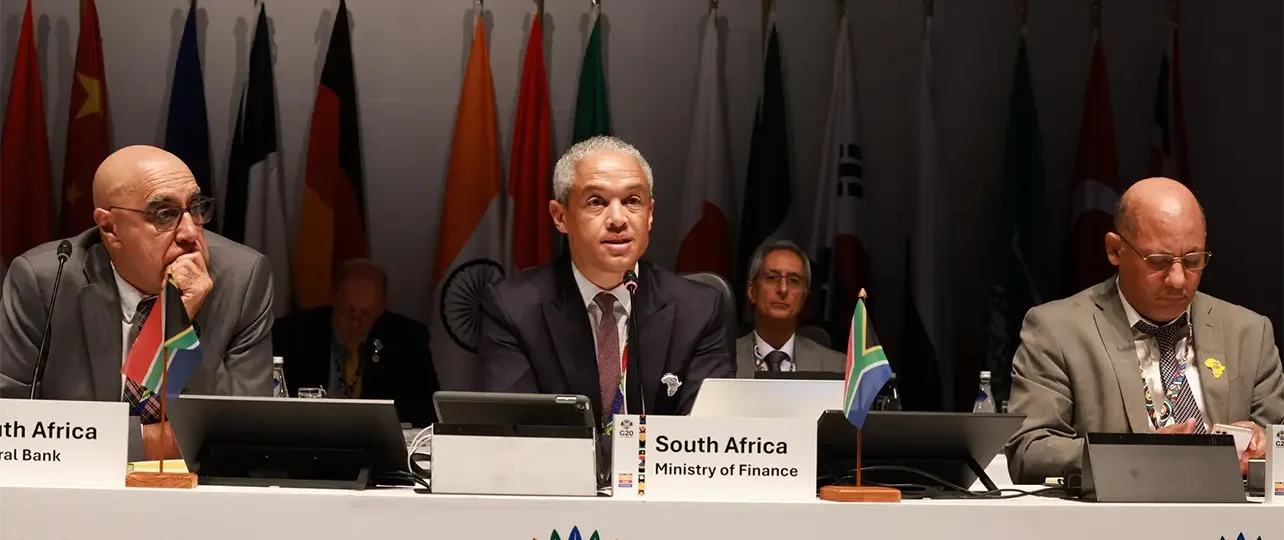

SOUTH Africa has proposed a five-year G20 Africa Engagement Framework aimed at addressing critical impediments to the continent’s economic development, the country’s Director-General, Dr Duncan Pieterse, has announced at the African Union’s finance committee meeting.
Speaking at the 8th Ordinary Session of the AU’s Specialised Technical Committee on Finance in his capacity as representative of South Africa’s G20 Presidency, Pieterse outlined four key barriers constraining African growth: weak economic institutions, infrastructure gaps, macroeconomic vulnerabilities, and high capital costs.
“These impediments to growth are deeply interconnected and require multiple, coordinated, and cross-cutting interventions,” Pieterse told delegates, adding that South Africa has commissioned analytical notes from four international organisations to develop actionable recommendations.
The proposed framework, set to run from 2026 to 2030, represents a shift toward sustained engagement on African development issues within the G20’s Finance Track. South Africa is currently consulting African policymakers, regional development institutions, G20 members, and multilateral development banks to build support for the initiative.
Infrastructure and Financing Initiatives
A major outcome of South Africa’s G20 presidency has been the launch of the Ubuntu Initiative on 22 September, developed in partnership with the African Development Bank. The initiative will accelerate regional infrastructure projects under the AU Programme for Infrastructure Development by developing innovative financing instruments and building advisory capacity.
“Transformational regional projects are important to unlock trade and investment in the African region,” Pieterse said, noting that cross-border infrastructure is vital for enhancing regional connectivity and economic integration.
South Africa’s presidency has also advanced work on blended finance mechanisms to mobilise private sector funding, particularly as traditional aid flows decline. Recommendations include improved coordination among development partners, better data sharing to reduce perceived investment risks, and scaling up derisking tools such as guarantees.
Debt and Climate Finance Progress
On debt sustainability, the G20 has produced guidance on improving the Common Framework and supporting vulnerable countries facing liquidity challenges. A mapping exercise on climate-resilient debt clauses drew input from 32 African countries, revealing increasing interest from both creditors and borrowers in including such provisions in loan agreements.
In climate finance, South Africa has initiated discussions on unlocking carbon markets as a financing mechanism for developing countries’ low-carbon transitions. The presidency is developing a set of guiding principles and a Common Carbon Credit Data Model to enhance market integrity and attract cross-border climate finance.
Tax and Financial Inclusion
The presidency has prioritised domestic resource mobilisation, convening a ministerial engagement in February on strengthening revenue administrations in developing countries. Work is also progressing on addressing base erosion and profit shifting, issues that have significantly impacted African fiscal positions.
On financial inclusion, South Africa has focused on moving beyond mere access to actual usage of financial services, particularly among vulnerable groups where uptake remains limited despite improved access in recent years.
Finance Minister Enoch Godongwana will present South Africa’s G20 Africa priorities to his counterparts later this week. The G20 Africa Experts Panel, chaired by former Finance Minister Trevor Manuel, will also present its work on advancing African perspectives within the G20’s global economic policy agenda.
The initiatives come as South Africa’s G20 Presidency, operating under the theme “Solidarity, Equality, Sustainability,” emphasises challenges facing emerging markets and developing countries, with particular attention to the African continent.