Our website use cookies to improve and personalize your experience and to display advertisements (if any). Our website may also include cookies from third parties like Google Adsense, Google Analytics, and Youtube. By using the website, you consent to the use of cookies.

Elephants use the tips of their trunks to grasp things with great precision – how this can help robotic design

Elephants use the tips of their trunks to grasp things with great precision – how this can help robotic design

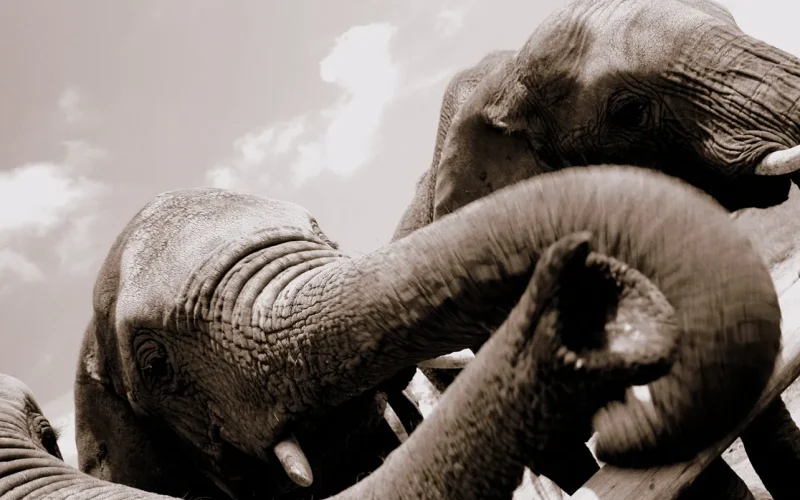
AN elephant uses its trunk for eating, drinking water, communicating, exploring the environment, social behaviour, and making and using tools. The trunk, which contains six muscle groups, is not only very strong – it can uproot a tree – but can be used with great precision. Elephants use a number of techniques to grasp objects, including suction, pinching with the two “fingers” at the tip of the trunk and wrapping the trunk around the object. Researcher Pauline Costes was part of a group of scientists who tested six female African savannah elephants in a zoo to see how much force…
Read More
How old are South African fossils like the Taung Child? New study offers an answer

How old are South African fossils like the Taung Child? New study offers an answer

ONE hundred years ago the discovery of a skull in South Africa’s North West province altered our understanding of human evolution. The juvenile skull was dubbed the Taung Child by Raymond Dart, an anatomist at the University of the Witwatersrand, who first described it. In 1924 Dart could not say exactly how old it was, but he announced that it belonged to a new species which he named Australopithecus africanus. It was the first evidence that confirmed British naturalist Charles Darwin’s assertion that apes and humans shared a long-ago common ancestor and that humanity originated from Africa. Following on from…
Read More
World’s oldest termite mounds discovered in South Africa – and they’ve been storing precious carbon for thousands of years

World’s oldest termite mounds discovered in South Africa – and they’ve been storing precious carbon for thousands of years

THE landscape along the Buffels River in South Africa’s Namaqualand region is dotted with thousands of sandy mounds that occupy about 20% of the surface area. These heuweltjies, as the locals call them (the word means “little hills” in Afrikaans), are termite mounds, inhabited by an underground network of tunnels and nests of the southern harvester termite, Microhodotermes viator. I’m part of a group of earth scientists who, in 2021, set out to study why the groundwater in the area, around 530km from Cape Town, is saline. The groundwater salinity seemed to be specifically related to the location of these…
Read More
Zimbabwe’s new dinosaur discovery: inside the find

Zimbabwe’s new dinosaur discovery: inside the find

VISITORS to Lake Kariba – the world’s largest man-made lake, along the border between Zambia and Zimbabwe – come to enjoy the abundant wildlife, fine fishing or spectacular scenery. However, in 2017, our crew of palaeontologists came to Zimbabwe to hunt game of a different kind: dinosaurs. Many of our discoveries are still under study, but the team has just announced its first new dinosaur, dubbed Musankwa sanyatiensis. At first sight, it’s unremarkable – just a few bones from a single hind leg. It was found with the thigh, shin and ankle bones still connected, but weathering out on the…
Read More
Becoming human in southern Africa: what ancient hunter-gatherer genomes reveal

Becoming human in southern Africa: what ancient hunter-gatherer genomes reveal

NEW genetic research is shedding light on some of the earliest chapters of our human history. In one of the largest studies of its kind, scientists analysed DNA from 28 individuals who lived in southern Africa between 10,200 and a few hundred years ago. The study provides more evidence that hunter-gatherers from southern Africa were some of the earliest modern human groups, with a genetic ancestry tracing back to about 300,000 years ago. Marlize Lombard, an archaeologist whose research focuses on the development of the human mind, breaks down the key findings. Why did you study the DNA of ancient…
Read More
Clothed pig carcasses are revealing the secrets of mummification – South African study provides insights for forensic scientists

Clothed pig carcasses are revealing the secrets of mummification – South African study provides insights for forensic scientists

IT was the kind of task any competent seamstress had completed hundreds of times before: altering denim jeans and jerseys. But there was something different about this piece of work. Though our team of scientists were paying for it, we weren’t her ultimate customers – the clothes were to be worn by dead pigs. The pigs and their specially tailored outfits were central to research conducted by ourselves, Devin Finaughty and our colleagues from South Africa’s University of Cape Town (UCT), a group of forensic scientists known as taphonomists. We study the environmental forces that drive changes to a body…
Read More
MeerKAT: the South African radio telescope that’s transformed our understanding of the cosmos

MeerKAT: the South African radio telescope that’s transformed our understanding of the cosmos

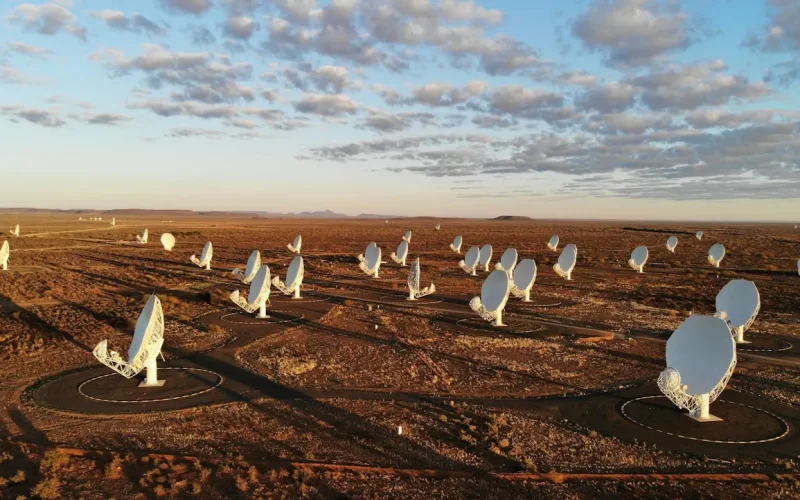
SOUTH Africa’s Karoo region is a vast semi-arid area that stretches across four of the country’s provinces. It is sparsely populated and renowned for its wide open spaces. In the heart of this landscape, near the small Northern Cape town of Carnarvon, the South African Radio Astronomy Observatory operates a technological marvel that has transformed our understanding of the cosmos. The MeerKAT radio telescope has unlocked cosmic mysteries. It’s fostered scientific collaboration. It is also nurturing local talent. MeerKAT, which is among South Africa’s largest scientific infrastructure projects of the 30 year period since democracy, has emerged as a beacon…
Read More
Eclipses aren’t just visual spectacles, they are at the heart of scientific efforts to understand distant planets

Eclipses aren’t just visual spectacles, they are at the heart of scientific efforts to understand distant planets

THE total solar eclipse across North America on April 8 2024 is a stunning and memorable event for everyone in its path. However, eclipses are not just valued for their visual impact, they are at the heart of cutting-edge science. Eclipses can tell us a vast amount about distant planets beyond our Solar System – or exoplanets. Since the first exoplanet was detected in 1992, astronomers have discovered more than 5,600 worlds orbiting stars other than the Sun. They have used a variety of powerful telescopes to observe them. However, as with the total solar eclipse, there is still a…
Read More
Botswana’s 90 million-year-old ancient beetle discovery explains earth’s evolution

Botswana’s 90 million-year-old ancient beetle discovery explains earth’s evolution

A team of scientists from GENUS, a department of paleosciences at the University of Witwatersrand has discovered an ancient beetle species at the site that not only reaffirms Africa’s rich biodiversity but also contributes to understanding the mysteries of prehistoric life on Earth. The latest discovery is in part thanks to the 1980 discovery of fossil material at the Orapa Diamond Mine in the Central District of Botswana, which sparked years-long research interest among scientists. This site is now emerging as a hotbed for groundbreaking research uncovering unique details about early life on Earth. “This beetle is a clue into…
Read More
Duckbill dinosaur discovery in Morocco – expert unpacks the mystery of how they got there

Duckbill dinosaur discovery in Morocco – expert unpacks the mystery of how they got there

WHY are fossils of duckbill dinosaurs, a North American family, found in North Africa? Dinosaurs couldn’t just walk there. Sixty-six million years ago, when duckbills suddenly appear in Africa’s fossil record, the world’s land masses formed a series of islands. A seaway divided eastern and western North America; Europe was an archipelago. South America, India, Australia and Madagascar were all island continents, surrounded by ocean. Africa was an island too – it was impossible to walk there from North America. And yet, somehow, we’ve now found fossils of duckbill dinosaurs in Morocco. The world at the end of the Cretaceous,…
Read More