Our website use cookies to improve and personalize your experience and to display advertisements (if any). Our website may also include cookies from third parties like Google Adsense, Google Analytics, and Youtube. By using the website, you consent to the use of cookies.

Has the Strait of Hormuz emerged as Iran’s most powerful form of deterrence?

Has the Strait of Hormuz emerged as Iran’s most powerful form of deterrence?

ONE of the US and Israel’s justifications for launching the war on Iran was to ensure the regime in Tehran could never possess nuclear weapons, the ultimate deterrent against external attack. But the main lesson that has been taken from the war, according to some commentators, is that Iran’s own geography already provides it with all the deterrent it needs. The US-Israeli strikes have inflicted massive damage on Iran’s leadership and have destroyed billions of US dollars' worth of military and civilian infrastructure. However, this display of force has proved unable to stop Iran from controlling who enters the Strait…
Read More
Sexual misconduct by lawmakers is widespread — but often goes unreported

Sexual misconduct by lawmakers is widespread — but often goes unreported

THE recent resignations of two members of Congress have reignited a conversation about sexual harassment in politics nearly nine years after the peak of the #MeToo movement. And new data sheds more light on the scope of the problem — and the major barriers to reporting and addressing abuse.    The National Women’s Defense League (NWDL), a nonpartisan, nonprofit organization focused on combating sexual misconduct in politics at the state level,  released its annual updated report detailing ongoing research into sexual misconduct in statehouses and — for the first time — data on sexual misconduct in Congress, shared first with The…
Read More
The end of oil? As fuel shocks cascade, 53 nations gather to plan a fossil fuel phaseout

The end of oil? As fuel shocks cascade, 53 nations gather to plan a fossil fuel phaseout

US President Donald Trump is a longtime climate denier and oil industry ally, who sums up his own energy policy as “drill, baby, drill”. Yet he is doing more than almost anyone to speed up the global shift from fossil fuels to clean energy and electric vehicles (EVs). After the US and Israel struck Iran in late February, Tehran closed the Strait of Hormuz and triggered the largest disruption of oil supply in history. Ironically, for Trump and his oil industry donors, this crisis may be an irreversible tipping point for clean energy. For years, fossil fuel advocates spruiked oil,…
Read More
Middle East conflict looks increasingly like a war nobody can win

Middle East conflict looks increasingly like a war nobody can win

LET'S begin with a simple question that rarely gets a straight answer: what would victory over Iran actually look like? In Washington and Jerusalem, the answers tend to sound definitive: eliminate Iran’s nuclear capability, break its regional power, perhaps even force political change at the top. It’s the language of decisive war, the kind with a clear endpoint. But shift the perspective to Tehran, and the definition changes completely. Victory, for Iran, is survival. That asymmetry shapes the entire conflict. In wars like this, the side that needs less to claim success often has the advantage – and, right now,…
Read More
Why the US military is stuck using $1 million missiles against Iran’s $20,000 drones

Why the US military is stuck using $1 million missiles against Iran’s $20,000 drones

IT may sound hard to believe, but the almost trillion-dollar U.S. military is struggling to fight cheap drones in its war with Iran. Iran has built a simple drone, the Shahed, with a motorcycle-type engine, loaded it with explosives and successfully targeted its neighbors’ cities and power plants. Iran has also hit U.S. military bases with these drones, including an early April 2026 attack on the U.S. Victory Base Complex in Baghdad. The drones cost between US$20,000 and $50,000 to build. In response, the U.S. military sometimes fires missiles worth more than $1 million to shoot one down. As a…
Read More
In abusive relationships, the end can be the most dangerous part

In abusive relationships, the end can be the most dangerous part

TWO deadly high-profile domestic violence cases this month highlight how the most dangerous part of a relationship can be when it is ending — particularly for women and families, and especially if guns are involved.  In Virginia, authorities say former Lt. Gov. Justin Fairfax fatally shot his wife, Dr. Cerina Fairfax, in mid-April before killing himself. The two had been in the midst of a divorce. And on Sunday, a gunman in Shreveport, Louisiana, killed eight children and injured two women in what authorities described as the deadliest mass shooting in the United States in more than two years. Authorities…
Read More
Four presidents, one warning: American democracy faces its starkest test on the eve of the republic’s 250th year

Four presidents, one warning: American democracy faces its starkest test on the eve of the republic’s 250th year

THEY came not as rivals or partisans, but as men who have held the weight of the world's most powerful office - and what they said, jointly, in a rare gathering on the eve of America's 250th anniversary, amounted to something closer to a civic alarm than a celebration. Former presidents Joe Biden, Barack Obama, George W. Bush, and Bill Clinton appeared at a private History Channel event in Philadelphia — "History Talks" — on the weekend of 19-20 April 2026, each speaking individually to NBC's Jenna Bush Hager in what was subsequently broadcast as a TODAY exclusive. Together, the…
Read More
Who is calling the shots in Iran?

Who is calling the shots in Iran?

FOLLOWING the last round of talks between the United States and Iran in Islamabad, Iran’s foreign minister and negotiator Abbas Araghchi declared in a post on X on April 17 that the Strait of Hormuz was “completely open”. This came after he also signalled that his government could be flexible over the issue of nuclear enrichment as well as Iran’s support for its proxies in the region. Then came an abrupt correction. Mohammad Bagher Zolghadr, a former commander in the Islamic Revolutionary Guards Corps (IRGC) who was recently appointed as secretary of the Supreme National Security Council, is understood to…
Read More
Healthocide? Why the attack on the Pasteur Institute of Iran is more than a war crime

Healthocide? Why the attack on the Pasteur Institute of Iran is more than a war crime

ON 2 April, the United States and Israel bombed the 106-year-old Pasteur Institute, targeting one of Iran’s oldest and most critical public health institutions. Established in 1920, the institute has long been central to vaccine production, infectious disease surveillance, and epidemiological research in the Middle East and beyond. But this wasn’t simply a strike on a building. It was much larger than any single incident. It was a brazen attack on the infrastructure that sustains Iran’s public health. And it reflects a broader pattern in modern warfare, where the target is no longer just people, but the systems that keep…
Read More
Israel’s onslaught against Lebanon may strengthen Hezbollah – just when it’s at its weakest

Israel’s onslaught against Lebanon may strengthen Hezbollah – just when it’s at its weakest

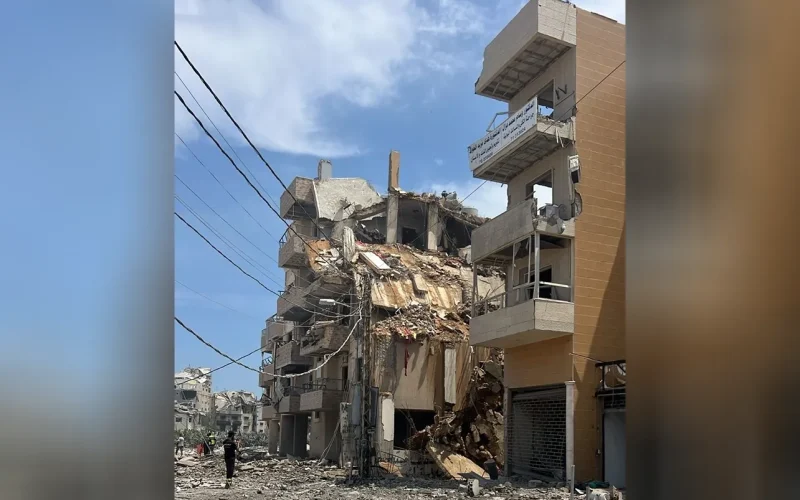
AS the tentative ceasefire in Lebanon holds, people are returning to their homes in the south to find widespread destruction. Whole villages were laid waste, roads and bridges were ruined, and hospitals and other civic infrastructure were flattened. And the Israeli army is still very much in evidence in many areas. The most recent conflict between Israel and Lebanon has killed more than 2,100 people and displaced more than a million people. Israel’s stated aim is to destroy Hezbollah, which it describes as an Iranian proxy. But this is a misleading framing of the situation. And trying to destroy Hezbollah…
Read More