THE Chairman of Kenya’s Pharmacy and Poisons Board has issued a powerful call for continental regulatory harmonisation, describing it as essential to unlocking Africa’s potential in health product manufacturing and cross-border trade.
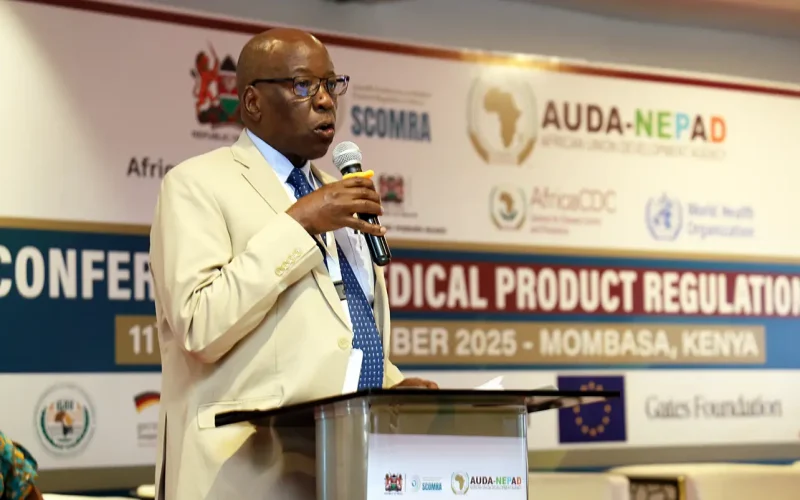
Dr John Munyu, speaking at the opening of the 7th Biennial Scientific Conference on Medical Products Regulation in Africa on Tuesday, told delegates that the gathering represents more than academic discussion – it’s a “continental call to action.”
“We are gathered here under a theme that is not just a topic for discussion, but a continental call to action: ‘Regulatory Harmonization: Unlocking Africa’s Potential in Health Product Manufacturing and Trade,'” Dr. Munyu declared in his opening remarks to an audience that included Dr Mimi Darko, Director General of the African Medicines Agency, heads of national regulatory authorities, and development partners.
The three-day conference in Mombasa comes at a critical juncture for Africa’s pharmaceutical sector, which remains heavily dependent on imported medicines. Dr Munyu’s emphasis on regulatory alignment as the key to boosting local manufacturing signals a strategic shift toward addressing the structural barriers that have hampered the continent’s pharmaceutical independence.
Speaking on behalf of the Conference Organising Committee, the African Union Development Agency (AUDA-NEPAD), Dr Munyu extended what he called his “profound honour and privilege” to welcome delegates as both Chairman of the Pharmacy and Poisons Board and Director.
“I extend my heartfelt gratitude to our host, Governor for Mombasa County, H.E. Abdul-swamad Sharriff, for hosting this conference here in the beautiful coastal city of Mombasa, Kenya,” he said, noting the governor’s absence from the opening ceremony.
The conference brings together regulatory authorities from across the continent to tackle the fragmentation that experts say has made it economically unviable for pharmaceutical manufacturers to scale production for African markets. With 54 separate national regulatory systems, companies currently face enormous costs and delays in seeking approvals across multiple jurisdictions.
Dr Darko’s presence as the guest of honour underscores the continental significance of the regulatory harmonisation agenda. The African Medicines Agency, which she heads, was established to create more unified regulatory standards and facilitate mutual recognition of drug approvals across member states.
The Mombasa conference is expected to produce concrete recommendations on technical standards, capacity building for regulatory authorities, and frameworks for mutual recognition agreements that would allow medicines approved in one African country to gain faster authorisation in others.
Kenya’s Ministry of Health, working in partnership with AUDA-NEPAD, organised the biennial gathering, which has become a key forum for advancing pharmaceutical policy across the continent.
Dr. Munyu’s framing of regulatory harmonisation as a “call to action” rather than merely a discussion topic reflects growing impatience with the pace of reform, particularly after the COVID-19 pandemic exposed Africa’s vulnerability due to its dependence on pharmaceutical imports.
The conference continues through November 14, with technical sessions focused on translating regulatory alignment principles into operational frameworks that can be implemented by national authorities.
Industry observers say the success of harmonisation efforts will ultimately depend on whether African governments are willing to cede some regulatory sovereignty in exchange for the economic and health security benefits of a more integrated pharmaceutical market.