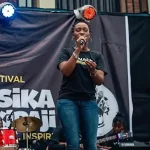
ON the last Friday of every month, they would gather in public spaces to share their latest verses.
At festivals and in stadiums, they would perform to packed audiences who would listen to every line.
In classrooms, they stood before rows of students, guiding them through their craft.
For the past decade, slam poetry – a form of performance poetry with bite – has thrived in the main cities of eastern Democratic Republic of the Congo, becoming one of the war-torn region’s most vital forms of cultural expression and political dissent.
But the scene is now confronting unprecedented challenges.
Since the start of the year, a rebel group known as the March 23 Movement, or M23, has intensified a brutal insurgency, seizing the two biggest cities where slam poets were active – Goma and Bukavu – and plunging the region into one of its most severe crises in years.
As it tightens its grip, the M23 – backed extensively by troops from neighbouring Rwanda – has crushed public dissent, forcing the region’s vibrant slam poetry movement underground.
“Speaking freely has become an act of courage, sometimes even a risk,” said Shukuru (his real name is not being disclosed), a 28-year-old slammer from Bukavu, where there have been constant reports of killings and executions.
Shukuru said he wakes up each morning with fear in his stomach, worried that his hairstyle might get him mistaken for an anti-M23 fighter. “That can be enough to provoke an arrest, a kidnapping, or worse,” he said.
Shukuru was one of nearly a dozen slammers who spoke to The New Humanitarian for this report, explaining how the M23 rebellion is not only displacing millions of people but also threatening a cultural movement that has become a lifeline for young people seeking to bear witness and challenge power.
Some slammers described being forced to flee their cities, while others said they have stayed put but been targeted by rebels. Unable to perform publicly, many said they have become anxious and driftless, or that words themselves have deserted them.
Still, others said they are continuing to practise the craft – either from their places of exile or secretly and anonymously inside the country. Several have created powerful new works as part of a project with The New Humanitarian that tries to amplify civil society voices amid the clampdown.
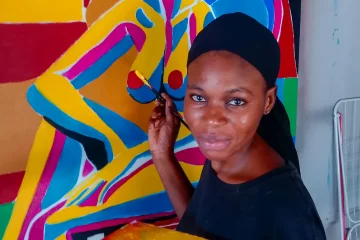
“Writing, painting, and other hidden works can serve to bear witness to the current situation and make us feel useful,” said Imani, an artist-activist and community organiser from Goma whose name has also been changed.
“They can be a powerful antidote to the depression that threatens many of us,” Imani added. “Even without public spaces, art remains our oxygen.”
Demanding justice
The slam movement in DRC emerged from artistic and activist circles in a region that has endured more than a century of exploitation and conflict.
For decade after decade, Congo has been stripped of its riches – first by Belgian colonial rulers, and today by foreign powers and companies hungry for the minerals that power the global economy. Ordinary Congolese have seen little benefit.
Violence intensified in the 1990s after the genocide of the Tutsi in Rwanda. When genocidaire forces fled into eastern DRC, Rwanda’s government chased them across the border, backing rebels – the M23 is the latest – that challenged and toppled Congolese administrations.
Frustrated with the years of conflict and with the Congolese government’s many failings, young Goma residents founded activist groups, including La Lucha (Fight for Change).
Many La Lucha activists – who marched and protested for the government to provide basic services and respect human rights – later became slammers, inspired by international artists, including French poet Grand Corps Malade.
Steve Muhindo, a 25-year-old poet from a town called Sake, which is near Goma, remembers discovering slam at a La Lucha anniversary. “I heard young, committed voices denouncing injustice and violence,” he said. He joined them soon after.
Muhindo said slam is not only a means of self-expression, but something that saved him and many others he knows from joining armed groups, dozens of which have sprung up as conflicts have become entrenched in recent years.
As slam developed, artists spoke not only about conflict and injustice, but also about everyday life, love, and humour. Still, confronting violence remained at the heart of their work, as they blended free-form poetry with civic engagement and civil disobedience
By this stage, artists were performing in Goma, Bukavu, and beyond, while also teaching in schools – introducing youth to public speaking and poetry, and raising their awareness of peace, human rights, and responsible citizenship.
Many slammers organised into collectives such as Goma Slam Session. “Here, there is no leader; we advocate plurality and strength in numbers,” said Depaul Bakulu, one of the founders. “The more of us there are for the same cause, the more our voice is heard.”
That voice carried through classrooms, festivals, and public spaces – that is, until the M23 arrived and brought it all to an abrupt halt.
“Fear has silenced us”
Mostly led by Congolese Tutsis, the M23 reignited a rebellion in late 2021 on the basis that the government had failed to implement a prior peace deal with the group and that Tutsi communities in the east were being discriminated against.
Rwanda justified its involvement by arguing that the Congolese army had been collaborating with genocidaire forces that link back to 1994, but most analysts say its true aim is asserting geopolitical power in a resource-rich region that it considers its backyard.
An offensive earlier this year brought Goma and Bukavu under rebel control, and neither city has seen a peaceful day since: Each one brings reports of kidnappings, looting, and murders – carried out by the M23 or by criminals exploiting the chaos.
Once epicentres of culture, Goma and Bukavu are now subdued. Performance venues are closed; artists, activists, and journalists live under surveillance; and the classrooms that once hosted slammers now struggle simply to keep their doors open.
Some artists have been killed while working. In February, the dissident singer and rapper Delcat Idengo was shot dead by M23 forces while filming a music video. His last song criticised the group for sexual violence and looting, among other things.
For Chicco Mwenge, a slammer exiled in Belgium, the message was clear: “Committed artists must leave to continue the struggle,” he said. “It’s pointless to count other Idengos; death is not a goal.”
Chicco said the dangers facing slammers don’t just come from the M23. “As a committed slam artist, I found myself trapped between a government that treats any dissident as an enemy and M23 rebels”, he said.
DePaul, the co-founder of Goma Slam Session, said he left DRC out of necessity because of threats he faced for denouncing human rights violations by the M23 and for helping displaced people.
“My commitment as an activist-artist and a defender of human rights work, in a context of war, occupation, and repression, has exposed me to real risks,” he said. “Fundamental freedoms are all restricted. Everything is monitored or suppressed.”
Soleil, a slam poet who first discovered the art form in 2020 when slammers visited her school, said she has been targeted in recent months after a member of the new rebel administration took revenge on her father over an old business dispute.
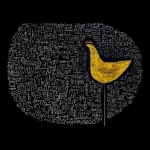
On one occasion, armed men wielding knives and guns invaded her home and forced her to undress in front of her two sisters, aged four and 15, she said: Her experience is described in the poem – commissioned by The New Humanitarian – below:
Before he escaped to Tanzania, Goma-based artist Osée Elektra said he had put all his projects on hold – not even releasing poems and songs that are ready – while also changing the way he dressed.
“I lie to myself, pretending everything is fine when I no longer feel free,” Osée said in an interview before leaving the city. “I don’t feel safe in Goma, neither as an artist nor as a human being.”
Imani, the poet and community organiser from Goma, said the “terror and anxiety” that he faces has had disastrous consequences for him as both an activist and an artist, leaving him uncertain about his future.
“There is no more public mobilisation,” he said, referring to slam performances. “No more words, no more events – fear has silenced us. Now, we move cautiously, watching for those who might target us. Extreme caution has become our daily life.”
Resistance
While the challenges slammers face today may be new, they are far from the first.
The movement came of age under the repressive regime of former president Joseph Kabila, who ruled the country for 18 years. His refusal to step down from power sparked both a prolonged political standoff and humanitarian crisis from 2016 to 2018.
Many poets have also long had to contend with the various taboos and inherited norms instilled in them since childhood, said Ben Kamuntu, the author of the 2021 poem, Bosembo, meaning “justice” in the local Lingala language
“In Congo, we are taught not to criticise the chief, not to say no to our father, and not to claim our rights,” he said. “Women are supposed to stay in the kitchen, and men are supposed to go to school.”
Having weathered earlier challenges, several slammers said they are trying to resist today’s threats by continuing to create and perform poetry either from within DRC or from exile abroad.
“Slam liberates me when I don’t know how to express what is inside me.”
From his refuge in Tanzania, Depaul said he is far from disengaged from events back home. “I speak out for my people, I write, I intervene, I organise, and I build solidarity,” he said.
Earlier this year, Depaul received a prestigious award from Harvard Law School – recognition, he said in his acceptance speech, that “pays tribute to all those who refuse to give up”.
In the speech, Depaul also highlighted the natural beauty and mineral wealth of eastern DRC, while condemning what he describes as “a tragic reality of war, looting, repression, and revolting international indifference”.
In a poem commissioned by The New Humanitarian, Depaul criticises a recent US-brokered agreement between DRC and Rwanda, which is framed as a peace deal but tied to opening up avenues for American investment in Congolese minerals.
DePaul argues that the agreement functions less as a peace pact and more as a mining arrangement. “A race for numbers, a taste for green bills, whitewashing crimes, pardoning criminals. And without remorse, sharing the minerals”, he says in his poem.
Another poet continuing to write is 25-year-old Eliane Feza, who is currently exiled in Nairobi. A criminal lawyer and a human rights defender, Eliane is one of Goma’s most prominent voices, having discovered slam in 2019 through Goma Slam Session.
On 30 June, as Congolese communities celebrated Independence Day, Eliane published on social media an excerpt from her poem “Loba Pona Congo”, which means speaking in the name of the Congo.
The text dreams of peace and reminds listeners that justice is possible. “What is happening in Congo must be known to all,” Eliane said. “We have to denounce it and shake consciences, so the change we have been waiting for finally becomes a reality.”
Soleil, the artist who was assaulted by the M23, said she continues to write from Goma. From time to time, she said she also gathers her younger sisters together and teaches them slam-therapy techniques – using poetry as a form of healing.
“When I get back on stage, I will have things to say,” she said. “I remain positive, and I hope for change. I believe, like the other women in my city, that this is not the end of Goma’s story.”
In Bukavu — a mountainous, muddy lakeside city — artists told The New Humanitarian they too are still producing work, even under difficult conditions that prevent them from sharing it publicly.
Shukuru said he recently brought together 20 slam artists, rappers, comedians, and singers to compose the song “Pamoja”, which means “together” in Kiswahili, promoting peace and coexistence.
Shukuru called on slammers to help combat xenophobia and hate speech. His message is urgent because the M23 rebellion has polarised different Congolese communities.
Malaika, another well-known artist from Bukavu, said slam poetry remains her refuge, despite the anxiety that has gripped her since the beginning of the M23 occupation. “Slam liberates me when I don’t know how to express what is inside me,” she said.
She wrote a poem, “We Are Not Dead”, for The New Humanitarian, based on a bus journey where she heard passengers talk about the war and the people they had lost. The poem captures the toll of conflict while celebrating the resilience of those who survive.
“For over a century we have been in agony,” Malaika writes in the poem. “But we are not dead. This is our greatest victory: We are not dead”.
Edited by Philip Kleinfeld.
–––––
The New Humanitarian puts quality, independent journalism at the service of the millions of people affected by humanitarian crises around the world. Find out more at www.thenewhumanitarian.org.