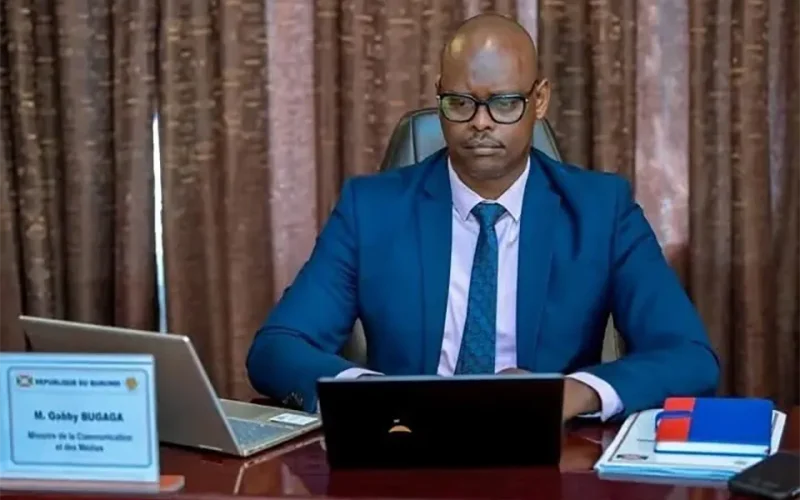
BURUNDI’S Minister of Communications and Media, Gaby Bugagga, was found dead early Thursday morning inside a vehicle abandoned in a remote palm plantation near Kiboga, approximately 10 kilometres from Bujumbura — with the government hastily attributing the death to an accident even as police sources flagged numerous unexplained inconsistencies.
The body was discovered by farmers, roughly ten metres off a sparsely trafficked road cutting through hundreds of hectares of palm trees. They posted photographs of the deceased online in an attempt to identify him. In the images, Bugagga appeared partially slumped across the dashboard, dressed in shorts, a casual shirt, and white athletic shoes.
While the Burundian government described the death as an “unexpected accident”, local police sources pointed to numerous unresolved questions. According to one officer who requested anonymity, Bugagga’s skull bore a deep wound — but the car’s cabin showed no signs of major impact, with only minor scuff marks visible on the rear and side panels. 
“The government does not want scandals and has decided to bury the case without an official investigation,” the officer said.
Official Condolences, No Transparency
The Burundian government confirmed the death later on Thursday. “The Burundian government is saddened by the sudden death of Communication and Media Minister Gabby Bugaga in the early hours of Thursday in an accident,” said Secretary General of the State and government spokesperson Jerome Niyonzima, who added that details on funeral arrangements would be released later. 
The official statement offered no explanation for the circumstances of the minister’s death — not least why a serving cabinet minister was alone, without a driver or security detail, on a remote rural road in the dead of night.
Neither the prosecutor’s office nor any independent authority has confirmed whether a formal investigation will be launched. 
A Career Rooted in Public Broadcasting
Bugagga had served as Communications and Media Minister since August 2025.  A former journalist with Burundi’s National Radio and Television (RTNB), he later worked for the country’s Independent Electoral Commission before his cabinet appointment. 
His death at the helm of the ministry responsible for state media — in a country where the press operates under severe restrictions — will deepen concern among regional and international observers monitoring Burundi’s democratic trajectory.
Echoes of Political Violence
The death echoes past incidents of political violence in Burundi. In 2017, Environment Minister Emmanuel Niyonkuru was shot dead — two years after a major political crisis erupted over President Pierre Nkurunziza’s controversial bid for a third term, a period that saw several high-profile assassinations and attempted killings of senior figures. 
Burundi has been in a political and economic crisis since 2015. Democratic gains made after the 12-year civil war ended in 2005 have been undone by a shift toward authoritarian politics and violent repression against perceived opponents of the ruling party, the National Council for the Defense of Democracy–Forces for the Defense of Democracy (CNDD-FDD).
The broader political climate in Bujumbura has remained volatile in recent months. In early April, two figures close to the CNDD-FDD were transferred to Bujumbura’s central Mpimba prison in a case involving alleged corruption and economic activities in rebel-held areas, as Burundi intensified its anti-embezzlement drive targeting the political and economic elite close to the government. 
Bugagga’s death adds to a pattern of unexplained fatalities and governance opacity that human rights organisations have long documented. The UN Commission of Inquiry on Burundi has noted that corpses have regularly been found in public areas, including near roads and waterways, and that in many cases local administrative officials, ruling party youth wing members, or police officers buried the bodies without investigation. 
The circumstances surrounding the minister’s death — a solitary figure, a lonely plantation road, a wound inconsistent with the vehicle damage, and a government rushing to close the file — are already drawing sharp scrutiny on social media inside and outside Burundi.
As of the time of publication, no independent forensic examination had been announced, no witnesses had been identified, and no state authority had offered an account of the minister’s movements in his final hours.