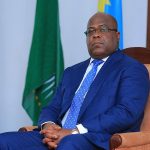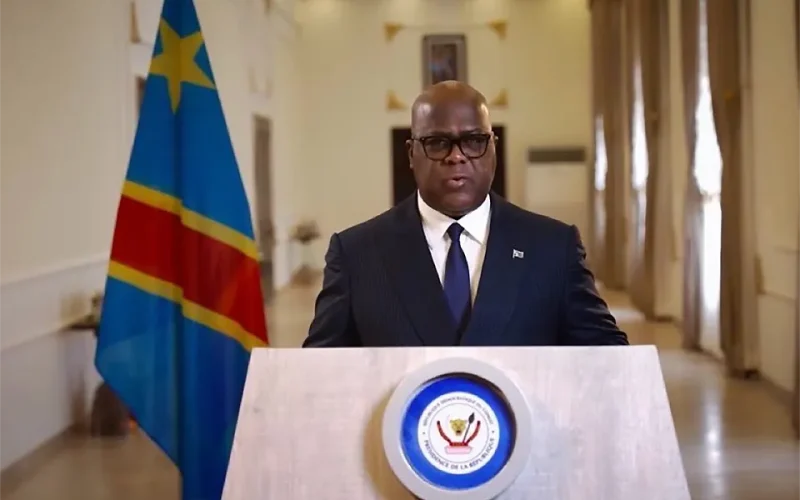
PRESIDENT Félix-Antoine Tshisekedi used the Democratic Republic of the Congo’s 66th Independence Day address on Tuesday to deliver what may be the most forceful articulation yet of his economic sovereignty doctrine, declaring an end to the era in which Congolese minerals were “extracted at home, exported raw, valorised elsewhere, then sold back to the world” while the people who produced that wealth remained trapped in poverty.
Delivered from the Palais de la Nation against the backdrop of an ongoing eastern insurgency, a resurgent Ebola outbreak and a combustible domestic political climate, the address fused triumphant nationalism – anchored by the Leopards’ historic World Cup run – with a hard-edged warning to both foreign partners and domestic political rivals that Kinshasa will not be dictated to on either its resources or its Constitution.
Economic Sovereignty: “This Belongs to the Past”
The President’s sharpest and most consequential language was reserved for the question that has defined his presidency’s economic narrative: who benefits from Congo’s cobalt, copper, coltan and lithium. Tshisekedi told the nation that the DRC’s vast mineral endowment — long synonymous with conflict, foreign extraction and chronic underdevelopment — is now being repositioned as a strategic lever rather than a liability.
“The Democratic Republic of the Congo will no longer be reduced to the image of a country to be coveted, plundered, or destabilised. I have made that pledge before the Nation,” Tshisekedi declared, framing the moment as a deliberate repositioning of how the DRC is perceived globally – from a “territory of crises” to what he termed a “pays solutions,” a solutions country whose critical minerals are “already helping shape the future of the world.”
On the strategic partnerships his government is now negotiating – most notably with the United States – Tshisekedi set out conditions that read as a direct rebuttal of decades of asymmetric resource agreements:
“All of them must meet one clear requirement: to serve the fundamental interests of the Congolese people, strengthen our sovereignty, support peace, foster local transformation, secure value chains, and create lasting jobs for our youth,” he said.
All partnerships, he insisted, must serve the fundamental interests of the Congolese people, reinforce sovereignty, support peace, drive local transformation, secure value chains and create durable jobs for Congolese youth.
Then came the line that will likely headline coverage from Kinshasa to Washington:
“The era in which our minerals were extracted at home, exported raw, processed elsewhere, and then sold back to the world while our population remained mired in poverty now belongs to the past.”
Tshisekedi linked this directly to the DRC’s presidency of the International Conference on the Great Lakes Region and to a high-level UN Security Council session he will chair next month on the link between natural resources, peace and security – a platform, he said, the DRC will use to insist that “natural resources must no longer be regarded as a curse,” but as “a lever for peace, prosperity, sovereignty, justice and transformation.”
Analysts will note the timing: the speech lands as Kinshasa deepens its critical-minerals partnership framework with Washington, giving Tshisekedi’s domestic audience reassurance that economic diplomacy with major powers will not repeat the extractive patterns of the past.
The Referendum Law: Tshisekedi Refers Parliament’s Bill to the Constitutional Court
The President confirmed, for the first time in this format, that he has formally referred the contested referendum bill – already adopted by both chambers of Parliament – to the Constitutional Court for review of its constitutionality ahead of any eventual promulgation. The move comes against a backdrop of sharp political contestation over proposed constitutional and institutional reforms, with opposition parties signalling planned demonstrations against the legislation.
Tshisekedi was careful to frame the referral as routine constitutional process rather than political retreat, invoking the separation of powers directly:
He said: “In a democratic Republic, Parliament debates, deliberates, and legislates. The President of the Republic, as guarantor of the proper functioning of institutions, exercises the prerogatives conferred on him by the Constitution. The competent courts, for their part, ensure respect for the constitutional order and the rule of law.
“It is in this spirit of inter-institutional cooperation and respect for the rule of law that I referred this law to the Constitutional Court, for examination of its constitutionality prior to any eventual promulgation, in accordance with Article 160, paragraph 3, of our Constitution,” he said.
He was equally unambiguous about the limits of legitimate political contestation in the current climate. On dialogue with opposition figures and armed actors alike, he warned:
“Recourse to violence, weapons, hatred, disinformation, or any attack on our sovereignty and territorial integrity cannot constitute a form of political expression. Under no circumstances can it open a special path to negotiation, nor can it place those who threaten the Republic above those who respect its laws,”
he said.
He called on “political actors, of the majority as well as the opposition,” alongside religious, economic, media and civil society leaders, to exercise “restraint, composure and responsibility” – a direct appeal to de-escalate ahead of any planned demonstrations over the referendum legislation.
Eastern Conflict: Diplomacy Without Compromise on Sovereignty
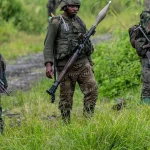
Tshisekedi devoted a substantial portion of the address to the continuing crisis in North Kivu, South Kivu, Ituri, Tanganyika and Maniema, describing populations there as suffering “aggression,” armed groups and “terrorist” activity, forced displacement, looting and “repeated violations of international law.” He paid tribute to the FARDC, national police, security services and the Wazalendo militia operating “within the legal framework” of national defence.
Reviewing a year of diplomacy since the Washington Accord and the Doha talks, he insisted those processes “only have meaning if they produce concrete, verifiable and irreversible results” — the silencing of guns, an end to support for armed groups, withdrawal of “uninvited foreign forces,” disarmament, the return of displaced people, and justice for victims. He was blunt about the limits of compromise:
“Peace cannot mean setting truth aside, nor can it be a reward granted to those who take up arms against the Republic – still less a compromise on our sovereignty, our justice, or our territorial integrity.”
he said. He thanked the United States, Qatar, the African Union, the United Nations, SADC, the EAC and the ICGLR for their roles in the process.
Ebola Resurgence: $319 Million Response Plan Activated
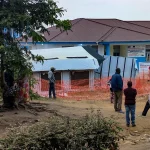
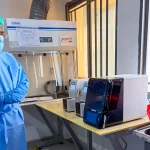
The President confirmed a fresh outbreak of Ebola virus disease, caused by the Bundibugyo strain, concentrated in the Rwampara, Mongwalu and Bunia health zones of Ituri province. A national response plan budgeted at US$319 million has been drawn up, with the government already mobilising emergency resources. Tshisekedi extended condolences to bereaved families and praised health workers, while urging citizens to “remain vigilant, responsible and disciplined,” insisting that “Ebola is neither a rumour nor a shame” but a health emergency demanding “responsibility, solidarity and truth.”
The Bigger Picture: Four Pillars of “Lived” Sovereignty
Tshisekedi closed by setting out what he called the unfinished business of independence: turning political sovereignty into security, economic, digital and diplomatic sovereignty that is “fully lived, concrete and irreversible.” Invoking Nelson Mandela – “with freedom come responsibilities” – he called for unity, discipline and a “patriotic awakening” to build, as he put it, the Congo of 2030, 2040 and 2050.
Taken together, the address represents Tshisekedi’s clearest fusion yet of resource nationalism, constitutional caution and security pragmatism – a positioning that will be closely watched in Washington, Kigali, Brussels and across the African Union as the DRC enters a politically fraught second half of the year.