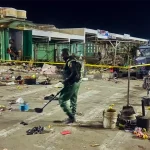

IN the small, dangerous hours before dawn on Sunday, gunmen from the Islamic State West Africa Province (ISWAP) crept toward the perimeter of the Federal Government Girls College (FGGC) in Monguno, Borno State, carrying with them the unmistakable intent to stage one of the deadliest mass abductions the North East has witnessed since the world learned the name Chibok. They did not succeed. But they did not leave without taking lives.
At about 1:30 a.m. on 19 July 2026, troops of Operation HADIN KAI (OPHK), reinforced by personnel of the Nigeria Police Mobile Force (MOPOL), intercepted the terrorists as they attempted to breach the FGGC facility, which the Borno State Government has been using as temporary hostel accommodation for students of the Federal Polytechnic, Monguno. According to a statement issued by Captain Mohammed Goni, Acting Military Information Officer at the Headquarters of the Joint Task Force North East, the attackers reportedly gained entry with the help of suspected collaborators embedded close to the facility – a detail that has already begun to raise uncomfortable questions about how deeply the insurgency’s informant networks have penetrated communities the military insists it now controls.
What followed was not the familiar, grim script of insurgents disappearing into the Sambisa scrubland with truckloads of captives. Alert security personnel moved first, engaging the terrorists with what the military described as coordinated and overwhelming firepower, stalling the assault before it could fully develop. Sector 3’s Quick Reaction Force (QRF) raced to reinforce the school, tilting the firefight decisively against the attackers. Confronted by resistance they had not anticipated, the terrorists broke off the operation and scattered into the darkness, leaving without a single hostage.
ALL 46 ACCOUNTED FOR – BUT THE FIGHT LEFT A TRAGIC TOLL
In the aftermath, troops evacuated all 46 students to Kinnasara Barracks in Monguno, where they underwent medical assessment. The military has confirmed that every one of the 46 is medically stable and that not a single student was taken — a rescue outcome that, set against the trauma this region has endured, borders on remarkable. Parts of the school’s infrastructure were damaged in the exchange of fire, a physical reminder of how close the outcome came to catastrophe.

The relief, however, is shadowed by grief. Operation HADIN KAI has confirmed that some students were fatally struck by sporadic gunfire from the fleeing terrorists during the encounter and has extended condolences to the affected families. The military has not yet disclosed the exact number of fatalities, and The African Mirror has sought further clarity on this from security sources in Maiduguri. What is not in dispute is that a mass abduction was prevented — even as innocent lives were still lost defending against it.
The Monguno operation does not stand alone. It arrives at the tail end of a fortnight of unusually intense, intelligence-driven activity by Operation HADIN KAI across Borno State — a run of arrests of suspected terrorist logistics suppliers and collaborators in Jere, Monguno and Biu; the surrender of terrorist family members fleeing the Mandara Mountains axis around Gwoza and Pulka; the rescue of kidnap victims near Armuda Bridge and in Kukawa; and the foiling of coordinated ISWAP infiltration attempts into Maiduguri metropolis itself earlier this month. Read together, these operations describe something the Nigerian military has for years struggled to convincingly claim: a shift from reactive containment toward proactive disruption of ISWAP’s operational and logistical networks.
For a counter-insurgency campaign whose credibility has for over a decade been measured against the ghosts of Chibok in 2014, Dapchi in 2018 and Kankara in 2020 – each a case where security failures allowed mass abductions to succeed before rescue became the only option – the Monguno outcome marks a genuinely significant inflexion point. This time, the intervention came before the school gate, not after it, and before the girls disappeared into captivity that, history shows, can last years.
QUESTIONS THE MILITARY MUST STILL ANSWER
Yet the celebration of a prevented tragedy should not obscure the troubling questions the incident leaves open. Chief among them: how did ISWAP fighters, in a garrison town housing a forward operating base and a Sector 3 command presence, manage to approach a girls’ hostel with the assistance of collaborators embedded nearby? The military says exploitation of the incident is ongoing to identify and apprehend those suspected collaborators, and that fleeing terrorists are being actively tracked. But the reliance of repurposed, under-secured facilities like FGGC Monguno – a school building never designed as a hostel, now sheltering polytechnic students displaced by the North East’s long housing crisis – as makeshift accommodation for young people in an active conflict zone remains a structural vulnerability that will need to be addressed by both the Borno State Government and the security architecture protecting it.
Operation HADIN KAI has reiterated its commitment to sustaining pressure on ISWAP, denying the group freedom of movement, and dismantling its operational capability, working in liaison with the Borno State Government to safeguard educational institutions and other critical infrastructure across the North East. For families in Monguno, and for a nation that has learned to dread every pre-dawn report from Borno, the promise will be judged less by its wording than by whether the next attempted raid on a school is met with the same speed, and whether every one of its potential victims comes home.