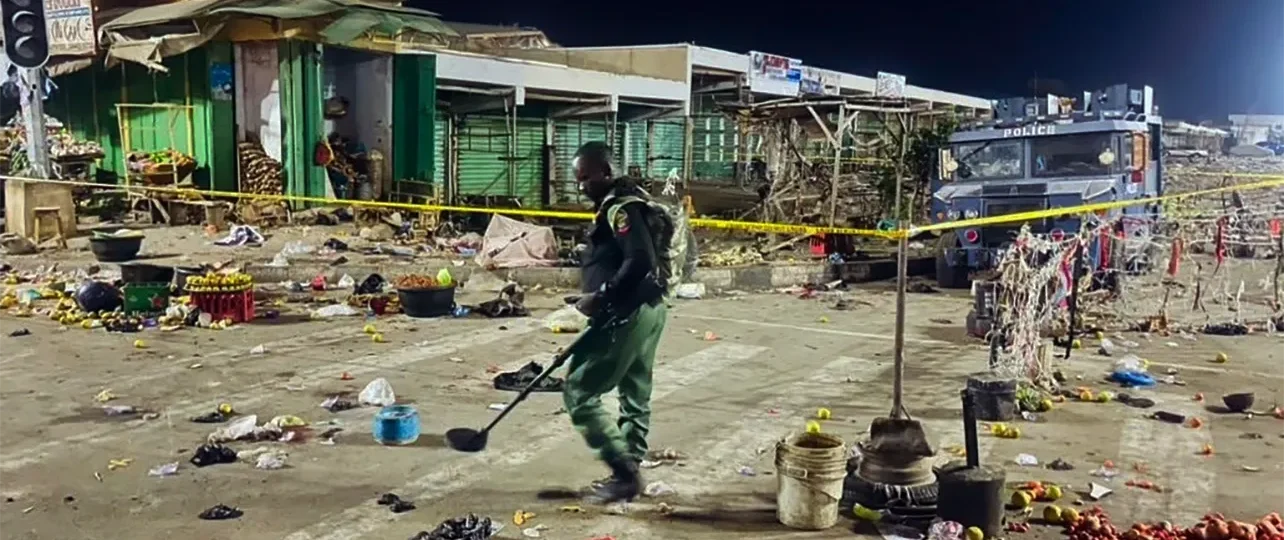

IN the early hours of Monday, 16 March 2026, Borno State — already Nigeria’s most battle-scarred territory — descended once again into fire. Multiple suicide bombers struck civilian targets in Maiduguri city: the entrance to the University of Maiduguri Teaching Hospital, the Post Office market, and the Monday Market. Scores were killed and injured. Just hours earlier, Boko Haram fighters had attempted to overrun a military outpost in the Ajilari Cross district on the city’s southwestern outskirts. It was the most brazen assault on Maiduguri in years — and it was not a single incident. It was the latest instalment in a relentless war of attrition that is now openly challenging the authority, competence and political survival of President Bola Ahmed Tinubu.
A CITY UNDER SIEGE: THE MARCH 16 ATTACKS
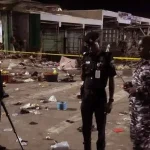
The March 16 bombings sent shockwaves far beyond Borno State. According to Sirajo Abdullahi, head of operations for Nigeria’s National Emergency Management Agency (NEMA) in Maiduguri, explosions struck at least three locations simultaneously. The choice of targets — a public teaching hospital and two of the city’s busiest markets — was deliberate and designed to maximise civilian casualties, terror and economic disruption. Casualty figures were still being compiled by the time emergency services arrived at the scenes; the NEMA coordinator confirmed that casualties were being treated but could not yet give a final count.
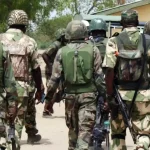
The midnight assault on Ajilari Cross — a suburb located just a few kilometres from Maiduguri’s international airport — preceded the civilian bombings by only hours. Security forces comprising the Nigerian Army, Air Force, police, and the Civilian Joint Task Force had repelled the attackers, with residents reporting four insurgent corpses in their community. Mustapha Aminu, a local resident, told AFP: gunfire erupted from the direction of the military base shortly after midnight before it became clear Boko Haram had entered the neighbourhood. Another resident, Yakaka Ali Gana, said it was the first time insurgents had attacked the military base in their community. The Borno State Police Command spokesman, Nahum Kenneth Daso, confirmed that simultaneous infiltrations were attempted in Ajilari Cross and along the Damboa-Maiduguri road — both repelled by security operatives described as already on “heightened alert.”
Within hours, the city was burning anyway. The evening’s suicide bombings demonstrated that repelling an armed incursion at the gate meant little when the attackers had already positioned operatives inside the city. The Teaching Hospital attack struck at the very institution to which bombing victims would be rushed. This is the logic of terror at its most calculated.
“We all woke up because Boko Haram terrorists have invaded our community. We cannot sleep anymore.”
Ajilari Cross resident, speaking to SaharaReporters
SIXTEEN YEARS OF BLOOD: THE ANATOMY OF THE INSURGENCY
The Boko Haram insurgency formally began in July 2009, when the Islamic militant movement — founded in Maiduguri by Mohammed Yusuf around 2002 — launched its armed rebellion against the Nigerian state. Its founding ideology, a radical rejection of Western education and secular governance, found fertile ground in the socioeconomic marginalisation of Nigeria’s far northeast. After Yusuf’s extrajudicial killing by police following the failed 2009 uprising, his deputy Abubakar Shekau assumed command and transformed Boko Haram into a guerrilla army of devastating capability.
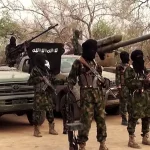
Over sixteen years, the insurgency has killed more than 40,000 people and displaced approximately two million. Villages have been razed, schoolgirls abducted — most infamously the 276 Chibok girls in 2014 — and military bases overrun. The movement fractured over time, producing the Islamic State West Africa Province (ISWAP), aligned with the global Islamic State network, which has proven to be more disciplined, strategically coherent and increasingly dominant. ISWAP has reorganised itself into three primary provinces — Buhaira (Lake Chad fringes), Faruq (southern Borno, southern Yobe, northern Adamawa) and Krenowa (central and northern Borno) — enabling simultaneous multi-front operations that stretch the Nigerian military’s resources.
By 2025, ISWAP had launched what internal communications described as a campaign it named “holocaust of the camps” — a systematic assault on Nigerian military bases designed to seize weapons, kill commanding officers and demonstrate the state’s inability to defend even its own military infrastructure. In January 2025, ISWAP overran an army base in Mallam Fatori near the Niger border, killing the commanding officer and seizing weapons. By March of that year, attacks had intensified across southern Borno, striking at Wajiroko, Kumshe and Katafila. In May, the group attacked the Buni Gari camp housing the army’s 27 Task Force Brigade — a key pillar of Operation Hadin Kai — torching the base and capturing weapons.
THE ESCALATION OF 2026: A NEW PHASE OF THE WAR
What distinguishes the current phase of the insurgency from preceding waves is its scale, coordination, and the audacity of bringing the fight directly to Maiduguri — the state capital that had enjoyed relative calm for several years. In the first quarter of 2026 alone, ISWAP launched attacks on more than six military camps. Those assaults reportedly resulted in the deaths of several senior officers and soldiers.
On the night of 5 March 2026, ISWAP launched simultaneous raids on four Nigerian Army bases in Mainok, Jakana, Marte and Konduga. Armed with heavy weapons and arriving on motorcycles and vehicles, insurgents engaged soldiers in combat lasting more than five hours, setting parts of the camps ablaze. The terrorists subsequently claimed to have captured military vehicles, motorcycles and a significant cache of arms and ammunition — a propaganda and operational coup of the first order. Nigerian troops under Operation Hadin Kai repelled the assaults, but the message was delivered: the insurgents could strike across four locations in a single night.
Separately, in the border community of Ngoshe in Gwoza Local Council, Boko Haram launched a deadly coordinated assault on Nigerian Army artillery positions on 3 March 2026. The response — airstrikes by the Nigerian Air Force that killed approximately 50 insurgents on their withdrawal routes — was accompanied by an admission from President Tinubu’s office that some casualties occurred during the aerial operation, described as friendly fire. In Ngoshe, a community that had been attacked repeatedly between 2013 and 2024 and whose residents had spent eleven years as refugees in Cameroon, the March assault represented a cruel reiteration that the war is not over.
Then came the March 10 warning from an anonymous military strategist, published by SaharaReporters, that security indicators — including the insurgents’ seizure of military weapons — pointed clearly to an imminent attack on Maiduguri itself. Six days later, the warning proved accurate.
Their 16-year campaign to establish a caliphate has killed more than 40,000 people and displaced around two million. The insurgency now enjoys what analysts describe as the most successful period in its history.
TINUBU’S EXISTENTIAL CHALLENGE: SECURITY AS POLITICAL SURVIVAL
For President Bola Tinubu, the Borno insurgency is not merely a regional security crisis. It is the single most consequential test of his government’s legitimacy and capacity to govern. Tinubu assumed the presidency in May 2023 under the cloud of an acrimonious election dispute, and has since grappled with crippling economic reforms — the removal of the fuel subsidy and the floating of the naira — that have driven the cost of living to historic highs for ordinary Nigerians. In this context, visible failures of security, particularly in Nigeria’s most chronically battered region, compound public disillusionment.
The administration has not been passive. In December 2025, Tinubu appointed General Christopher Gwabin Musa as Minister of Defence — widely interpreted as a strategic reset aimed at integrating military operations more effectively with political strategy. Tinubu also approved the deployment of approximately 200 United States military personnel to Nigeria in what the US Africa Command described as a technical training and advisory mission — a significant diplomatic and security step that acknowledges the limits of Nigeria’s unilateral capacity to suppress the insurgency. The administration has also announced plans to recruit an additional 50,000 police officers.
On the battlefield, Operation Hadin Kai — the multi-service counter-insurgency operation covering Borno, Yobe and Adamawa states — recorded genuine tactical gains in 2025 and early 2026. In January 2026, troops penetrated the Timbuktu Triangle in Gujba Local Government Area, dismantling three ISWAP detention facilities that together could hold approximately 300 captives. On 9-10 March, Joint Task Force troops eliminated ISWAP commander Abu Yusu and nineteen others during coordinated raids in Goniri, Yobe State. The Nigerian Financial Intelligence Unit reported freezing over two billion naira in accounts linked to suspected terror financing in 2025.
But tactical victories and strategic failure can coexist — and in Borno, they have done so for sixteen years. The pattern is familiar: military offensives degrade insurgent capacity temporarily, press releases celebrate eliminated commanders, and then the attacks resume. The March 16 bombings on Maiduguri’s hospital entrance and crowded markets arrived less than two weeks after one of the government’s highest-profile counter-insurgency moments. The gap between military communiqués and civilian reality on the streets of Borno State has never been wider — or more politically dangerous.
THE HUMAN COST: CITIZENS IN THE CROSSFIRE
Behind every military briefing are the people of Borno State — a civilian population that has spent sixteen years trapped between a jihadist movement that uses them as hostages, shields and targets, and a state counter-insurgency that has, on its own admission, killed civilians through friendly fire. The March 16 bombing of the University of Maiduguri Teaching Hospital entrance is emblematic of the deliberate targeting of civilian life-support infrastructure. The Monday Market and Post Office market attacks struck the economic arteries through which ordinary families in Maiduguri sustain themselves.
The abduction of more than 100 residents in Ngoshe during the March attacks — with the military subsequently recapturing the village but leaving the abductees in captivity — represents the insurgency’s most persistent and psychologically devastating weapon. Since 2009, millions have been displaced from Borno and surrounding states. The United Nations has documented the displacement of approximately two million people; independent estimates place the figure considerably higher. Borno State remains host to one of the highest concentrations of internally displaced persons in Africa, with approximately 57 percent of schools in the state having been closed at the insurgency’s peak — affecting the educational futures of approximately three million children.
For the women of Ajilari Cross, speaking to cameras in the early hours of 16 March with gunfire audible in the background, the question of government effectiveness was not abstract. “Please, put us in your prayers,” one woman appealed. “They have entered Ajilari.” The voice of a civilian population that has prayed its way through sixteen years of atrocity — and is still waiting to sleep in peace.
The gap between military communiqués and civilian reality on the streets of Borno has never been wider — or more politically dangerous for the Tinubu administration.
REGIONAL DIMENSIONS: A WAR WITHOUT BORDERS
The Borno insurgency is not a domestic Nigerian problem with a domestic Nigerian solution. ISWAP’s reorganisation into provincial structures extending across the Lake Chad Basin — encompassing Cameroon, Chad and Niger — reflects a regional insurgency that routinely exploits the porous borders of four states whose own governance and military capacities are severely strained. Nigeria’s Multinational Joint Task Force, operating across these borders, has increased joint patrol frequency and intelligence-sharing in 2025, but remains limited by diplomatic sensitivities and the collapse of civil order in Niger and other states following military coups.
The West African security architecture has been further destabilised by the withdrawal of French forces from Mali, Burkina Faso and Niger — nations that once hosted Barkhane and then the G5 Sahel force — leaving an intelligence and interdiction vacuum that both ISWAP and al-Qaeda in the Islamic Maghreb (AQIM)-aligned groups have moved rapidly to fill. ISWAP has demonstrated its capacity to expand into northern Adamawa State and the Far North region of Cameroon — territories previously outside its primary operational zone. The March 2026 Maiduguri attacks did not emerge from a vacuum; they are the southward expression of a regional jihadist resurgence that stretches from the Sahel to the Lake Chad basin.
The involvement of United States military personnel, confirmed by the Defence Headquarters, which asserted Nigeria’s sovereignty was uncompromised, signals that Washington views the Lake Chad insurgency as a genuine threat to regional stability — and potentially to the broader arc of Sahel destabilisation that has become one of the defining security crises of the decade. For the Tinubu government, American technical support is both a practical asset and a political liability: useful against the insurgency, but vulnerable to nationalist criticism that Nigeria’s security is being outsourced.
THE POLITICAL RECKONING: WHAT TINUBU MUST ANSWER
The March 16 attacks arrive at a moment of intensifying political scrutiny for Tinubu. The administration’s economic reform programme — however structurally necessary — has imposed severe costs on Nigerian households. In this environment, persistent insecurity in the northeast does not merely register as a governance failure; it functions as a symbol of a government unable to deliver on the most fundamental promise of the state — the protection of its citizens.
The political logic is unforgiving. President Tinubu condemned the Ngoshe attack in the immediate aftermath of the March 3 assault, extended condolences to victims’ families and called on Nigerians to demonstrate resilience. These are the expected gestures. What they do not address is the structural question: after sixteen years, five presidents, and tens of thousands of deaths, what is the Nigerian state’s theory of victory against Boko Haram and ISWAP? Operation Hadin Kai represents the current operational answer, but the March 16 bombings suggest it remains an insufficient one.
The appointment of General Christopher Musa to the Defence Ministry was intended to signal decisive leadership. The deployment of American trainers was intended to demonstrate strategic seriousness. The financial interdictions, the camp demolitions, and the airstrikes were intended to show momentum. None of these, individually or collectively, has yet produced the conditions under which a woman in Ajilari Cross can sleep through the night without listening for gunfire.
What is required — and what successive Nigerian governments have failed to deliver — is a comprehensive political settlement that addresses the conditions that gave rise to the insurgency in the first instance: the structural marginalisation of Nigeria’s northeast, the education deficit, the collapse of rural livelihoods, and the absence of legitimate state institutions at the community level. Military operations can degrade insurgent capacity. They cannot eradicate the grievances from which insurgent recruitment draws.
ANALYSIS: THE BIGGEST THREAT TO TINUBU’S NIGERIA
In the hierarchy of threats confronting the Tinubu administration — banditry in the northwest, farmer-herder violence in the Middle Belt, separatist agitation in the southeast, economic instability — the Borno insurgency stands apart. It alone represents a challenge not merely to public order, but to the territorial integrity and sovereign authority of the Nigerian state. Boko Haram and ISWAP do not seek redress or reform. They seek the destruction of the existing state and its replacement with a caliphate. That is categorically different from the grievances animating other security challenges.
The March 16 attacks on Maiduguri — a city that had known relative calm, a city that symbolically represented the potential for recovery — represent a strategic setback of the first order. They signal that the insurgency retains the capability and the will to bring the war back to urban centres. The targeting of a teaching hospital and public markets is not random; it is designed to destroy the social contract between the Nigerian state and the people of Borno — to demonstrate, in the most visceral terms, that the government cannot protect its citizens in the most basic spaces of daily life.
For President Tinubu, there is no neutral ground. Either the government develops and executes a strategy — military, political, economic and diplomatic — adequate to the scale of this threat, or the insurgency will continue to write its own narrative on the streets of Maiduguri. The March 16 bombings were not simply an attack on Nigeria’s northeast. They were a statement about who is winning — and who is not.