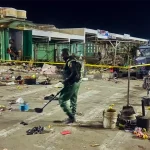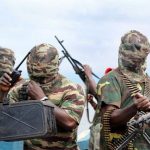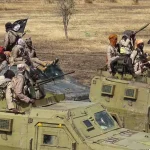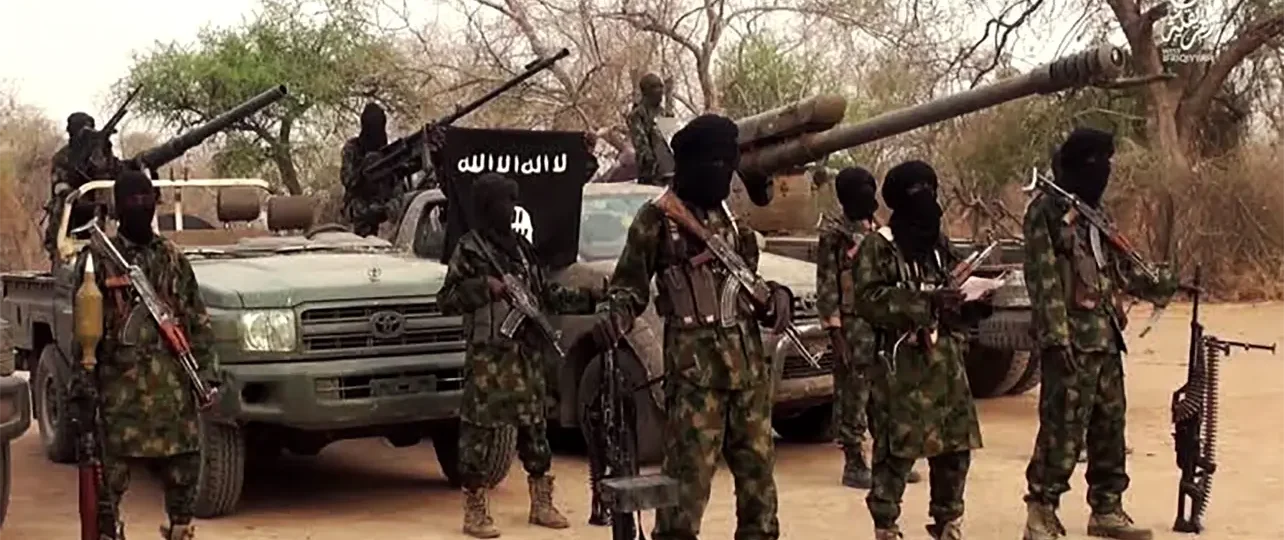

IN the span of a few devastating days in early March 2026, the insurgent threat that Nigeria had declared progressively degraded, announced itself with renewed and terrifying ferocity. The Ngoshe community in Gwoza Local Government Area — a settlement etched with years of Boko Haram memory — was overrun. Civilians were abducted. Lives, including those of military personnel, were lost. And in a painful complication that underscored the chaos of asymmetric warfare, Nigerian Air Force interdiction of fleeing terrorists resulted in friendly fire casualties among the very people the state had sworn to protect.
The attacks were not isolated. Coordinated assaults on military formations at Konduga, Marte, Jakana, and Mainok — key nodes in the north-eastern security architecture — suggested a level of tactical planning and operational intelligence that security analysts had warned was quietly reconstituting within the Lake Chad Basin. The message was unmistakable: Boko Haram, or its fractured ideological successors, had not been eliminated. They had been patient.
The geography of these strikes matters. Konduga sits on the road between Maiduguri and the Sambisa Forest — the terror group’s historic stronghold. Marte lies at the edge of the Lake Chad shoreline, a porous frontier exploited by both Islamic State West Africa Province (ISWAP) and Boko Haram remnants for resupply and recruitment. Jakana and Mainok are highway settlements whose symbolic and strategic value — controlling movement in and out of Borno’s capital — makes them recurring flashpoints. That all four were targeted simultaneously signals a coordinated operation, not a spontaneous offensive.
“The events of the past few days are a painful reminder of the shadow that persists, but let it be known: we choose light over shadow, and hope over despair.” — Vice President Kashim Shettima
ABUJA RESPONDS: RESOLVE, RHETORIC, AND RAPID MOBILISATION
The federal government’s response was swift in language and — officials insist — equally rapid in operational deployment. President Bola Ahmed Tinubu, breaking fast with members of the Armed Forces at the Presidential Villa on March 7, extended condolences to Borno State and pledged that the nation would prevail. It was a setting pregnant with symbolism: a commander-in-chief among soldiers, their shared fast a moment of common humanity amid institutional crisis.
Tinubu was unambiguous about operational intent. He directed the Armed Forces to intensify protection of civilians nationwide, to prevent further attacks on military installations in the North East, and — critically — to work urgently toward rescuing those kidnapped. He also announced continued investment in modern equipment, intelligence infrastructure, and logistics to sharpen operational effectiveness, a pledge the Chief of Army Staff, Lt. Gen. Waidi Shaibu, corroborated by citing recent presidential approvals for salary uplifts, equipment procurement, and improved accommodation for service personnel.
Vice President Kashim Shettima, himself a son of Borno and former governor of the state, brought a harder edge. Deploying the language of civilisational stakes, Shettima reframed the conflict not merely as a security challenge but as a contest for the soul of the Nigerian nation. His statement confirmed what security insiders had been signalling for weeks: additional tactical assets and intelligence-driven reinforcements were already being moved into the theatre. “The Federal Government will not tolerate any sanctuary for those who seek to displace our people or occupy an inch of Nigerian soil,” he declared.
The deployment of the phrase ‘swift and total mobilisation of our security architecture’ is notable. It implies a whole-of-government response — not simply a troop surge — suggesting the involvement of signals intelligence, air assets, special operations forces, and possibly regional cooperation with Chad, Cameroon, and Niger, whose own fragile borders remain permeable to cross-boundary insurgent logistics.
THE WEIGHT OF HISTORY: BORNO’S UNENDING TRIAL
To understand March 2026, one must reckon with more than a decade of catastrophe. Borno State has been the epicentre of one of the world’s most prolonged and destructive Islamist insurgencies. Since Boko Haram first declared its campaign of terror against Western education and the Nigerian state in the late 2000s, the north-eastern states of Borno, Yobe, and Adamawa have borne a disproportionate burden of national suffering — measured in lives lost, children abducted, communities razed, and futures deferred.
The 2014 mass abduction of 276 schoolgirls from Chibok became a global symbol of this crisis, forcing Nigeria’s security failures onto the front pages of international newspapers and generating international pressure that, for all its noise, produced only modest concrete results. Less publicised but equally devastating have been the hundreds of smaller-scale attacks, the displacement of millions, and the systematic destruction of livelihoods across the Lake Chad Basin.
Governor Babagana Zulum — a technocratic administrator whose personal courage in visiting frontline areas has earned both admiration and concern — has governed Borno through some of this period’s most harrowing chapters. He has consistently called for more federal resources, more robust rules of engagement, and greater coordination between the military and local community self-defence groups. Shettima’s statement praising Zulum’s “resilience” and the troops’ “gallantry” implicitly acknowledged that the burden has fallen unevenly on Borno’s people while the federal centre debates strategy.
“Our hearts bleed for the families and the brave soldiers who paid the supreme price in the line of duty. This administration will not rest until abducted citizens safely reunite with their families.” — VP Shettima
THE STRATEGIC PICTURE: A FRAGMENTED BUT RESILIENT ENEMY
The insurgent landscape of north-east Nigeria is considerably more complex than the monolithic Boko Haram of early media coverage. The movement has fractured, mutated, and in some respects become more dangerous through diffusion. The killing of Abubakar Shekau in 2021, by his own hand as ISWAP forces closed in, marked a decisive shift. ISWAP — formally aligned with the Islamic State’s global network — subsequently absorbed large numbers of Boko Haram fighters and has demonstrated superior organisational discipline, governance capabilities in areas it controls, and a more tactically sophisticated approach to military engagements.
The March 2026 attacks bear hallmarks of ISWAP methodology: multi-vector simultaneous strikes, targeted attacks on military infrastructure rather than pure civilian terror, and the use of abductions as both psychological warfare and operational currency. The coordination across four distinct military formations in a compressed timeframe is not the work of a disorganised remnant. It is the signature of a force that has rebuilt its command-and-control capacity.
Nigeria’s security forces have made genuine, measurable progress over the past several years. Billions of naira in equipment, drone acquisitions, and special forces training have improved both intelligence gathering and strike capability. The military’s swift response to the Ngoshe attack — killing scores of insurgents and forcing their retreat — is evidence of improved reactive capacity. But reactive capacity is not the same as strategic defeat. The question that military planners and independent security analysts continue to wrestle with is whether Nigeria possesses, or is building, the population-centric, sustained-presence, civil-military integration capability that successful counterinsurgency ultimately requires.
The friendly fire deaths during aerial interdiction, while deeply tragic, illustrate a persistent challenge: in densely populated, poorly mapped terrain where insurgents deliberately mingle with and abduct civilians, airpower is blunt. Precision is limited. And the cost of imprecision is borne by the very communities whose trust the military needs in order to win.
THE POLITICAL DIMENSION: TINUBU, THE NORTH-EAST, AND NATIONAL COHESION
The timing of these attacks arrives at a politically sensitive moment for the Tinubu administration. The President has been navigating the economic turbulence of subsidy removal and currency reform — painful reforms he has consistently defended as necessary long-term medicine for Nigeria’s structural dysfunction. His messaging at the Ramadan breaking-of-fast dinner — “We are now out of the dark tunnel” — was designed as much for domestic political consumption as for military morale: an affirmation that economic sacrifice is yielding results even as security challenges persist.
The intersection of economic dislocation and security stress is not coincidental. In communities where young men have limited economic alternatives, where government presence is perceived as extractive rather than protective, and where the social contract has been repeatedly violated, insurgent recruitment remains structurally enabled. No volume of additional tactical assets addresses this root architecture. The Tinubu administration is aware of this — its development frameworks for the North East include livelihood components — but the gap between policy articulation and on-the-ground implementation in Borno, Yobe, and Adamawa remains enormous.
Vice President Shettima’s personal identity as a Borno indigene and former governor adds a layer of credibility — and political weight — to the administration’s response that is not lost on either domestic or regional audiences. When Shettima says “our hearts bleed,” it is not the abstract empathy of a distant Abuja official. It is the language of a man who has navigated these same roads, buried constituents, and managed the impossible mathematics of keeping a state functional under existential threat.
THE LAKE CHAD BASIN: A WAR WITHOUT BORDERS
Nigeria’s battle cannot be fully understood in isolation. The Lake Chad Basin — spanning Chad, Niger, Cameroon, and Nigeria — is a single operational theatre for ISWAP. The political instability that has swept francophone West Africa, including military coups in Mali, Burkina Faso, and Niger, has disrupted counterterrorism cooperation frameworks and, in the case of Niger’s junta, severed formal military partnerships with Western partners that previously provided intelligence and logistical support to regional operations.
The departure of French forces from the Sahel and the ongoing restructuring of American counterterrorism posture in the region have left a vacuum that Nigerian security planners must now navigate without the intelligence scaffolding they previously relied upon. The Multinational Joint Task Force (MNJTF) — the regional body coordinating Lake Chad Basin counterterrorism — continues to operate, but at reduced effectiveness relative to its mandate.
For Abuja, this means that the additional tactical assets being deployed to Borno must compensate not only for the immediate operational challenge but also for a diminished regional architecture. It is a significant ask of an Armed Forces that is simultaneously managing banditry in the North West, separatist tensions in the South East, and herder-farmer conflicts across the Middle Belt.
ASSESSMENT: RESOLUTE, BUT THE WAR REMAINS UNFINISHED
The Tinubu administration’s response to the Borno attacks has been, by the standards of Nigerian governmental communication, unusually rapid, emotionally calibrated, and operationally specific. The combination of presidential condolence, vice-presidential defiance, military investment announcements, and field reinforcement represents a reasonably coherent multi-dimensional response. Shettima’s phrase — “not with empty words, but with the decisive and overwhelming force of the Nigerian State” — is the right tone for a government determined not to appear paralysed.
But resolve is not a strategy. And the history of this conflict is littered with official declarations of victory, degradation, and denouement that were subsequently contradicted by events. What the Ngoshe attacks of March 2026 confirm is that the insurgency retains the capacity to strike at will, to abduct civilians, to challenge military installations, and to do so across multiple simultaneous vectors. That is not the profile of a defeated enemy. It is the profile of an enemy in adaptive recovery.
The path to genuine security in Nigeria’s North East runs through interconnected imperatives: sustained military pressure combined with precision intelligence; the return of displaced populations and reconstruction of social infrastructure; economic inclusion programmes that remove the preconditions for recruitment; and a political settlement framework — however long-term — that addresses the governance grievances that have historically fed extremist narratives in the region.
Nigeria has, in the past, demonstrated the capacity to contain and functionally manage this insurgency. The question is whether the current administration — under intensified domestic economic pressure, with a diminished regional security architecture, and facing an enemy that has reconstituted more effectively than many analysts projected — possesses both the strategic coherence and the institutional stamina to move from management to meaningful defeat.
The administration is not cowed. But being uncowed and being victorious are, as Borno’s long history of suffering attests, very different things.