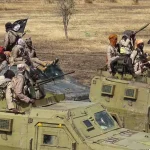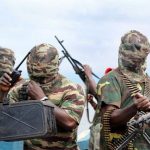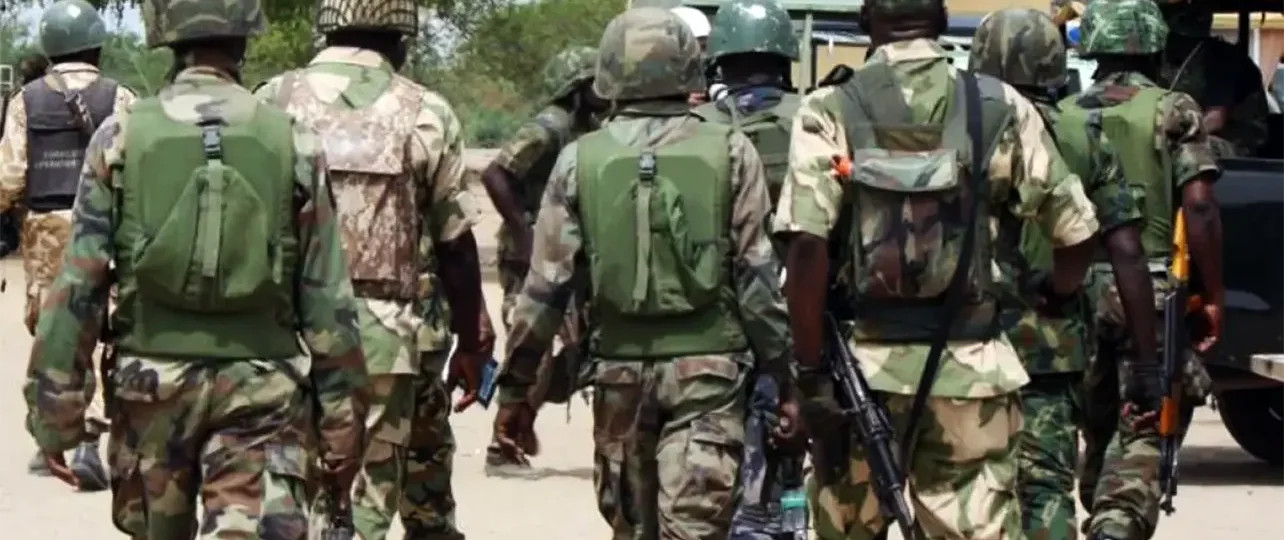

NIGERIAN troops dealt a significant blow to Boko Haram and Islamic State West Africa Province (ISWAP) fighters on Wednesday, killing at least 80 insurgents – including three senior commanders – and repelling a coordinated pre-dawn assault on a military base near the border town of Mallam Fatori in Borno State. The counterattack, supported by Nigerian Air Force precision strikes and allied Nigerien jets, came as the army signalled it had anticipated the assault and mounted an offensive-defensive response designed to turn ambush into annihilation.
The military said it recovered a large cache of weapons – assault rifles, RPG launchers, machine guns, ammunition, improvised explosive devices and components of armed drones, from insurgents who advanced on foot before being broken by ground fire and aerial bombardment. Four Nigerian soldiers were wounded and evacuated for treatment. Damage assessment from the airstrikes remained ongoing Wednesday evening, according to military task force spokesperson Sani Uba.
The operation delivered a rare tactical victory in what has otherwise been a week of grave jihadist provocation. It also carried a pointed message: that the Nigerian military, for all the pressure it faces across a front stretching hundreds of kilometres, retains the capacity to punish those who attack its positions.
A CITY UNDER SIEGE
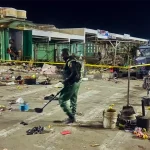
Wednesday’s counterstrike followed one of the most devastating jihadist assaults on Borno’s capital in years. On the evening of 16 March 2026, suicide bombers struck three locations in rapid succession: the entrance to the University of Maiduguri Teaching Hospital, the Post Office market and the Monday Market – killing at least 23 civilians and wounding more than 100. Security analysts described the targeting of a hospital entrance as a calculated strike on civilian life-support infrastructure: the same institution to which bombing victims would be rushed was made a target.
Hours before the evening bombings, Boko Haram fighters had attempted to overrun a military base in Maiduguri’s Ajilari Cross suburb – less than four kilometres from the city’s international airport – before being repelled by security forces already on heightened alert. Residents described waking to sustained gunfire in the early hours. ‘We all woke up because Boko Haram terrorists have invaded our community,’ one Ajilari Cross resident told SaharaReporters. For many in the neighbourhood, it was the first time insurgents had pressed so close.
Sirajo Abdullahi, head of operations for Nigeria’s National Emergency Management Agency in Maiduguri, confirmed simultaneous explosions across the city. Borno State Police spokesman Nahum Kenneth Daso said security operatives had also repelled insurgent infiltrations along the Damboa-Maiduguri road in the same period – a multi-axis pressure campaign that pointed to a sophisticated, synchronised operation.
PATTERN OF ESCALATION
The March 16 attacks were not an aberration. They were the latest and most lethal episode in a sustained escalating offensive that analysts say is reshaping the theatre. On 5 March, ISWAP launched simultaneous raids on Nigerian Army bases in Mainok, Jakana, Marte and Konduga – four separate locations struck in a single night. Troops under Operation Hadin Kai repelled the assaults after more than five hours of combat, but insurgents subsequently claimed to have seized military vehicles, motorcycles and weapons.
Three days earlier, on 3 March, a Boko Haram assault on the border community of Ngoshe ended in Nigerian Air Force airstrikes that killed approximately 50 insurgents – but also produced reported civilian casualties, which President Bola Tinubu’s office acknowledged occurred during the aerial operation. The episode underscored the brutal calculus of counterinsurgency in densely populated border terrain.
On 10 March, an anonymous military strategist issued a public warning via SaharaReporters that insurgents’ seizure of army weapons during the base raids pointed clearly to an imminent strike on Maiduguri itself. Six days later, the warning proved grimly accurate.
STRATEGIC RECALCULATION
The attacks represent more than a security challenge – they are a direct and humiliating challenge to Tinubu’s government, which has struggled to translate battlefield momentum into strategic containment against an insurgency now in its seventeenth year. ISWAP has reorganised into three operational provinces spanning Borno, Yobe and Adamawa states, enabling simultaneous multi-front assaults that stretch military resources and complicate the army’s ability to hold terrain it has cleared.
More than 40,000 people have been killed and approximately two million displaced since Boko Haram launched its armed rebellion in 2009. Those numbers have not stopped growing.
The Tinubu administration has not been passive. In December 2025, the president appointed General Christopher Gwabin Musa as Minister of Defence in what analysts widely described as a security reset. Approximately 200 United States military personnel are currently deployed in Nigeria in an advisory and training capacity. In January 2026, Operation Hadin Kai troops dismantled three ISWAP detention facilities in the Timbuktu Triangle in Yobe State. On 9 and 10 March – just days before the Maiduguri bombings – Joint Task Force raids killed ISWAP field commander Abu Yusu and nineteen fighters.
The March 16 bombings arrived less than a week after those raids. The message from the insurgents was unambiguous: tactical kills do not stop an organisation with the depth, ideology and territorial footprint that ISWAP now commands.
POLITICAL CONSEQUENCES
For Tinubu, who faces mounting public pressure over economic hardship following the removal of the fuel subsidy, the spectacle of suicide bombers targeting a hospital and crowded markets in a city that had known relative calm carries consequences that no military press release can soften. The symbolism of Maiduguri – the very epicentre of the insurgency’s birth – returning to the headlines as a bleeding city is as politically costly as it is strategically alarming.
Wednesday’s military strike at Mallam Fatori, and the body count it delivered, will be presented by the government as evidence that the armed forces are holding the line. The harder question – why, after seventeen years and billions of naira, jihadist fighters can still walk to the gates of Maiduguri and detonate bombs at a hospital – remains, for now, without a satisfactory answer.