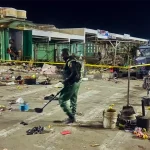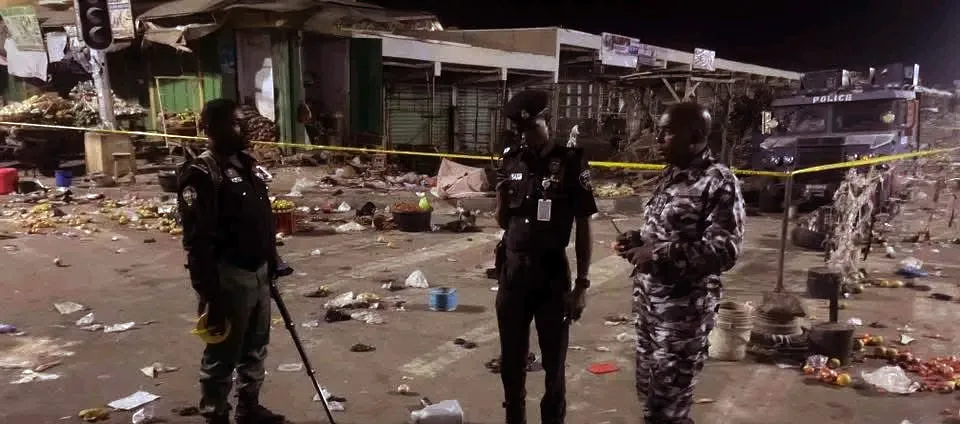

SUICIDE bombers struck the entrance to the University of Maiduguri Teaching Hospital, the Post Office market and the Monday Market on the evening of 16 March 2026, killing and wounding scores of civilians in the most devastating jihadist assault on Borno State’s capital in years.
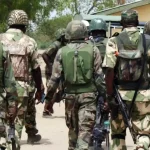
Hours earlier, Boko Haram fighters had attempted to overrun a military base in Maiduguri’s Ajilari Cross suburb, less than four kilometres from the city’s international airport, before being repelled by security forces.
Sirajo Abdullahi, head of operations for Nigeria’s National Emergency Management Agency (NEMA) in Maiduguri, confirmed multiple simultaneous explosions across the city. Borno State Police spokesman Nahum Kenneth Daso said security operatives already on “heightened alert” had repelled insurgent infiltrations at Ajilari Cross and along the Damboa-Maiduguri road in the hours before the evening bombings struck. Security analysts described the targeting of the Teaching Hospital entrance — the same institution to which bombing victims would be rushed – as a calculated strike on civilian life-support infrastructure.
Residents described waking in the early hours to sustained gunfire. “We all woke up because Boko Haram terrorists had invaded our community,” one Ajilari Cross resident told SaharaReporters. “We cannot sleep anymore.” Yakaka Ali Gana, a community member, said it was the first time insurgents had attacked the military base in her neighbourhood.
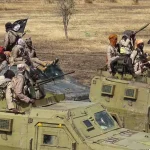
The March 16 attacks are the most high-profile episode in a sustained, escalating offensive that has brought the insurgency back to Borno’s urban heart after years of relative quiet in Maiduguri. On 5 March, the Islamic State West Africa Province (ISWAP) launched simultaneous raids on Nigerian Army bases in Mainok, Jakana, Marte and Konduga — four separate locations struck in a single night. Troops under Operation Hadin Kai repelled the assaults after more than five hours of combat, but insurgents subsequently claimed to have seized military vehicles, motorcycles and weapons. In the border community of Ngoshe, a Boko Haram assault on 3 March ended in Nigerian Air Force airstrikes that killed approximately 50 insurgents — but also produced reported civilian casualties, which President Tinubu’s office acknowledged occurred during the aerial operation.
On 10 March, an anonymous military strategist published a warning via SaharaReporters that security indicators – specifically the insurgents’ seizure of army weapons during the base raids – pointed clearly to an imminent attack on Maiduguri itself. Six days later, the warning proved accurate.
The attacks represent a direct and humiliating challenge to President Bola Tinubu’s government, which has struggled to translate battlefield momentum into strategic containment against an insurgency now in its sixteenth year. ISWAP has reorganised into three operational provinces spanning Borno, Yobe and Adamawa states, enabling simultaneous multi-front assaults that stretch Nigerian military resources. More than 40,000 people have been killed and approximately two million displaced since Boko Haram launched its armed rebellion in 2009.
The Tinubu administration has not been passive. In December 2025, the President appointed General Christopher Gwabin Musa as Minister of Defence in what analysts widely described as a security reset. Approximately 200 United States military personnel are currently deployed in Nigeria in an advisory and training capacity. In January 2026, Operation Hadin Kai troops dismantled three ISWAP detention facilities in the Timbuktu Triangle, Yobe State. On 9 and 10 March, Joint Task Force raids killed ISWAP field commander Abu Yusu and nineteen fighters.
The March 16 bombings arrived less than a week after those raids — a pointed reminder that tactical successes have not yet translated into strategic containment. For Tinubu, who faces mounting public pressure over the economic hardship that followed the removal of the fuel subsidy, the spectacle of suicide bombers targeting a hospital and crowded markets in a city that had known relative calm carries acute political consequences that no military press release can soften.