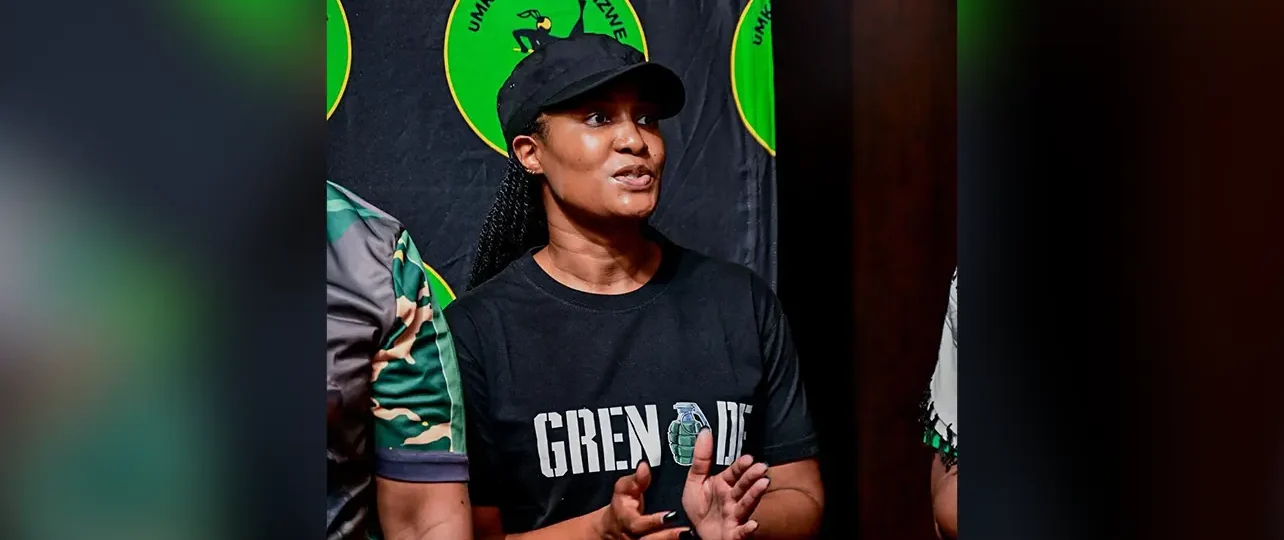

IN South Africa’s dynamic political landscape, a recent power struggle within the uMkhonto weSizwe (MK) Party has reached a tentative resolution, though underlying tensions persist. The confrontation between Duduzile Zuma-Sambudla, daughter of former President Jacob Zuma, and the party’s secretary-general, Floyd Shivambu, has highlighted the delicate balance between family loyalty and party discipline.
Following her controversial social media posts criticizing Shivambu as “useless” and “the worst thing that happened to MK,” Zuma took a firm stance against his daughter’s actions. His hardline approach has yielded results, with Duduzile issuing an apology to both the party leadership and Shivambu. This move has allowed her to retain her position within the party and her role in the Pan-African Parliament.
Duduzile wrote: “To President Jacob Zuma of the MK Party, the entire leadership, members, supporters of the MKP, and the people of South Africa, I wish to assure you that I never intended to harm the integrity of the party or the values it upholds. Hence, my deepest apology for any offence caused in this regard.”
“I am fully prepared and committed to cooperate with any internal processes deemed necessary by the party, as part of my continued dedication to the ideals of discipline, respect, and unity.”
However, observers note that Duduzile’s apology carries subtle undertones suggesting that her conflict with Shivambu is far from resolved. While pledging to address her concerns through proper party channels and protocols, her previous characterisation of herself as the “neck” to her father’s “head” of the party hints at her continued influence within the organization.
The resolution demonstrates Zuma’s commitment to maintaining party discipline, even when it involves family members. Yet, the power dynamics between Duduzile and the secretary-general remain complex, with both figures wielding significant influence within the party structure.
This development comes in the context of MK’s remarkable political impact, having secured more than 4 million votes since its launch in December 2023, contributing to the historic scenario where the ANC received less than 50% of the vote for the first time since South Africa’s 1994 democratic elections. The party’s ability to manage internal conflicts while maintaining its political momentum will be crucial for its future success.
I stand with you my sister ??? https://t.co/3yM7WotVqo
— Duduzane Zuma (@Duduzane__Zuma) February 11, 2025