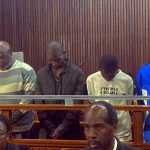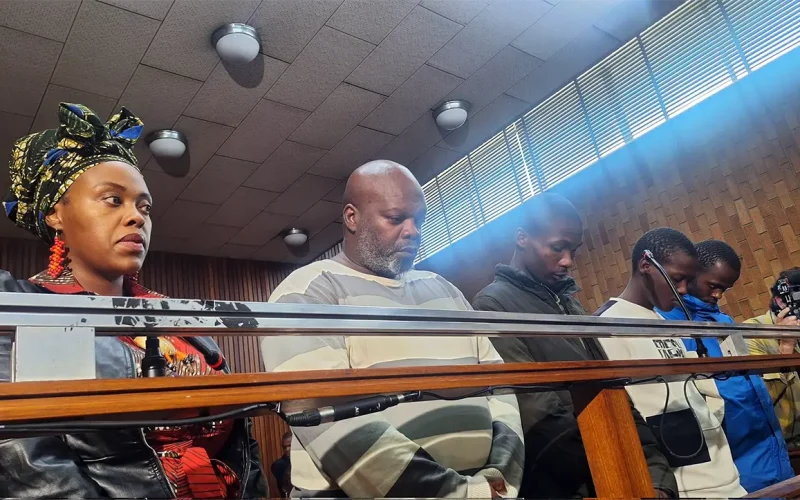
FIVE suspects appeared in Kempton Park Magistrates Court on Monday, facing charges of violating South Africa’s Foreign Military Assistance Act, marking the first arrests in a widening scandal that has already claimed the political career of former President Jacob Zuma’s daughter and exposed a sophisticated human trafficking network recruiting South Africans to fight in the Russia-Ukraine war.
The Directorate for Priority Crime Investigation (Hawks) announced the arrests of Nonkululeko Mantula (39), Thulani Mazibuko (24), Xolani Ntuli (47), Siphamandla Tshabalala (23), and Sfiso Mabena (21) following a dramatic week that saw siblings turned against each other at the highest levels of South African politics and a sitting member of Parliament forced to resign after what sources describe as an indirect confession to involvement in the recruitment scheme.
Duduzile Zuma-Sambudla: From Defiance to Resignation
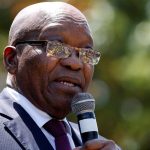
The most stunning development came with the resignation of Duduzile Zuma-Sambudla from her position as Member of Parliament representing the uMkhonto weSizwe (MK) Party—the political vehicle founded and led by her father. According to sources familiar with the matter, Zuma-Sambudla claimed she had been “misled” about the nature of the recruitment operation, an acknowledgement that legal experts characterise as an indirect admission of involvement while attempting to establish a defence of deception.
The resignation represents a spectacular fall for a politician who has cultivated a reputation as a provocateur and unapologetic defender of her father’s legacy. Zuma-Sambudla was already facing separate criminal charges for allegedly inciting violence during the catastrophic July 2021 riots in KwaZulu-Natal that left more than 350 people dead and caused billions in property damage.
Her exit from Parliament came just days after her elder sister, Nkosazana Bonganini Zuma-Mncube, filed criminal charges against her at Sandton Police Station on November 22, alleging her involvement in recruiting 17 South African men—including eight Zuma family members—under false pretences to fight for Russia in Ukraine. The charges invoked three serious statutes: the Prevention and Combating of Trafficking in Persons Act, the Regulation of Foreign Military Assistance Act, and common law fraud.
The resignation suggests either that Duduzile Zuma-Sambudla recognised her legal position had become untenable, or that the MK Party leadership—including potentially her father—concluded her continued presence in Parliament posed an unacceptable political liability. For a party that has positioned itself as the authentic inheritor of South Africa’s liberation legacy, having a sitting MP implicated in human trafficking was becoming a brand-destroying scandal.
The Hawks Strike: Arrests Follow Intelligence Tip-Off
The Hawks’ operation began with a tip-off from OR Tambo International Airport police regarding three males en route to Russia via the United Arab Emirates. The men were removed from the boarding gate as “suspicious” and referred to the Hawks’ Crimes Against the State (CATS) section—a unit typically reserved for matters involving national security, terrorism, and threats to state integrity.
The classification signals that authorities view this not merely as criminal recruitment but as a potential threat to South Africa’s sovereignty and international standing. The use of CATS resources suggests investigators suspect broader implications—possibly connections to foreign intelligence services, organised crime networks, or systematic compromise of South Africa’s border and immigration controls.
Preliminary investigation revealed that a South African female had been facilitating the travel and recruitment of these individuals into the Russian Federation Military. While the Hawks’ statement does not name this central figure, the timing and description align closely with the allegations made by Nkosazana Zuma-Mncube against her sister and two others: Duduzile Zuma-Sambudla, Siphokazi Xuma, and Blessing Khoza.
The fourth suspect was arrested upon return from an international trip, and the fifth, Sfiso Mabena, was arrested on Saturday, November 29, 2025. The arrests followed the execution of search and seizure warrants, with investigators seizing electronic devices and two backpacks believed to contain evidence of the recruitment network’s operations, communications, and possibly financial records.
Critically, one individual had already departed for Russia before investigators could intervene. Upon this person’s return to OR Tambo International Airport on November 27, 2025, they were interviewed, and “further evidence was uncovered.” This suggests either cooperation with investigators or that evidence obtained during the interview directly implicated additional suspects, leading to the arrest of three more males on November 28.
Five Defendants: The Operational Network
The five accused represent different nodes in what appears to be a multi-layered recruitment and facilitation network:
Nonkululeko Mantula (39): As the oldest defendant and identified as the primary facilitator in the Hawks’ statement, Mantula likely served as a coordinator or manager within the operation. Her age and apparent seniority suggest experience and connections necessary to establish relationships with both Russian contacts and South African recruits.
Xolani Ntuli (47): The second-oldest defendant, Ntuli, may have served as an enforcer, logistics coordinator, or financial handler within the network. Middle-aged operatives often provide operational stability and community connections that younger recruiters lack.
Thulani Mazibuko (24), Siphamandla Tshabalala (23), and Sfiso Mabena (21): The three youngest defendants, all in their early twenties, likely served as street-level recruiters, peer influencers who could relate to potential recruits of similar age. Their youth and demographic profile match the target recruitment population—young men aged 20-39 facing limited employment prospects.
This age distribution suggests organisational sophistication: senior figures managing strategy and external relationships, while younger operatives handled ground-level recruitment where peer credibility matters most. It’s a structure common to organised crime networks, multi-level marketing schemes, and human trafficking operations—all of which share characteristics with this recruitment ring.
Legal Framework: The Foreign Military Assistance Act
The Regulation of Foreign Military Assistance Act of 1998 represents one of Africa’s most robust anti-mercenary legal frameworks. Enacted during South Africa’s post-apartheid transition, the Act emerged from the determination that South African citizens should not serve as guns-for-hire in foreign conflicts—a direct response to the apartheid regime’s extensive use of military and security personnel across southern Africa and beyond.
The Act prohibits South African citizens or residents from:
- Providing military assistance to any foreign country or entity without government authorisation
- Recruiting persons for the purpose of providing such assistance
- Facilitating, organising, or financing such recruitment or assistance
Violations carry severe penalties, including imprisonment for up to 25 years for the most serious offences. The Act also provides for asset forfeiture and significant fines, creating powerful deterrents against mercenary activity.
The statute’s application to the Russia-Ukraine recruitment operation is straightforward: The accused allegedly recruited and facilitated the travel of South African citizens to serve in a foreign military force without authorisation from the South African government. That several recruits are now stranded in the Donbas region, pleading for government assistance, provides compelling evidence of the harm the Act was designed to prevent.
Remand and Bail: Accused Held Pending Application
The court remanded all five accused in custody, with the case postponed to Monday, December 8, 2025, for a formal bail application. The remand decision suggests prosecutors convinced the magistrate that the accused poses flight risks, might interfere with witnesses or evidence, or that the offences are serious enough to warrant pre-trial detention.
Bail hearings in Foreign Military Assistance Act cases involve complex considerations:
Flight risk: With evidence of international travel, connections to foreign entities (Russian military or recruitment networks), and potential access to funds from recruitment operations, prosecutors will argue the accused have both means and motivation to flee.
Witness interference: If investigations are ongoing and additional suspects remain at large—particularly if more prominent figures like those named in Nkosazana Zuma-Mncube’s complaint have not yet been arrested—prosecutors may argue the accused could warn co-conspirators or intimidate witnesses.
Seriousness of offence: Violations of the Foreign Military Assistance Act carry severe maximum penalties, which courts consider when assessing whether accused persons might flee rather than face lengthy imprisonment if convicted.
Ongoing investigation: The Hawks’ statement that “coordination with intelligence and international law enforcement agencies is ongoing to determine the full extent of the network” suggests investigators believe these five represent only part of a larger operation. Releasing accused persons could compromise efforts to identify and apprehend additional suspects.
International Dimensions: Intelligence and Law Enforcement Coordination
The Hawks’ acknowledgement of “coordination with intelligence and international law enforcement agencies” reveals the investigation’s complexity and international reach. This coordination likely involves:
Interpol: For information sharing about suspects, victims, and recruitment networks operating across multiple countries. With more than 1,400 Africans from over 30 countries fighting for Russia in Ukraine, this is explicitly a transnational criminal matter.
Russian authorities: Despite political sensitivities, practical cooperation may be necessary to determine the fate of South African citizens in Russian military formations and to establish whether Russian state actors were involved in recruitment.
Ukrainian intelligence: Ukraine has reported extensively on foreign fighters in Russian ranks and may possess communications intercepts, captured documents, or prisoner interrogations relevant to recruitment methods and networks.
UAE authorities: Since the intercepted suspects were travelling via the United Arab Emirates, Emirati cooperation is essential to understand transit routes, identify additional suspects who may have travelled the same route, and potentially disrupt ongoing operations.
Western intelligence services: Given intense Western interest in Russian military recruitment and force composition, agencies like the CIA, MI6, and European services likely possess relevant intelligence about recruitment networks they may share with South African authorities.
The reference to determining “any further security threats” is particularly ominous. It suggests investigators are exploring whether the recruitment network poses additional dangers beyond individual criminal violations—potentially including:
- Espionage: Whether recruitment facilitators maintained relationships with Russian intelligence services
- Future recruitment: Whether the network planned to expand operations or recruit for other purposes
- Organised crime connections: Whether the operation involved traditional criminal organisations with broader illegal activities
- State compromise: Whether the network’s success indicates corruption or penetration of South African border control, immigration, or security agencies
The 17 Stranded: Victims Awaiting Rescue
While prosecutors pursue those who sent them, 17 South African men remain trapped in the Donbas region of Ukraine, facing combat conditions in one of the 21st century’s bloodiest conflicts. Eight are Zuma family members. All were allegedly recruited under false pretences—promised security jobs, bodyguard training, or technical work—only to find themselves handed to Russian military formations and deployed to front-line combat.
Their situation illustrates the human cost of the recruitment operation:
- They face artillery warfare with casualty rates reportedly exceeding 70% in some units
- They lack military training, appropriate language skills, or understanding of their combat environment
- They cannot easily surrender to Ukrainian forces without risking prisoner-of-war status and indefinite detention
- They cannot flee Russian formations without facing military justice for desertion
- They depend on diplomatic negotiations between South Africa, Russia, and Ukraine—countries with complex, sometimes conflicting interests
The South African government has urged families to maintain silence during “sensitive diplomatic negotiations,” though Nkosazana Zuma-Mncube’s public criminal complaint and the arrests have ensured this crisis remains in public view.
Former President Jacob Zuma has reportedly appealed directly to the Russian government for the men’s release—a shadow diplomatic track that may help or hinder official efforts, particularly now that his daughter’s involvement has become the subject of criminal investigation.
Political Fallout: The MK Party’s Crisis
For the uMkhonto weSizwe Party, Duduzile Zuma-Sambudla’s resignation represents only the beginning of political damage. The party, which performed surprisingly well in the 2024 elections by positioning itself as the authentic inheritor of the ANC’s liberation legacy, now faces devastating questions:
Was party infrastructure used to facilitate recruitment? If Duduzile exploited party connections, resources, or personnel in the recruitment operation, the party itself could face legal jeopardy and catastrophic reputational damage.
What did Jacob Zuma know? As party founder and leader, and as father to both the accused and the accuser, Zuma’s position is extraordinarily complex. His reported appeals to Russia for the men’s release suggest either genuine ignorance of his daughters’ alleged involvement or an attempt to mitigate damage after discovering it.
How will the party respond? Beyond Duduzile’s resignation, will the MK Party cooperate with investigations, distance itself from the accused, or defend its members? Each option carries political risks with the party’s base and the broader electorate.
The ANC and opposition parties are already exploiting the scandal. The question being asked is pointed and damaging: Has uMkhonto weSizwe—the name of the ANC’s former armed wing that fought apartheid with genuine ideological purpose—been reduced to a vehicle for human trafficking and mercenary recruitment for profit?
Continental Context: Africa’s Mercenary Crisis
South Africa’s arrests and prosecutions are significant because they represent the continent’s most aggressive legal response to a crisis affecting 30+ African nations. Kenya has confirmed more than 200 citizens fighting for Russia, with recruitment networks remaining active despite government awareness. Uganda, Nigeria, Sierra Leone, and numerous other countries have citizens in Ukraine, many recruited identically.
Most African countries lack South Africa’s legal frameworks or enforcement capacity. The Foreign Military Assistance Act and the Trafficking in Persons Act provide prosecutors with powerful tools that most continental counterparts lack. South Africa’s prosecutions could establish precedent and pressure other governments to strengthen legal frameworks and enforcement.
But the underlying pathologies remain: Youth unemployment exceeds 60% in South Africa, the world’s highest rate. Across the continent, millions of young people face futures without formal employment, dignity, or opportunity. For them, offers of $18,000 for “security work” or “technical jobs” abroad—even when suspiciously vague—represent potentially transformative opportunities.
Until African economies generate viable pathways to dignity and security for young people, recruitment networks will find willing targets, and prosecutors will face an endless supply of cases. The arrests are necessary and important, but they address symptoms rather than causes.
Conclusion: First Blood in a Long Campaign
The five arrests and Duduzile Zuma-Sambudla’s resignation mark important victories for South African law enforcement, but they are opening salvos in what will be an extended campaign. The Hawks’ statement that investigations continue, that international coordination is ongoing, and that authorities are working to determine the “full extent of the network” indicates expectations of additional arrests.
Prosecutors will pursue convictions against the five accused, seeking lengthy sentences that establish deterrence. Defence attorneys will argue their clients were themselves misled, that they believed they were facilitating legitimate employment, or that evidence was obtained improperly. The trials will expose the recruitment network’s operations in granular detail, potentially implicating additional figures.
The diplomatic effort to repatriate the 17 stranded men continues, complicated by the arrests and political fallout. Will Russia be more or less cooperative now that South Africa has arrested recruiters? Will the men themselves cooperate with investigations upon return, or will they refuse to testify for fear of self-incrimination or loyalty to those who recruited them?
The Zuma family’s spectacular fracture—siblings on opposite sides of a criminal investigation, family members trapped in a war zone, a former president navigating between protecting his daughters and protecting his family members in Ukraine—will play out in courts and media for months or years.
And across Africa, young men will continue receiving messages promising opportunity abroad, forced to decide whether suspiciously generous offers represent genuine pathways or deadly deception. Until that changes, the arrests of five facilitators, however significant, represent a battle won in a war that Africa is still losing.