IN the annals of Botswana’s legal history, few stories capture the dramatic rise and fall of power quite like that of Carter Morupisi. The former Permanent Secretary to the President’s tale has taken yet another extraordinary turn, marking perhaps the final chapter in a saga that has gripped the nation.
Late in 2024, Morupisi’s world crumbled when Botswana’s highest court, the Court of Appeal, transformed his suspended sentence into a seven-year prison term. The judges had found his original punishment for corruption – involving a luxury vehicle and a P500 million pension fund contract – embarrassingly lenient.
But Morupisi, the man who once walked the corridors of power with unshakeable confidence, wasn’t done fighting. In an unprecedented move that left legal scholars stunned, he approached a lower court to challenge the verdict of the nation’s apex court. Even more astonishing was that he succeeded – briefly. A High Court judge, in a decision that sent shockwaves through Botswana’s judicial system, ordered Morupisi’s release on grounds of human rights violations.
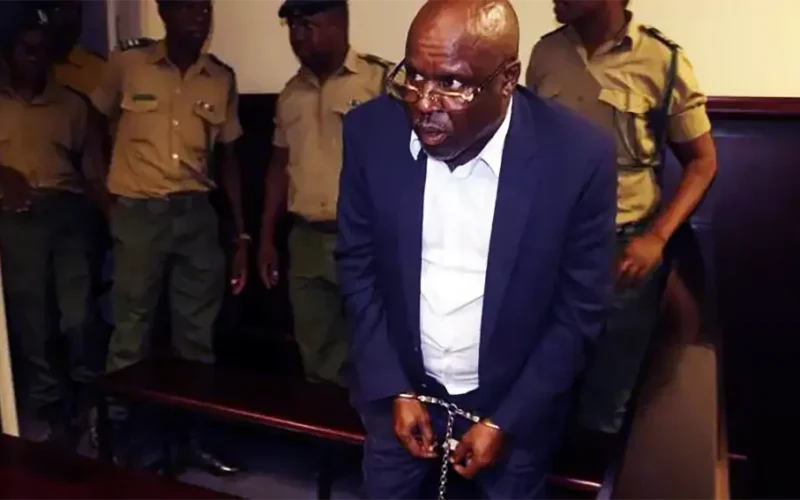
The victory celebration was short-lived. A full bench of five judges has now decisively reversed that controversial ruling, sending Morupisi back to serve his original seven-year sentence. The legal community watches with bated breath, as this extraordinary case may have far-reaching implications for the High Court judge who dared to overturn the apex court’s decision.
Today, Morupisi finds himself back behind bars, his brief taste of freedom serving only to underscore the spectacular nature of his downfall. As he begins his long stay in prison, his case stands as a stark reminder that in Botswana’s justice system, even those who once stood at the pinnacle of power must ultimately answer for their misdeeds.
The five judges who handed down the unanimous decision that sent Morupisi back to a prison cell were: JC Froneman, E Cameron, IBK Lesetedi, GL Tebogo-Maruping and LI Dambe.
In their judgment, the five judges were scathing on the high court’s attempt to arrogate to itself the competence to sit in review of a judgment of the Court of Appeal – the highest court in Botswana. The judges extensively quoted the Constitution of Botswana and legal authorities which made it clear that the Court of Appeal is the final court of appeal in Botswana, with jurisdiction to make final determinations on appeal from all the lower courts.
“The High Court is nowhere afforded the power to interrogate, question or inquire into any decision of the Court of Appeal regarding fundamental rights or freedoms. This is logically obvious. It has also been enshrined for some two decades in explicit decisions of the Court that were binding on the High Court that heard this matter. Three five-judge decisions of this court expressly establish these principles in the law and practice of this country. The High Court has no authority over the Court of Appeal judgments, even those affecting fundamental rights and freedoms,” the judges wrote.
The five judges found that, Section 18(1) which was relied on by Morupisi in his appeal does not afford the High Court jurisdiction to set aside an order by another judge of the High Court that has been confirmed by the Court of Appeal. An meritorious complaint should have been referred to the Court of Appeal because the High Court has no jurisdiction to deal with the matter.
Meanwhile, somewhere in South Africa, his alleged co-conspirator – a prominent businessman fighting extradition – surely watches these developments with growing unease, knowing that Botswana’s courts have demonstrated their willingness to hold even the most powerful to account.
The message resonating through the halls of power is clear: no one, not even a former Permanent Secretary to the President, is above the law – and attempts to manipulate the justice system may only serve to tighten its grip.