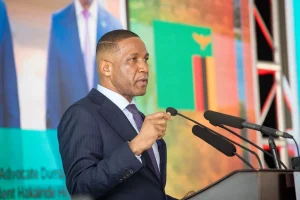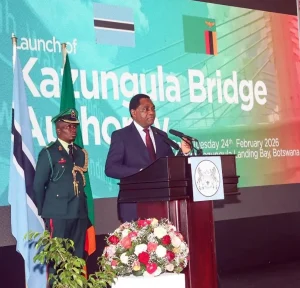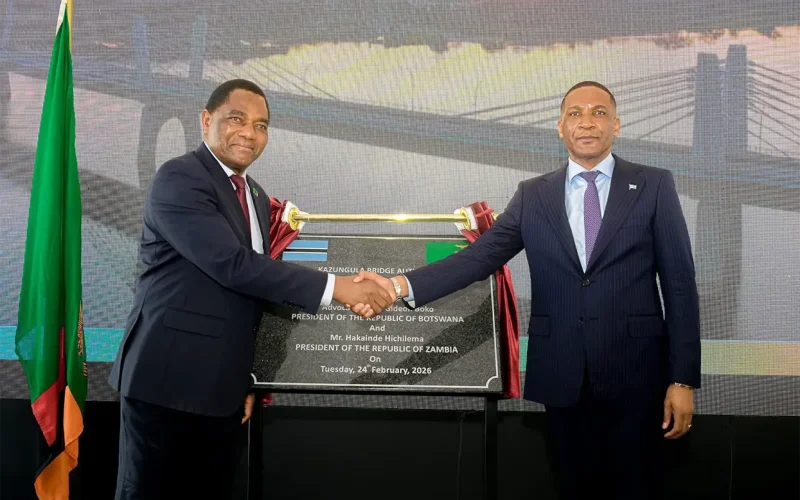
WHEN Presidents Duma Boko and Hakainde Hichilema stood together at the old Kazungula ferry ramp this week, the symbolism was deliberate and pointed. The same river crossing that once served as a lifeline for southern Africa’s liberation movements – a clandestine artery for freedom fighters evading apartheid’s reach – is now being repositioned as infrastructure for a different kind of freedom: economic sovereignty.
The formal launch of the Kazungula Bridge Authority marks a significant, if under-reported, moment in African regional integration. Five years after the bridge itself was commissioned, Botswana and Zambia have moved beyond the ribbon-cutting to do the harder institutional work – creating a joint body with real governance architecture, a 24-hour one-stop border post, a shared maintenance mandate, and a long-term operational framework. Botswana will host the headquarters; Zambia will hold the Executive Director position. Both governments will co-fund operations.
It is, in practical terms, exactly the kind of structure that trade economists have long argued Africa needs more of.
The African Continental Free Trade Area has generated enormous political enthusiasm since trading formally commenced in 2021. Yet intra-African trade remains stubbornly low – hovering around 15 percent of the continent’s total trade, compared to roughly 60 percent within Europe and nearly 40 percent within Asia. The gap between the agreement on paper and commerce on the ground is, in large part, an infrastructure and governance gap.
President Hichilema named this directly. “AfCFTA cannot exist in a vacuum,” he said. “It has to be anchored. This bridge, among others, is the anchor to deepening and realising the Africa Continental Free Trade Area.”
The Kazungula Bridge already handles significant north-south freight traffic along the north-south SADC corridor, and has rapidly become the preferred crossing for landlocked countries to the north seeking access to southern African ports. The ambition, as Hichilema stated plainly, is to scale that to a thousand trucks per day – a target that would make it one of the busiest border crossings on the continent and generate measurable economic spillover into the surrounding towns of Kasane and Kazungula.
What distinguishes the Kazungula model is not the bridge itself – impressive as the engineering is at the world’s only quadripoint, where Botswana, Zambia, Zimbabwe and Namibia meet – but the institutional thinking behind it.
Too many of Africa’s cross-border infrastructure projects stall at the operational phase, undermined by competing national interests, inconsistent funding, and the absence of shared accountability structures. The KBA attempts to pre-empt those failure modes by embedding joint ownership from the start. Neither country dominates; both are invested.
President Boko framed it in terms that should resonate with any business audience on the continent: “We are not merely commissioning an Authority; we are consolidating a partnership.” He added that the institution embeds governance within opportunity – a phrase that deserves more attention than it will likely receive in the day’s coverage.
For African businesses – logistics operators, manufacturers, agricultural exporters, and the growing cohort of intra-African traders – the practical implications are significant. A reliably managed, 24-hour one-stop crossing reduces dwell times, lowers transport costs, and diminishes the informal fees that bleed margins on cross-border shipments. These are not abstractions. They are the difference between competitive and uncompetitive in a trade corridor.
Botswana and Zambia are not economic giants. Neither commands the continental weight of Nigeria, South Africa, or Egypt. Yet that may be precisely why their approach is instructive. Unburdened by the complexity of managing larger geopolitical interests, they have been able to move with a clarity of purpose that bigger players often cannot.
Their message to the continent was not subtle. Both presidents invoked Africa’s shared history, the artificial colonial borders that divided a single people, and the imperative to build something different. “Africa will rule the world,” Hichilema said — rhetoric, yes, but rhetoric anchored in a concrete institutional act on the same day.
For African business leaders watching regional integration move slowly elsewhere, Kazungula offers a working proof of concept: two neighbouring governments, one shared asset, an institutional framework with defined roles, and a growth target stated in trucks per day.
The continent has enough summits. It needs more of this.