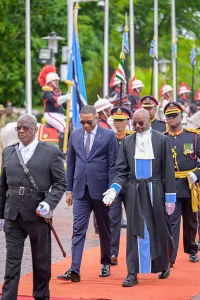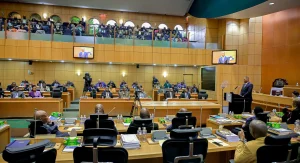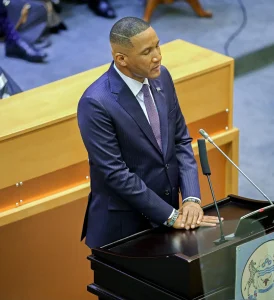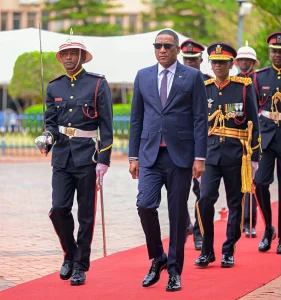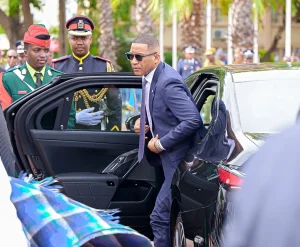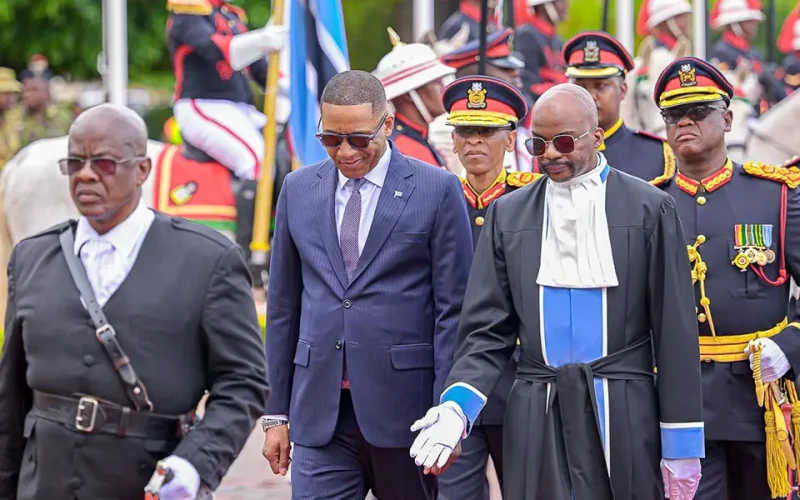
IN a sweeping State of the Nation address that resonated with both urgency and hope, President Duma Boko laid out an ambitious roadmap for Botswana’s economic transformation – one that seeks to honour past achievements while boldly reimagining the nation’s future.
Standing before his fellow citizens, Boko invoked the words of Nelson Mandela: “The greatest glory in living lies not in never falling, but in rising every time we fall.” With conviction fortified by early victories, he declared: “Botswana is rising again, to heights she has never reached before!”
Delivering on Promises: A Government in Motion
Since taking office, Boko’s administration has wasted no time translating campaign rhetoric into tangible action. The president proudly pointed to measurable successes that signal his government’s commitment to its electoral mandate.
Agricultural production has surged dramatically – a 34.2% increase in planted area yielded an estimated 144,000 tonnes of crops in the 2024/25 season, a staggering improvement from just 39,795 tonnes the previous year. “This is well within the UDC manifesto objective of tripling food production yield and output; another success milestone delivered!” Boko proclaimed.
The turnaround extends beyond fields and farms. The troubled Botswana Meat Commission, long plagued by delays, has slashed payment processing times from months to just seven days. In Ngamiland, a new Direct Cattle Procurement Scheme now pays farmers instantly – a game-changer for communities historically excluded from market access.
The Master Plan: NDP 12 and Economic Transformation
At the heart of Boko’s vision lies the 12th National Development Plan (NDP 12) and its powerful engine, the Botswana Economic Transformation Programme (BETP). Together, they chart a course toward what the president calls Botswana’s “True North” – a high-income, digitally enabled, export-driven nation where every citizen is employed, empowered, and fulfilled.
The numbers are audacious: BETP aims to elevate Botswana to high-income status by 2036, with per capita income reaching P200,000. The program targets the creation of 512,000 jobs – primarily for youth – while fundamentally diversifying an economy that has long depended on diamonds.
“These are not distant ideals, but practical commitments,” Boko emphasised, “to create jobs where they are needed most, to restore dignity through health and housing, to empower youth with skills and opportunities.”
Agriculture: Feeding a Nation’s Ambitions
Recognising agriculture as the sector with “the greatest prospects, immediate and long-term, for sustainable creation of jobs,” the government has set a bold target: raising agriculture’s contribution to GDP from 2% to at least 6% in the immediate term.
Central to this agricultural renaissance is an ambitious livestock expansion program aimed at growing the national cattle herd from 1.7 million to 5 million by 2030. The decline from 3 million head in the 1970s to current levels has spurred comprehensive intervention – including extension support, animal health services, artificial insemination programs, and rangeland restoration initiatives launched in partnership with the Green Climate Fund.
The dairy sector tells a particularly compelling story of determination. After years of stagnation due to foot-and-mouth disease preventing biological imports, a government mission to Brazil has secured protocols to import 1,000 Girolando cattle. Through Milk Valley, a subsidiary of the Botswana Development Corporation, the nation aims to boost local milk production capacity from 13% to over 60% within a year.
Horticulture production has similarly flourished, reaching 88,670 tonnes and meeting 80% of national vegetable demand and 29% of fruit demand. To accelerate this momentum, the government organised a groundbreaking trip for 16 farmers to Bangladesh in July 2025, exposing them to commercial-scale farming techniques that will position them as anchor farmers supporting others.
Perhaps most intriguingly, Botswana is pioneering a new frontier: industrial hemp and medicinal cannabis cultivation. With enabling legislation passed and a Memorandum of Understanding signed with Hemp Innovations, pilot cultivation is set to commence in December 2025, opening pathways to economic diversification that few African nations have dared to explore.
Mining: Beyond Diamonds
While diamonds will remain central to Botswana’s economy, Boko announced transformative changes to the sector. New agreements with De Beers extend Debswana mining licenses to 2054 while progressively increasing the Okavango Diamond Company’s access to diamonds from 30% to ultimately 50%.
Most significantly, the government is pursuing the acquisition of Anglo-American’s shares in De Beers, seeking majority control to better align the industry with national development goals.
But the mining revolution extends far beyond diamonds. Botswana is positioning itself in the global clean energy supply chain through projects like the Letlhakane Uranium Project (targeting 3 million pounds annually), the K. Hill Battery-Grade Manganese Project in Kanye, and iron ore developments in Ngamiland. A P1.4 billion investment will establish Southern Africa’s first integrated plant for producing critical mining chemicals in Palapye.
“Uranium, manganese, and iron ore form an emerging triad of opportunity in Botswana’s mining renaissance,” the president declared, signalling the nation’s pivot toward industrial minerals and green steel.
Energy Independence and Green Ambitions
Addressing a critical bottleneck, the government has launched an aggressive energy expansion program. Currently importing 35% of national demand, Botswana is developing 900 MW of solar photovoltaic power and 600 MW of thermal generation. By December 2025, over 100 MW of solar power will flow into the grid, with thermal capacity targeted for December 2027.
The remediation of Morupule B has already brought three units online, with a fourth to follow. Once complete, local thermal generation will reach 720 MW – transforming Botswana from an energy importer to a potential regional exporter.
In a forward-thinking move, Botswana has applied to become an authorised issuer of International Renewable Energy Certificates (I-RECs), opening new revenue streams for project developers and positioning the nation in the growing global market for renewable energy.
Investment Revolution: New Vehicles for Growth
President Boko unveiled a suite of transformative financial instruments designed to position Botswana as Africa’s gateway for international investment:
The Botswana International Financial Centre (BIFC) will operate as an independent jurisdiction within Botswana, founded on transparency, accountability, and the rule of law—a regulated hub for financial services flowing into Africa.
The Sovereign Wealth Fund represents a bold decision to strengthen fiscal discipline while channelling capital into economic diversification, job creation, and skills transfer. Operating on commercial lines with independent oversight, it will embody the Santiago Principles on transparency.
The Botswana Mercantile Exchange (BMX), operational by March 2026, will create a regional hub for trading both soft commodities (wheat, sorghum, beef) and hard commodities (oil, gold, copper, diamonds). This platform will enable farmers to list products for global trading, access international prices and give immediate value to producers.
Perhaps most controversially, Boko announced an Impact Citizenship Programme – carefully distinguishing it from “selling citizenship.” Instead, he framed it as inviting select global investors, innovators, and changemakers to contribute meaningfully to national development goals, with rigorous vetting and due diligence built into the process.
Youth: The Heart of National Renewal
Addressing Botswana’s pressing unemployment crisis, with youth unemployment at 38%, Boko’s tone became particularly impassioned.
“To the youth of our great nation, our most precious resource, more valuable than any physical asset we possess, we see your energy, we value your ideas, we admire your courage,” he declared. “The Botswana we build tomorrow will be shaped by your imagination and courage today.”
The Presidential Youth Empowerment Campaign (PYEC), established in partnership with UNICEF and UN agencies, will begin with a baseline study identifying the 1,000 most promising candidates, producing a Botswana Digital Employability Index and national trainer registry before scaling to 10,000 participants.
Specific initiatives include a Climate-Smart Horticulture Development Programme targeting 500 small-hold farmers, a Textile Acceleration Programme, and a Government Automobile Maintenance Programme – all combining skills development with mentorship.
New agreements with De Beers will launch an International Graduate Development Programme, university sponsorships for advanced studies, and a Diamond Entrepreneurship Programme developing Batswana as diamantaires through two 5-year programs.
The government has also allocated P200 million from the Alcohol Levy Fund toward procuring creative arts content from young people, while plans advance for a 50-bed youth-friendly rehabilitation centre in Serowe to combat drug and alcohol abuse.
Digital Economy and Strategic Partnerships
The administration has moved swiftly to attract international business process outsourcing operations. CCI Global, a UAE-headquartered company with 10,000 employees across five continents, began operations at the Botswana Digital Innovation Hub in October 2025. The initial phase has already created 51 full-time jobs, targeting 720 within 12 months and 3,000 within 36 months.
Infrastructure to support the digital economy is advancing with the establishment of a National Retail Payment Switch – a special-purpose vehicle under the Bank of Botswana that will streamline transactions, reduce leakages, increase financial inclusion, and ensure payments stay within the local economy.
Infrastructure: Connecting Botswana to the World
As a “land-linked” transit country providing critical connectivity in Southern Africa, Botswana is positioning itself as a transport hub for the 360-million-strong SADC market.
Construction of the A3 toll road has commenced, with feasibility studies for the A1 dual carriageway spanning over 600 kilometres scheduled before the year’s end. Alternative railway lines, including the Mmamabula-Lephalale Railway Line and the Mosetse-Kazungula-Livingstone line, will unlock new trade corridors aligned with SADC’s North-South Corridor Strategic Plan.
Major water infrastructure projects are reaching completion, including the NSC pipeline connections, Mmamashia Water Treatment Plant, and the long-awaited Maun Water and Sanitation project, bringing relief to communities that have waited years for reliable access to safe drinking water.
Tourism and Culture: Soft Power, Hard Returns
With tourism vital to Botswana’s economy, the government aims to double international arrivals within five years. Concession allocations in Ngamiland and Makgadikgadi are empowering citizens as active participants in the tourism economy, with joint ventures in Khwai and Mababe attracting P72 million in investment and creating 127 jobs.
The creative industries are receiving unprecedented attention. A Cinematography Bill modernising the film industry will be tabled in Parliament, while the reintroduction of sporting activities in schools represents “a valuable investment in the future,” enabling the nation to nurture elite athletes, performers, and creative talents.
A Course Correction: Learning from Mistakes
In a display of accountability, Boko candidly addressed the flawed Development Manager Model inherited from the previous administration. A review completed in March and published in August 2025 revealed serious procedural gaps and unsustainable financial burdens.
“In response, the Government revoked all three Presidential Directives that had approved the model,” Boko stated. Sixteen projects under construction will continue using alternative methods, while 132 conceptual-stage projects undergo reassessment to ensure value for money.
The government is strengthening the Public-Private Partnership framework through BETP, with urgent milestones including tabling the PPP Bill and operationalising governance structures within twelve months.
The Steady Path Forward
Boko’s speech painted a portrait of a nation at an inflexion point – one that refuses to accept decline as destiny. From agricultural fields to mining operations, from digital hubs to renewable energy installations, from financial innovation to youth empowerment, his government is orchestrating a comprehensive transformation.
“The steady path we traverse as we navigate our economic challenges, though urgent, is not one of hasty shortcuts,” the president acknowledged. “It is a path of hard work and tangible progress aimed at diversifying the economy for resilience and laying the foundation for sustained growth anchored on good governance, security, and institutional performance that will endure for generations.”
The early victories – tripled crop yields, reformed payment systems, secured international partnerships, and launched youth programs – suggest that this is not merely aspirational rhetoric. It is a government executing a vision with methodical determination.
As Botswana positions itself at the intersection of African development and global markets, Boko’s message resonates beyond his borders: a resource-rich nation need not remain hostage to commodity volatility. With strategic planning, bold reforms, and unwavering focus on human capital, it can chart its own course toward prosperity.
“Botswana is rising again,” Boko declared, “to heights she has never reached before.”
The journey has begun. The world is watching. And the steady path forward, paved with concrete achievements and ambitious targets, suggests that this time, the rise may indeed be sustainable.