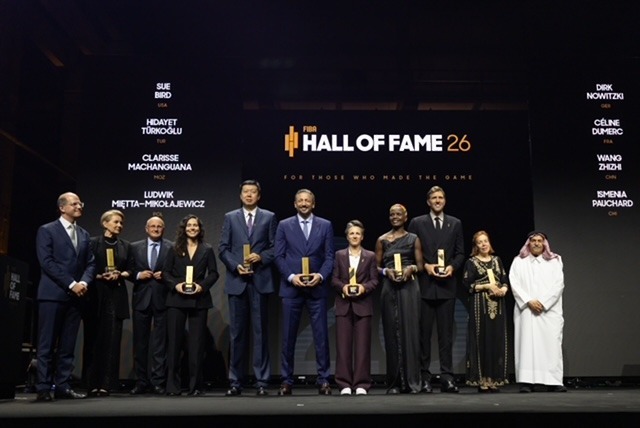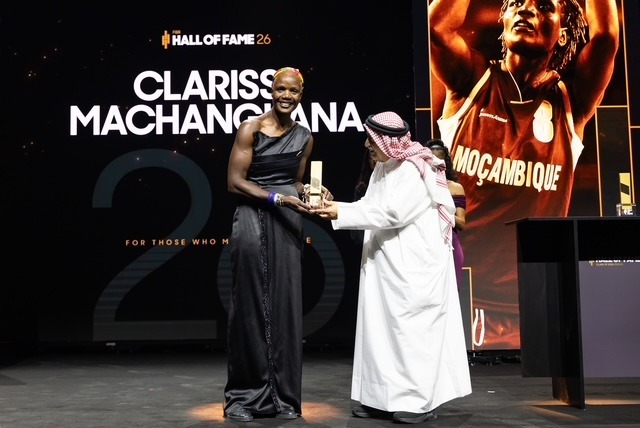
SHE carried the weight of a continent on her shoulders and made it look effortless. On Tuesday night in Berlin, the basketball world finally gave Clarisse Machanguana the honour her extraordinary career has always deserved – a place in the FIBA Hall of Fame.
The Mozambican centre, one of the most commanding and influential figures to emerge from African basketball, was formally inducted at a ceremony on 22 April in the German capital, joining a distinguished Class of 2026 that includes United States legend Sue Bird, France’s Céline Dumerc, German icon Dirk Nowitzki, Chile’s Ismenia Pauchard, Turkey’s Hedo Türkoğlu, China’s Wang Zhizhi, and Polish coach Ludwik Miętta‑Mikołajewicz.
For African basketball, the induction carries a significance that transcends individual accolades. Machanguana was not merely a great player — she was a standard-bearer, a proof of concept at a time when the global game had scarcely acknowledged the talent lying dormant across the continent.
“She carried Mozambique and, in doing so, carried Africa. This Hall of Fame is a monument to what she built.”
FROM MAPUTO TO MARCH MADNESS
The story of Machanguana’s rise is one of the most compelling in African sports history. At just 15 years of age, she was already performing on the continental stage, helping Mozambique claim gold at the 1991 African Games — a moment that announced a generational talent to anyone watching.
What followed was a career of extraordinary reach. It was in the United States that she first seized the global basketball imagination. At Old Dominion University, she was the engine of a Lady Monarchs side that posted a staggering 34-2 campaign in 1997, carrying the team all the way to the NCAA Final. Machanguana finished her college career with 1,813 points, led her teams in scoring and field-goal percentage every single season — shooting an exceptional 62 percent from the floor and averaging 18.3 points per game. These are not African basketball numbers; these are numbers that would define any career, anywhere in the world.
The 1997 NCAA Final Four All-Tournament Team recognised her dominance. The Kodak All-American distinction that same year confirmed it. These were honours she had long been building toward, having already been named CAA Player of the Year and to the CAA All-Freshman Team.
BREAKING INTO THE WNBA
Drafted by the Los Angeles Sparks, Machanguana became one of the first African women to stake a claim in the WNBA — playing for the Sparks, Charlotte Sting, and Orlando Miracle. Her presence in the league was not a footnote; it was a signal to a generation of African girls that the highest stages of the game were within reach.
She further demonstrated that excellence is borderless, carving out an extensive European career across Spain, Italy, and France, and competing in the EuroLeague Women — one of the world’s most competitive club competitions.
“At 15, she won a gold medal for Mozambique. At 37, she won a silver. The arc of that career is almost incomprehensible.”
22 YEARS OF FAITHFUL SERVICE
Perhaps the most remarkable statistic of Machanguana’s career is also the most human: the 22-year span between her first continental glory and her last. In 2013 — twenty-two years after that teenage gold at the African Games — she led Mozambique to the FIBA Women’s AfroBasket Final, claiming silver. The longevity, the consistency, the refusal to yield to time: these are the marks not merely of a great athlete, but of an irreplaceable one.
BEYOND THE COURT
What elevates Machanguana above even her extraordinary on-court legacy is what she chose to do with the platform that excellence built. In 2014, she founded the Clarisse Machanguana Foundation, directing her energy toward empowering young Mozambicans through sport, education, and health initiatives. Where she once scored baskets, she now opens doors.
Her induction into the FIBA Hall of Fame is thus more than a celebration of what she achieved — it is a recognition of what she represents: the full, undiminished potential of African women’s sport, and what becomes possible when that potential is given the space to flourish.
On a night in Berlin when the basketball world gathered to honour its greatest, Africa — in the form of Clarisse Machanguana — stood tall, as it always has.