
IN Botswana, we know the sting of scarcity intimately. As a semi-arid country, we have learned that every drop counts. We are a water-scarce nation due to arid and semi-arid climatic conditions across most of our territory, coupled with inadequate water supply sources and services. In recent years, water shortages have persisted as demand grows, exacerbated by the relentless effects of climate change.
Climate variability and uncertainty bring extreme events such as droughts and unpredictable rainfall patterns, challenging our people’s conventional food production methods and our potable water supply, which relies heavily on annual rainfall. Our groundwater resources have also been significantly impacted by climate change variables, while the country’s sparse population distribution creates major engineering and financial challenges for water infrastructure development.
The International Decade of Action calls for “Water for sustainable development,” and we must intensify efforts toward achieving Sustainable Development Goal 6—ensuring availability and sustainable management of water and sanitation for all by 2030. It is therefore the government’s responsibility to ensure that every designated settlement receives potable water, regardless of proximity to the nearest water source. Water is a basic human right, and without water, there is no life. Many settlements in Botswana are located where there is little or no water source, creating an urgent need to reticulate, store, and distribute clean water to these communities.
These challenges present significant opportunities for investment in Botswana’s water and sanitation sector. Investment opportunities include major water transfer schemes, water treatment plants, storage facilities, sanitation schemes, and wastewater reclamation for productive reuse. The decentralisation of water infrastructure requires designing and building numerous pump stations, water transfer and distribution pipelines, treatment plants, and storage tanks across the country.
The Botswana Government is focusing on initiatives that will lead to sustainable management and utilisation of water resources, as well as water supply and sanitation service delivery—both essential for economic growth. Sustainability in water resource management requires extensive investment in resource development, planning, infrastructure development, and water resource protection.
Botswana shares most river systems with riparian countries, making international water relations crucial for ensuring water security and building mutual cooperation. The Botswana Government continues to engage and collaborate with partners, particularly those related to shared watercourses under the auspices of the Permanent Okavango River Basin Commission (OKACOM), Orange-Senqu River Basin Commission (ORASECOM), Zambezi River Basin Commission (ZAMCOM), and Limpopo Watercourse Commission (LIMCOM). Our actions to promote water cooperation include:
- Legal and institutional dimensions of transboundary water cooperation
- Data, information, knowledge, and technical support for transboundary water cooperation
- Capacity development for transboundary water cooperation
- Funding and financing for transboundary water cooperation and infrastructure development
Botswana is one of four Southern African nations that could become “highly water-stressed by 2040” under a “business as usual” scenario. It is therefore critical to adopt a risk management approach in water planning and management to ensure water availability for sustained economic growth.
Adaptation to climate change will involve tailored interventions thoughtfully integrated into existing development processes and activities. The Government of Botswana is making deliberate efforts to change our development trajectory by embracing private investment and allowing investors to leverage their expertise.
Efficiency in water supply and sanitation service delivery requires constructing conveyance pipelines, rehabilitating and expanding reticulation networks, and building sewer networks throughout the entire onsite sanitation service chain. These are capital-intensive endeavours. It is therefore imperative to efficiently manage available water sources to effectively achieve Sustainable Development Goal 6 targets, as enshrined in our national aspirations: Botswana Vision 2036 and the Botswana Economic Transformation Programme (BETP).
Botswana stands at the threshold of a new chapter through the development and implementation of the Botswana Economic Transformation Programme. This program aims to ensure that innovation, enterprise, and local ambition fuel our journey toward a prosperous future. We will build a political and economic posture that opens doors to those ready to build with us.
This is a call to action for thinkers, investors, entrepreneurs, and institutions with bold ideas that can spark real economic progress. The BETP will engage projects and ideas that unlock new engines of growth across the country, bring fresh thinking to old challenges, create jobs and expand opportunities for Batswana, position Botswana competitively in the region and globally, and support inclusive and sustainable development—not just growth.
The AU-AIP Africa Water Investment Summit comes at a time when Botswana is intensifying investor involvement not only in the water and sanitation sectors but in our broader National Economic Transformation. Botswana critically needs investment in water and sanitation infrastructure development to provide water supply and sanitation services that are key economic drivers. These represent opportunities for African and global investors to partner with us for shared returns.
Let us seize this occasion as custodians of a shared and precious inheritance to act collectively, ensuring that Africa has the water it needs to thrive.
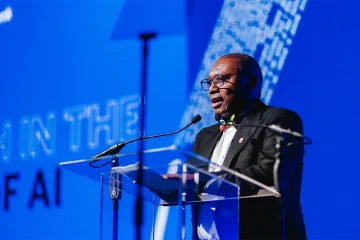
- This is an edited version of remarks by Duma Boko, the President of Botswana, at The AU-AIP WATER Investment Summit, Heads of State Roundtable in Cape Town, South Africa.