THE sarcasm of the security police captain was quite biting as Dean Tshenuwani Farisani sat handcuffed and manacled to an iron bar at the back of an open van. It was night, it was winter, and it was biting cold.
The year was 1977, and he was being taken from Pietermaritzburg to Howick Police Station, which was the torture chamber. The white captain looked at him and said, “Dean, be comfortable. We apologise that the state cannot afford a canopy for this bakkie, as the money goes to combating terrorism. Keep the wind out of the bakkie with your prayers. I wish you a good trip.”
Farisani relates the story: “We sped away from Pietermaritzburg at perhaps 140km/h. I froze in the ice-cold wind and wriggled as the handcuffs cut into my flesh and pain seared my twisted limbs…
“We followed the arrow to Howick Police Station. Handcuffed and leg-ironed, I struggled up the stairs to the third floor… The officer turned around and shouted… punches, kicks, punches, kicks, punches, kicks, pushed, pulled, pushed, pulled, pushed, pulled. Hair pulled out.
“Beard uprooted. Carried in the air by my hair. I was thrown on the floor, then commanded to stand. Thrown to the floor. Commanded to stand. It was a long, very long hour. Perhaps two, perhaps three. Perhaps thirty minutes. The thunders of the blows and the thuds were punctuated by my groaning and occasional shouts: ‘Enemy of my country! Communist! Terrorist! Die! Die! Die!'”
Farisani died on Thursday at the Muelmed Private Clinic in Tshwane, a few days after he was moved from a clinic in Polokwane, where he had been in the Intensive Care Unit for over seven weeks. He was suffering from Post Traumatic Stress Disorder, induced by the kind of treatment at Howick and a number of other places where he was brutally tortured by apartheid security forces.
The quotes above are from the book “Gathering Seaweed,” a collection of prison writing by a number of prominent Africans, including Nelson Mandela (the title of the book comes from his story), Kwame Nkrumah, Agostinho Neto, Ken Saro-Wiwa, Steve Biko, and many others.
Farisani’s chapter, from his book “Diary from a South African Prison,” is titled “The Wait is Over.” It denotes the end of a two-week waiting period as the police tortured people around him. The daily and nightly screams had haunted him as he sat waiting, knowing his turn would eventually come.
It is psychological warfare where they play with detainees’ minds before pouncing. His pouncing came that night, and after a few days of beatings and standing and not sleeping, he broke down and cried when he heard a woman next door screaming her lungs out.
Farisani was born on August 30, 1947, on his community’s land outside Makhado, in Limpopo. The land had been expropriated without compensation by the settler white community, who had turned his parents into free labour on the farm.
Growing up as a free child labourer himself and witnessing the abuses that his parents and other black people on the farms endured, this early childhood experience marked his determination to fight for freedom. Like all black children on farms, then, he did not go to school until, at the age of 12, he was noticed by a German missionary woman who sent him to school.
He was extremely bright in school and completed both primary and high school in record time, obtaining a first-class pass in matric. He enrolled at the Maphumulo Theological Seminary outside Stanger in KwaZulu-Natal, where he came into contact with Black Consciousness leaders such as Steve Biko, Saths Cooper, and many others. His understanding of Black theology, which he preached even at Maphumulo, led to his expulsion from the Seminary. He completed his studies remotely, obtaining a distinction.

He became one of the foremost anti-colonial preachers in the country, together with the likes of the late first President of the Black People’s Convention (BPC), Rev Castro Mayathula. The Lutheran Church placed him at Beuster Mission at Maungani, outside Thohoyandou. He became the first black head of that mission, with all previous ones being German expatriates.
Beuster became the central point of political activity, a Regina Mundi of the northern Transvaal, where political meetings of the BPC were held. This brought police attention, and at least four detention spells resulted, including the one described above.
He was elected President of BPC at its second congress at St Peter’s Seminary in Hammanskraal in December 1973, with Colin Geoffrey as his vice, Sipho Buthelezi as Secretary General, Nkwenkwe Nkomo as National Organiser, and Revabalan Cooper as Public Relations Officer.
Farisani went to Israel in 1974 to study Hebrew and only returned in 1975 after the start of the BC trial in which Saths Cooper was accused number one. Within the church, he was appointed Dean of the Devhula Circuit and even became Deputy Bishop.
When the Venda Bantustan attained its nominal independence from South Africa in September 1979, Farisani campaigned vigorously against the move, arguing that South Africa, or Azania as he called it then, was one unitary state that could not and should not be balkanised into ethnic enclaves.
However, many of the church leaders in his circuit were senior government officials of the bantustan administration, and attempts were first made to have him removed. When this failed, they started a campaign, led by one Sigwavhulimu, for the Lutheran Church in Venda to secede. Farisani successfully thwarted this.
Among the people he touched with his ministry in his early years was Cyril Ramaphosa, who was a staunch member of the Student Christian Movement at Mphaphuli High School in Sibasa. Together with Tshifhiwa Muofhe (who was later to be killed in detention in 1981), they formed the Black Evangelical Youth Organisation (BEYO), which later changed its name to the Bold Evangelical Christian Organisation.
Farisani was also detained in Venda in 1981, where he was accused of helping ANC guerrillas who had attacked the Sibasa police station. Muofhe was tortured to death during that time. There existed in the bantustan what was called the killer squad of policemen who included Captain Muthuphei Ramaligela, Sergeant Josias Managa, and Sergeant Takalani Nesamari. They testified at the Truth and Reconciliation Commission for amnesty on Muofhe.
Margaret Philpott, in a biography for SA History Online on Muofhe, says of Farisani’s torture in 1981: “Farisani was tortured by the same interrogators that killed Muofhe… Farisani survived to share his account of how he was made to do exercises until he collapsed. He was beaten until his eyes bled and his eardrums burst.
“He was suffocated under a wet canvas hood and subjected to electric shocks to his head, spine, and genitals until he lost consciousness. Three weeks after his initial torture, Farisani experienced a delayed shock to his nervous system, which caused heart failure, and he nearly died.”
He was detained again in late 1986, and rumours were persistent that he was on hunger strike. I kept pestering the then head of Security Police in Venda, General Tshamano Gerson Ramabulana, about his condition.
Ramabulana, whom I knew very well as we came from the same area, one day said: “I keep telling you he is not on a hunger strike and he is well. You don’t believe me because you just want to write your story that we are treating him badly. Now, if you are around here today, go to Tshilidzini Hospital at 2 pm.”
I took an escort with me. We found the place where he would be brought in and settled down under some shrubs. When the van arrived, Farisani was led out from the back and passed near us. I greeted him and asked how he was doing.
Farisani turned and saw me and said: “I am as you see me, my brother.” He had lost a lot of weight and was hurriedly shepherded into the room. We ran to the parking lot, and I headed out of Venda as soon as I could.
Once I was safely in Polokwane, I called Ramabulana and told him Farisani had lost a lot of weight. “But you guys have been saying he is critical and cannot walk. Didn’t he walk himself? And you did well by running away because the police were looking for you.”
I wrote my story about the chance meeting with Farisani, describing in detail all that I saw and what he said. When he was eventually released, he told me the cops were very worried that we could have been waiting to rescue him. He said his treatment improved after the story.
Following the detentions and torture, he went into exile to America, from where he wrote his “Diary From a South African Prison.” He campaigned vigorously for sanctions against SA as part of the ANC, lobbying the US government and legislators as well as at the United Nations.
He returned home in 1990 after the unbanning of liberation movements and became a Member of Parliament after the 1994 watershed elections, representing the ANC. Later, he was redeployed to Limpopo, where he served as MEC and later as Speaker of the Legislature until he retired from active politics in 2009.
Farisani, however, continued to work among communities. When the VBS scandal broke and it emerged that his own comrades were complicit in the looting of the bank, he was at the forefront of agitating for justice for the poor depositors whose savings had been gobbled up by the greedy high-fliers.
This brought threats to his life, and he was followed by strange vehicles and received threatening calls where he was told he should stop his campaign, or he would join two trade union leaders already killed. He never buckled.
Farisani broke down and cried during his acceptance speech of his honorary Doctorate bestowed by the University of Venda in 2023, when he recalled that his comrades had “stolen money even for Covid, even for Covid.”
Those tears were the hallmark of a political leader feeling betrayed. Tears have formed a huge part of his life: crying for freedom, crying from pain of torture, crying for the lady victim of torture in that cell next door at Howick’s torture chambers. And now crying for his ANC that has lost its way.
He leaves behind a legacy of commitment to freedom and justice and service to people without stealing and amassing for self. He is survived by his wife and three children.
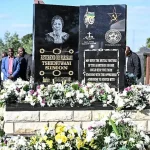
Farisani will be buried on Saturday, June 7, at Maungani outside Thohoyandou.