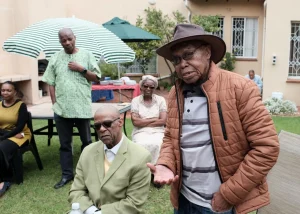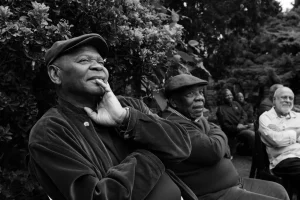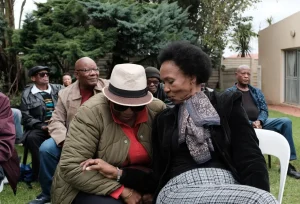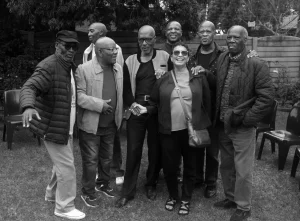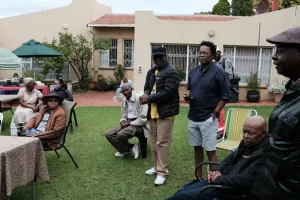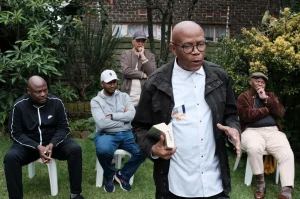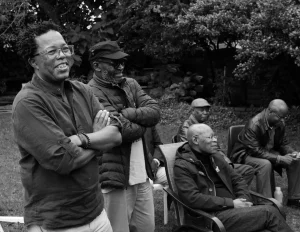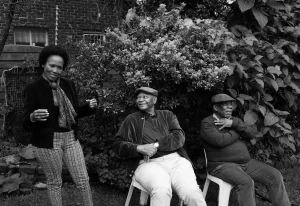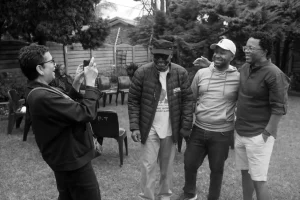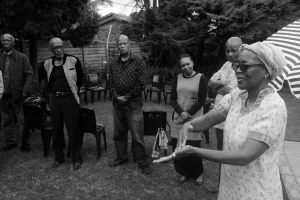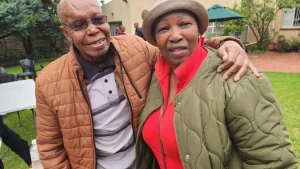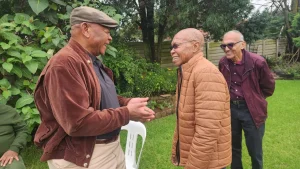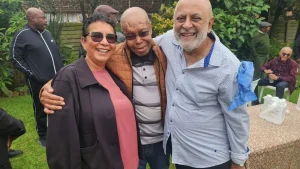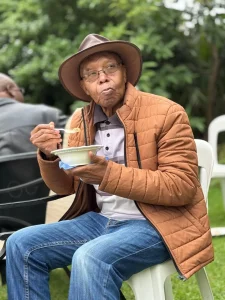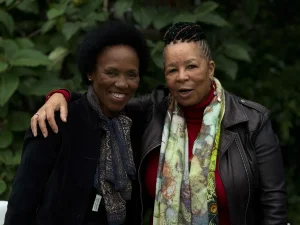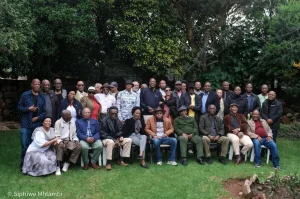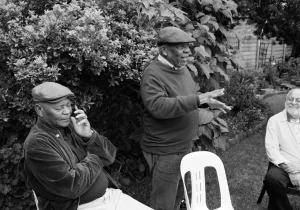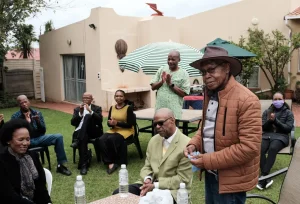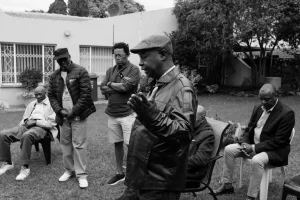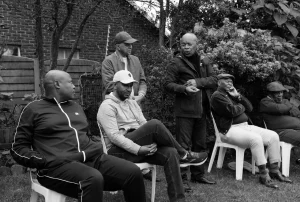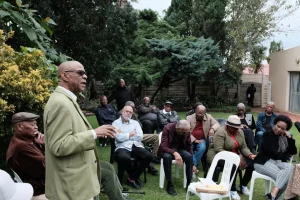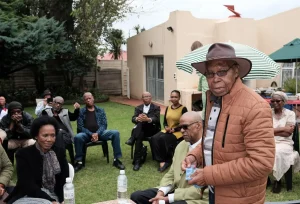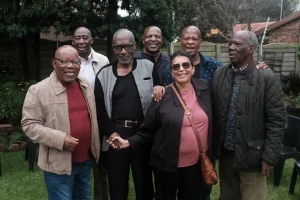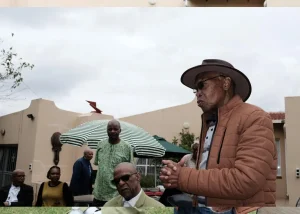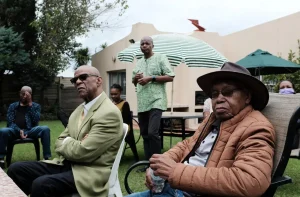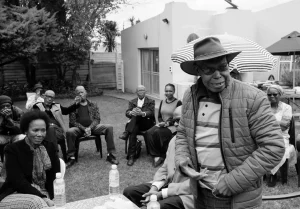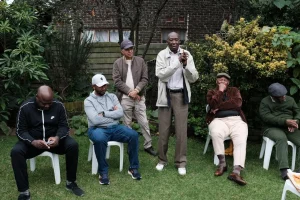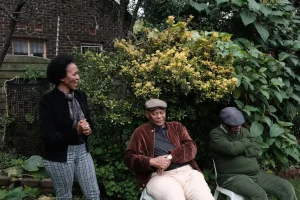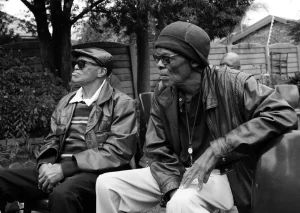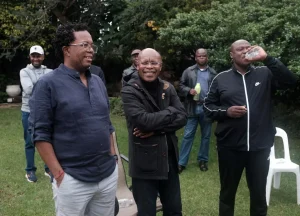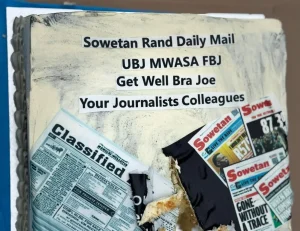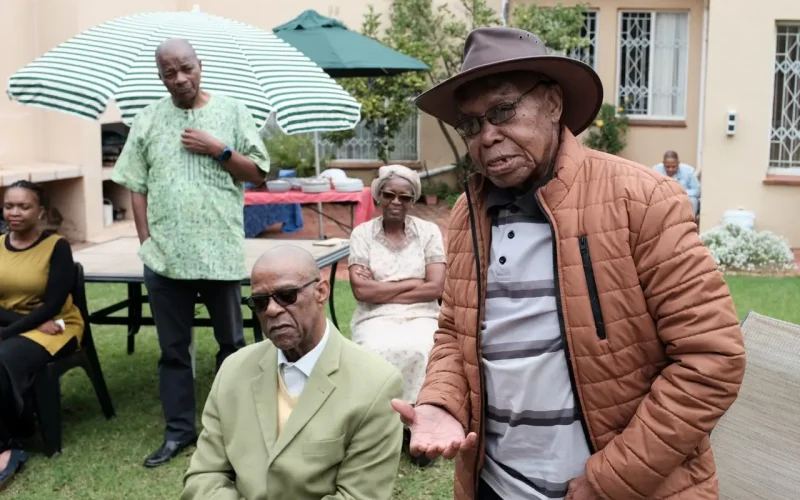
THE clouds hung low over Wilro Park that April morning, pregnant with rain and possibility, mirroring the weight of history gathered in the perfectly manicured garden of Joe Thloloe’s Roodepoort home. At 83, the lion of South African journalism sat among his pride – journalists young and old who had travelled from across the country to celebrate not just a birthday, but a living legend who had defied death, detention, and despair to help birth a free press in a democratic South Africa.
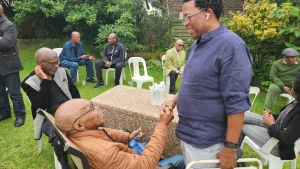
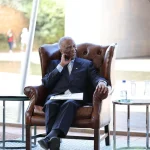
Thloloe former colleagues and mentees, arrived bearing gifts and warm smiles. They found Thloloe seated in a comfortable chair, his body perhaps diminished by age and the lingering effects of torture sessions at the hands of apartheid police, but his eyes still holding the same fierce intelligence and unwavering dignity that had made him a beacon for generations of journalists.
“This visit is a blessing,” Thloloe said, his voice soft but clear. “It has healed me.”
Morongoa Thloloe, his loving wife, stood nearby, her face a map of pride and concern as she welcomed the visitors she called “family,” insisting they needed no special invitation to enter their home. The aroma of freshly cooked food and desserts filled the air as they gathered around the man who had been detained, banned, imprisoned, and tortured – yet never broken.
Born in 1942 in Orlando East, Soweto, Joseph Nong “Joe” Thloloe’s journey into journalism began not in a classroom but in a prison cell. As a 17-year-old student at Orlando High School, he had joined the Pan Africanist Congress when they broke away from the ANC in 1959. His participation in the anti-pass campaign led to his arrest on March 21, 1960 – Sharpeville Day – and a three-year prison sentence.
It was behind bars, sitting at the feet of leaders like Robert Mangaliso Sobukwe and Zeph Mothopeng, that Thloloe received his first lessons in journalism. Released on Christmas Eve 1960, he completed his matric the following year and immediately began what would become an illustrious career at the Bantu World.
“When Joe writes, he does not just record history; he chronicles the soul of a nation fighting for its freedom,” remarked one editor who had risen through the ranks under Thloloe’s mentorship. “His pen became a weapon more powerful than any gun.”
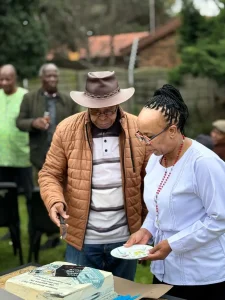
As colleagues shared stories over lunch and cake, the narrative of Thloloe’s life unfolded like chapters in a book too extraordinary to be fiction. His historic role as the first black journalist at the Rand Daily Mail in 1962, his fearless coverage of the emergence of the modern trade union movement, his presidency of the Union of Black Journalists when it was banned on October 19, 1977 – now commemorated as South African Media Freedom Day.
“There was a time,” one veteran journalist recalled, rising to his feet with emotion thickening his voice, “when Joe and his colleagues, frustrated by their inability to report on the violence of 1976, bought a small printing press and published a single edition of the Bulletin. It was immediately banned, and Joe was detained—to be released, again, on Christmas Eve 1976.”
The garden grew quiet as they remembered the price Thloloe had paid for truth-telling: detention in March 1977 under the Terrorism Act, 18 months in solitary confinement, house arrest in 1980 after fighting for racial parity in journalists’ salaries, another detention in 1982 followed by a 30-month sentence on Robben Island for possession of banned literature.
“The same courage that carried him through those dark days still burns in him now,” whispered a young reporter to her colleague. “Even as he faces health challenges, he remains unbroken.”
The afternoon drizzle arrived as tributes continued, highlighting Thloloe’s pivotal role in transforming South Africa’s media landscape post-apartheid. As Head of News and Current Affairs at the SABC, he had guided the broadcaster’s transition from state propaganda machine to public service provider. At e-TV as Editor-in-Chief from 2000 to 2006, he helped establish a new voice in the media landscape.
“But perhaps his greatest contribution,” noted a former editor, “was as Press Ombudsman and later Director of the Press Council. When government pressure threatened media self-regulation, Joe stood as our moral compass, our uncompromising defender of press freedom.”
Rain began to patter gently on the leaves above them, but no one moved to leave. Instead, they leaned in closer, as if proximity to Thloloe might infuse them with some measure of his indomitable spirit.
As the afternoon wore on, the gathering took on the quality of a living history lesson. Former students of Thloloe’s recounted how his soft-spoken mentorship had shaped their careers. Editors testified to his unwavering ethical standards. Authors cited his influence on their work. And throughout it all, Thloloe listened with characteristic humility, occasionally interjecting with a clarification or a forgotten detail, his mind still razor-sharp despite his physical frailty.
“What sustained you?” asked a young journalist, her question cutting through the reverence to the heart of what everyone wondered. “Through the torture, the solitary confinement, the banning orders—what kept you going?”
Thloloe was silent for a moment, his gaze drifting to the rain-washed garden before returning to meet the eyes of his questioner.
“The belief that truth matters,” he said finally. “The conviction that a free press is essential to a free people. And the knowledge that each story we tell, each injustice we expose, brings us one step closer to the country we are meant to be.”
As dusk approached and the celebration began to wind down, the symbolism of the moment was lost on no one. Here was a man who had witnessed South Africa’s darkest hours and contributed significantly to its brightest possibilities. A journalist who had refused to be silenced when silence meant safety. A leader who had helped transform not just media institutions but the very concept of what journalism could achieve in a society emerging from oppression.
“We brought you flowers while you are still with us,” said one veteran journalist, his voice breaking slightly. “Because too often we wait until people are gone to acknowledge their greatness.”
Thloloe smiled at this, a smile that carried no bitterness for the suffering he had endured but rather reflected the satisfaction of a life spent in service to truth and justice.
As the delegation prepared to leave, promises were made to return soon, to continue learning from the master while he was still among them. The rain had stopped, and a brilliant rainbow arched across the eastern sky- nature’s own tribute to a man whose life had spanned South Africa’s journey from the darkness of apartheid to the promise of democracy.
Standing at the garden gate, leaning slightly on his wife’s arm, Joe Thloloe watched his colleagues depart. His body may have been bowed by age and the lingering effects of apartheid’s cruelty, but his spirit remained what it had always been- unbreakable. In his quiet dignity was a reminder to all who had gathered: that some flames, once lit, can never be extinguished, and that courage, once awakened, becomes a legacy that outlives us all.
Behind him, the house stood solid and welcoming – much like the man himself. And in the hearts of those who had come to honor him, a renewed commitment to uphold the principles for which Joe Thloloe had sacrificed so much: that truth must be spoken, that power must be held accountable, and that a journalist’s highest calling is to give voice to those who would otherwise go unheard.
As the last car pulled away, a soft evening breeze rustled through the garden, carrying with it the whispered promise of storms weathered and freedom earned – the enduring legacy of Joseph Nong “Joe” Thloloe, the lion of South African journalism whose roar continues to echo in the work of every truth-teller who follows in his footsteps.