
By Ali M. Latifi and Khyber Khan
FOR 12 days in June, Israeli bombs fell on Tehran, but the fear didn’t just come from the sky for the city’s Afghan residents. While plumes of smoke billowed in the air, the streets of the Iranian capital also simmered with xenophobic rhetoric and vigilante violence, amid claims Afghan nationals were providing material support to Israel.
Afghans living in Iran were accused of everything from transporting and piloting drones to intelligence-gathering and planting bombs, with state-run media and X accounts even running unverified reports of Afghans “confessing” to being Israeli agents.
The accusations are particularly discordant given how vehemently the Afghan people and government have sided with Iran, with Afghanistan even offering sanctuary to Iranians if the conflict with Israel became prolonged.
But in a country where Iranian officials were already calling for a wall to be built along the 900-kilometre border – and where Afghans are barred from living in, travelling to, or seeking employment in the majority of provinces – the facts didn’t seem to matter much.
Arash Azizi, an Iranian writer who has written extensively on the treatment of Afghans, said the charges served their purpose as a “convenient excuse” to rile up the people and supercharge the longstanding anti-Afghan xenophobia in the country.
Israel’s aggression, including attacks that struck hospitals and state-run media, led to more than 950 deaths, at least three Afghans among them. But while Afghanistan and its people expressed solidarity with their Western neighbour, social media was quickly inundated with videos showing Afghans in Iran being verbally harassed, violently made to denounce their country, and beaten in public.
“When you blame your society’s problems on outsiders, it becomes a great tool for the rulers,” Azizi said, inferring that the Iranian government was intentionally scapegoating Afghans to try to divert any anger that might head its way from its own population.
Those societal problems, Azizi continued, are numerous: Inflation for food goods has risen by 284%; construction materials like cement and concrete have nearly doubled in price; and overall inflation is hovering around 40%.
But it’s not just the Iranian government that has been stirring things up.
Ideological opponents of the Islamic Republic are also taking aim at Afghans. Prominent anti-regime writers have been spreading the false claim that Tehran “has lost control of its borders” and that the government is engaging in a practice of demographic engineering by purposely importing Afghans to bolster support.
High-ranking officials have joined in: In the middle of Israel’s onslaught in June, Prosecutor-General Mohammad Movahedi Azad sought to further “fan the flames” of “vigilantism” by calling on the Iranian people to “identify those who have collaborated with the Zionist regime”, Azizi said.
Well-known Iranian politicians had already been blaming Afghans for violent attacks and security breaches long before the Israeli bombardment and the spying claims. But just like in Pakistan, where Afghans are facing a similar dynamic, more and more Iranians seem to be believing those claims.
Deportation sweeps and vigilante attacks
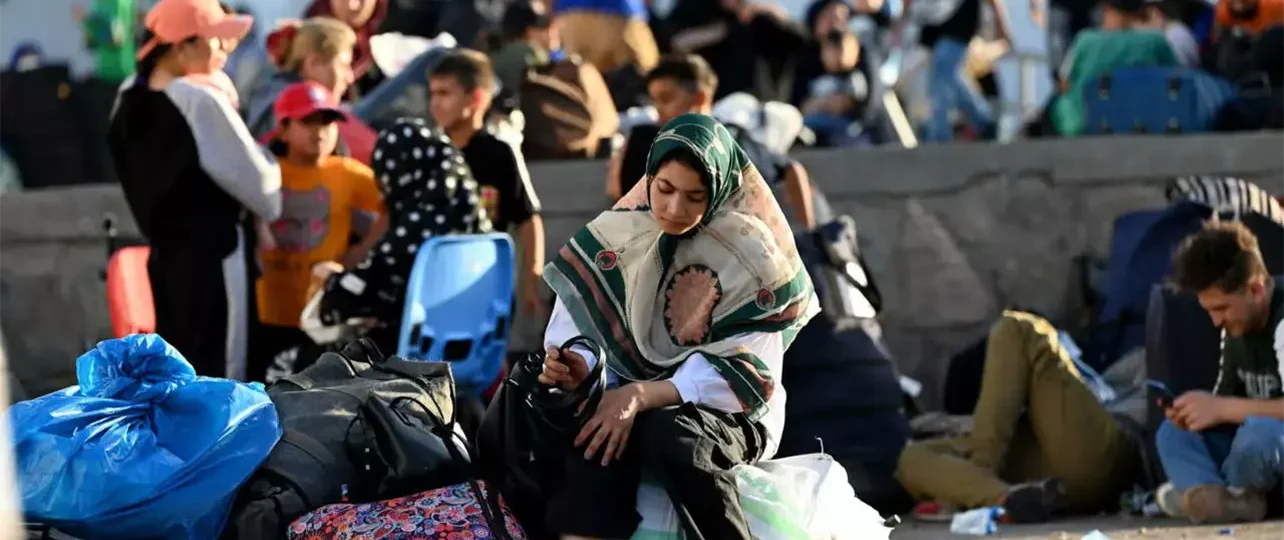
Afghan returnees in the border town of Islam Qala – either deportees or those who have chosen to return from Iran amid the growing vigilante violence – said the hostility on the streets was inescapable, even as they themselves were trying to shelter from Tel Aviv’s bombing campaigns.
Khala Rezayee (Aunt Rezayee), an Afghan grandmother, recalled the day she decided her family’s 17 years in the Islamic Republic had to come to an end.
“It was during the bombings. The streets were completely empty,” she told The New Humanitarian. She said she heard a voice shouting from some distance away: “You’re still here, you Afghan.” Before she could turn around, the voice continued, “You ungrateful Afghans used this country.”
“My friends told me to go home: ‘They’re coming. They’re looking for Afghans.’”
It was a trainee from a Tehran sweatshop she had worked in as a head seamstress. “You Afghans happily ate from our tables and now you all carry explosives behind your backs,” he said.
That run-in was just the latest indignity Rezayee had suffered. Days before, early in Israel’s bombing campaign, she and her family had been left in fear and disbelief after her teenage son ran into their home, frantic and out of breath.
“My friends told me to go home: ‘They’re coming. They’re looking for Afghans,’” the teenager said, locking the door behind him. When his mother asked who was coming, the teen instructed her and his sister to go up to the balcony and see for themselves.
What they saw were the lights of dozens of cars speeding towards Inqilab Township, the low-income neighbourhood of Tehran where their family and thousands of other immigrants were living.
“It was 10 o’clock, and they were all brandishing weapons. Some had wooden clubs and switchblades. Others had swords and hammers,” she said. “All we could hear was the sound of screeching tyres and shouts of, ‘Where are the Afghanis,” she said, using the pejorative term that Iranians use for Afghans.
The fact that those two incidents occurred within days of each other made it very clear it was time to go, Rezayee said: “If they said this to me with no shame today, what will they say to my [teenage] son tomorrow?”
“Go back to Afghanistan”
Things were already worse for Rezayee’s older son, Ramin, who has been caring for his son and daughter alone since his wife passed away two years ago.
“The police saw him on the street and said, ‘You’re young and healthy, go back to Afghanistan,’” Rezayee recalled of the mid-June encounter.
Ramin was immediately taken to what authorities call a migrant processing camp.
Azizi, the writer, said such facilities are more akin to “concentration camps”, where, as far back as 2023, Afghans have been penned up awaiting return with little access to food, water, and basic health services.
But other returnees in Islam Qala said Ramin was fortunate as he had only faced verbal intimidation by the police.
Mohibullah described how one evening in early July – shortly after the Israeli bombardment ended – police came to the Tehran construction site where he was working as a night guard, specifically looking for Afghans.
“I ran as far and as fast as I could, but then I felt a sharp pain. They had shot me in the leg,” the 22-year-old said. Iranian police are routinely accused of shooting at Afghans, but traditionally, that has been along the border, not in the main cities.
Mohibullah told The New Humanitarian that when he was in the migrant processing camp, he received no proper treatment for his injury: “I was just given one antibiotic pill every other day to keep the wound from being infected.
Even elderly and infirm Afghans said they hadn’t been spared the police violence. Amir, who is in his sixties, said he was on his way to pick up his prescriptions in early July at a pharmacy when police officers accosted him.
“They took my money and beat me,” Amir said, gripping the black cane he has carried since suffering a stroke a year ago. He recalled how he tried to explain that he was on his way to pick up his medicine, but the police replied with insults and vulgarities.
Amir and several of the other Afghan returnees The New Humanitarian spoke to said the police patdowns and checkpoints were all security theatre.
“They say they are searching you, but they’re just looking for money. Even if all you have is a few cents, they’ll take it from you,” Amir said.
The insults even turned political. “Why did you Afghans cut our water?” Amir said the police officers asked while they continued to strike him. Tehran has been suffering from severe water shortages, which some lawmakers have blamed on the building of dams in Afghanistan’s Herat, Helmand, and Nimroz provinces.
Amir said his young son, who was with him at the time, witnessed the ordeal. He added that he has no idea if his family in Tehran knows he has reached Afghanistan.
“Our own country is always better”
One Afghan returnee accused the police of using deceptive methods to illegally enter her home. Mariam, whose family had spent six years in Iran, said she and her five children were tending to her sick two-year-old son when there was a furious knocking on the door in mid-June.
“They almost broke down the door. When we didn’t answer, they finally said, ‘We are here to help, let us in,’” Mariam said. “When we opened the door, 10 or 12 police stormed in and told us to leave.”
Like others, they were then taken to a deportation centre for two weeks before being brought across the border to Islam Qala.
Iranian rights workers said the latest wave of deportations, more than 700,000 since June, which include beatings, property seizures, the withholding of money, and arbitrary detention, could amount to crimes against humanity.
Pakistan, despite its waves of mass deportations, trails behind with 185,000 returns over the last year.
Despite the fact that Afghanistan is suffering under the weight of two years of global aid cutbacks and the Islamic Emirate’s increasing social restrictions – including on the rights of women and girls – Rezayee and other returnees said they were happy to be out of Iran.
Over the last month, returnees have seen private citizens, local companies, money exchangers – even sports stars – come to their aid in Herat and Kabul.
Mohammad Nabi, the former captain of the national cricket team who was in the capital for a cricket tournament, recently went to visit some of the 700,000 Afghans who have left Iran over the last month and distributed one million afghanis ($14,600) to the families who have made it to Kabul.
“Families are exhausted & humiliated, returning with nothing… I urge our neighbours to stop the mistreatment of Afghans,” he posted on X.
The returnees in Islam Qala said they would never forget that mistreatment in Iran.
“Absolutely not, I would never go back,” Mohibullah said. “The Iranian people are fine with Afghans only as long as we are useful to them. The moment they are done with us, they belittle us and beat us for being Afghan.”
Even Rezayee, who had spent so long in Iran, said she had nothing but bitter memories now: “Our own country is always better.”
*Due to security and privacy concerns, all returnees interviewed only provide their first names or pseudonyms.
Edited by Eric Reidy and Andrew Gully.

–––––
The New Humanitarian puts quality, independent journalism at the service of the millions of people affected by humanitarian crises around the world. Find out more at www.thenewhumanitarian.org.