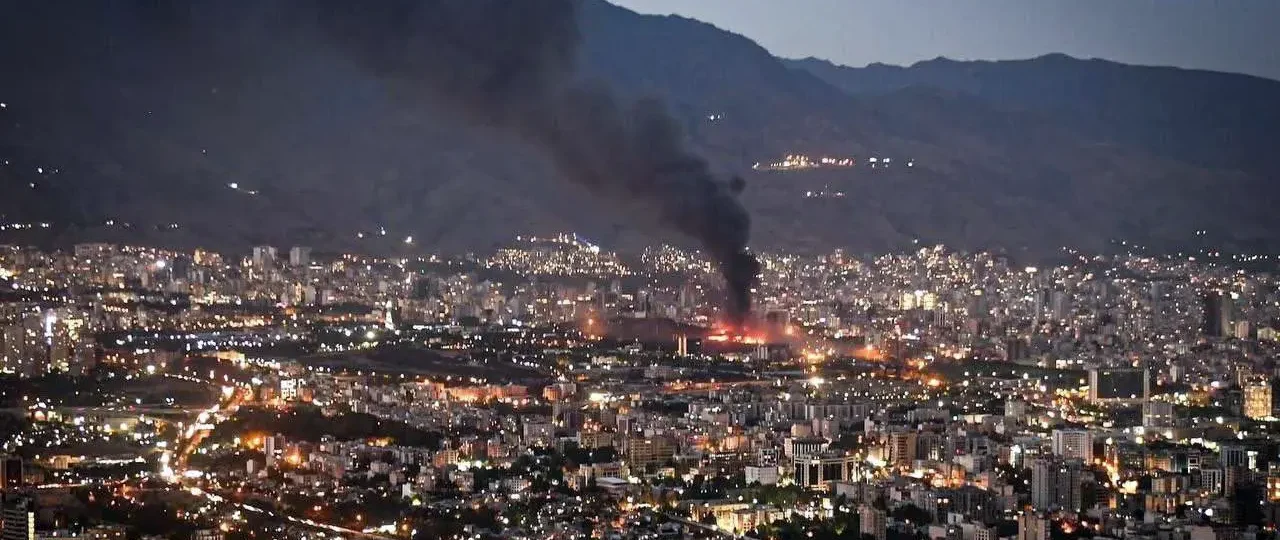

THE ancient city of Tehran trembles under a crimson sky as the dawn breaks not with the call to prayer, but with the thunder of war. Across the sprawling metropolis of nine million souls, highways have transformed into rivers of desperation—an endless procession of families clutching their most precious belongings, fleeing the capital that has been their home for generations.
Through the pre-dawn darkness, headlights pierce the chaos like fallen stars. The Tehran-North highway, normally a mundane commuter route, has become an artery of survival. Mothers cradle infants against their chests while fathers grip steering wheels with white knuckles, their eyes scanning the sky for the next wave of death from above. The Tehran-Qom road stretches like a serpent of steel and glass, choking on the weight of human fear.
This is not merely traffic – this is the haemorrhaging of a city’s lifeblood. Every car carries stories: the elderly grandmother who hasn’t left her neighborhood in decades, now clutching faded photographs of her late husband; the young couple who postponed their wedding, now fleeing toward an uncertain future; the shopkeeper who built his business brick by brick, watching it disappear in his rearview mirror, perhaps forever.
The silence between explosions is deafening. In apartment buildings across Tehran, residents huddle in stairwells and basements, cursing a government that spent decades building nuclear ambitions but neglected to build a single proper bomb shelter for its people. “Where are our bunkers?” they whisper in the darkness, their voices heavy with betrayal and terror.
Unlike their adversaries, who have lived with the reality of aerial bombardment for decades, Tehran’s residents face the sky with naked vulnerability. The Islamic Republic, so mighty in its rhetoric, so fierce in its regional ambitions, stands exposed as a paper tiger when it comes to protecting its own citizens.
Sacred Spaces, Desperate Measures
In a bitter irony that speaks to the desperation of the moment, the same mosques that once echoed with calls for death to Israel now open their doors as sanctuaries for the living. Metro stations designed to carry commuters to work have become underground cities for the displaced. Schools where children once learned poetry and mathematics now house families praying for morning to come peacefully.
Government officials, their voices cracking under the weight of their own inadequacy, announce these makeshift shelters with the hollow authority of leaders who have failed their most basic duty. The very institutions of daily life—places of worship, education, and transit—have become monuments to governmental negligence.
Digital Darkness
As if the physical bombardment were not enough, Tehran’s digital lifelines have been severed. Internet traffic has plummeted by half, creating an information void that amplifies every fear and rumour. Families separated in the chaos cannot reach each other; parents cannot confirm their children’s safety. The Ministry of Information and Communications speaks of “special conditions” and “temporary measures,” but for those trapped in the digital darkness, these are not bureaucratic inconveniences—they are additional layers of terror.
In this modern age, to be cut off from communication is to be truly alone. The internet blackout transforms Tehran into an island of uncertainty, where every explosion sounds like the end of the world and every siren could herald personal catastrophe.
The Hunt for Shadows
Amid the chaos, the security apparatus still functions with chilling efficiency. In the ancient city of Yazd, where Persian poetry once flourished and trade routes crossed, five souls have been dragged from their homes, accused of the ultimate betrayal—collaboration with the enemy. Their alleged crime: taking photographs and maintaining contact with Israeli agents.
These arrests, announced with the clinical precision of state media, represent more than law enforcement—they are the paranoid reflexes of a regime that sees enemies everywhere, especially among its own people. In a nation where war rages overhead, the government still finds time to hunt for shadows and manufacture conspiracies.
The Arithmetic of Destruction
The numbers tell a story that statistics cannot capture. At least 224 Iranian lives have been extinguished, their dreams and ambitions reduced to casualty reports. Over 1,200 wounded lie in hospitals, their bodies bearing the scars of a conflict they never chose. On the other side, Israeli emergency services report their own grim tallies—dozens injured, families shattered, communities traumatised.
These are not mere statistics; they are the measurement of human suffering. Each number represents a life interrupted, a family destroyed, a future stolen. The reciprocal strikes between Iran and Israel have created a mathematics of misery that grows more complex with each passing hour.
The Persistence of Hope
Yet even in this darkness, the human spirit endures. In the clogged highways leading out of Tehran, strangers share water and food. In the improvised shelters, neighbours comfort each other’s children. In the digital silence, people find ways to connect, to reassure, to maintain the bonds that make us human.
The people of Tehran, like civilians caught in conflicts throughout history, demonstrate that even in the face of overwhelming fear, the impulse to protect, to share, and to hope remains unbroken. They flee not out of cowardice, but out of love—for their families, for their future, for the possibility that tomorrow might bring peace.
The Uncertain Dawn
As the conflict enters its fourth day, the world watches with growing alarm. International leaders speak of de-escalation and diplomatic solutions, their words carrying the weight of urgent necessity but landing with the hollow sound of distant thunder. The reality on the ground—in the streets of Tehran, in the skies above Israel, in the hearts of millions caught between two nations’ fury—is far more immediate and terrifying.
The ancient Persian capital, heir to millennia of civilisation, now stands at the crossroads of a conflict that could reshape the Middle East. Its people, carriers of a proud cultural heritage, have become refugees in their own land. The highways that once connected communities now serve as escape routes from a city that no longer feels like home.
In this moment of supreme crisis, Tehran’s story becomes humanity’s story—a reminder that in the face of political failures and military ambitions, it is always the innocent who pay the highest price. The great exodus from Tehran is not just the flight of civilians from danger; it is the movement of hope itself, searching for a place where peace might still be possible.
The sky above Tehran remains uncertain, painted in shades of smoke and fire. But in the determination of its fleeing people, in their refusal to surrender to despair, lies the promise that this too shall pass, and that from the ashes of this conflict, something better might yet emerge.