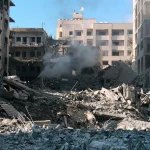
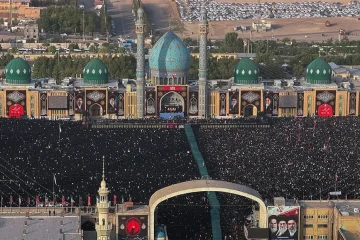
ALMOST a month since American and Israeli warplanes began striking Iran on 28 February, the toll on ordinary people has reached a magnitude that statistics alone cannot capture. A nine-million-strong capital reduced to a ghost town. Ambulances reduced to smouldering wreckage. Mothers fleeing southern Beirut in darkness, with no destination, no guarantee of safety — and no designated safe zones anywhere in the country.
This is not collateral damage. This is the lived reality of two populations caught between competing military imperatives and geopolitical calculations made in Washington and Tel Aviv — calculations that have never once factored in what it means to be a civilian in Tehran when the lights go out, or a displaced family in Lebanon when the bridge to the next town has been blown apart.
“While Tehran still maintains some basic services, some cities in the south are facing water and electricity cuts. Not to mention the fact that we have a nationwide internet blackout since 28 February.”
Maria Martinez, IFRC Head of Delegation in Iran
TEHRAN: A CITY HOLLOWED OUT
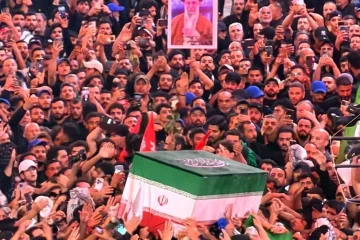
Iran’s capital has not been erased from the map — but in every human sense, it has been hollowed out. The International Federation of Red Cross and Red Crescent Societies (IFRC), operating inside Iran at extraordinary risk, describes a city of nine million people that “feels completely empty.” That phrase — not from a poet or a propagandist, but from a humanitarian official embedded in the crisis — carries the weight of a verdict on what this war has done to civilian life.
In the capital, basic services limp on. But move south, and the picture collapses entirely: entire communities without running water, without electricity, and since the first bombs fell on 28 February, without internet — a nationwide blackout that has severed Iran from the world and severed Iranians from each other. People cannot call relatives to check if they are alive. They cannot access information about where it is safe to go. They cannot tell the world what is being done to them.
The humanitarian workers attempting to fill that void are themselves being swallowed by the grief they are sent to alleviate. The IFRC’s Maria Martinez offered testimony that should stop the world in its tracks: one Red Crescent search-and-rescue worker pulled the bodies of his own family from the rubble. In Qom, another first responder uncovered his aunt, her husband, and a young child among the dead. These are the people the international community sends when everything else has failed — and they are now burying their own.
The systematic destruction of Iran’s medical infrastructure has reached a threshold that demands the language of atrocity. The World Health Organisation’s healthcare attacks monitor has logged 21 confirmed attacks on health workers and facilities since the war began. Seventeen Red Crescent centres have been struck. Nearly 100 ambulances have been damaged or destroyed. An ambulance is not a military asset. It is a covenant — a promise that even in the worst of times, someone will come. That covenant is being shredded, siren by siren, vehicle by vehicle.
“These are not just vehicles. They are often the only hope people have when the bombs fall.”
Maria Martinez, IFRC Head of Delegation in Iran
LEBANON: NO WARNING, NO SAFE SPACE, NO WAY OUT
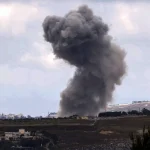
If the war’s impact on Iran is measured in blackouts and rubble, its impact on Lebanon is measured in the terror of not knowing when — and from where — the next strike will come. Israeli forces have intensified strikes on targets linked to Hezbollah, which has continued firing rockets into Israel since the broader conflict erupted. But the kill radius of these operations has rarely respected the boundaries between combatant and civilian.
The UN High Commissioner for Refugees’ Representative in Lebanon, Karolina Lindholm Billing, recounted a strike last week in Bashura, in central Beirut. Residents received a warning, but less than an hour before the strike, and at an hour when most people were still asleep. A second strike, this one near collective shelters housing displaced civilians, came with no warning at all. The shelters were not incidental targets in the vicinity of a strike — they were, in Billing’s assessment, “a direct target.”
UNICEF’s Lebanon Country Representative, Marcoluigi Corsi, was unequivocal: there is no safe space for civilians to go. Evacuation orders have been issued for the southern part of Beirut, sending people scrambling northward — only to find that strikes are happening in those areas too. The displacement offers no safety; it merely changes the coordinates of exposure.
“Although the evacuation order has been issued for the southern part of Beirut, people move out of there — but then we just recently saw that the strikes actually happen also in other parts of Beirut too.”
Marcoluigi Corsi, UNICEF Country Representative in Lebanon
WOMEN, CHILDREN, AND THE ARCHITECTURE OF DESPAIR
More than one million people have fled their homes in Lebanon in just a few weeks. The scale of that movement is almost impossible to comprehend — but UN Women’s Representative in Lebanon, Gielan El Messiri, has made the effort to render it human. She has met women and girls forced to flee at night, with no clear destination, having left behind not just possessions but their sense of safety, their livelihoods, their entire familiar world.
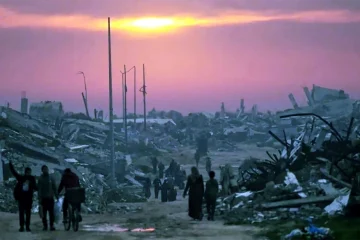
The destruction of key bridges in southern Lebanon by Israeli forces has added another layer of catastrophe. Entire districts have been cut off. More than 150,000 people are now isolated — unreachable by humanitarian convoys carrying food, medicine, and clean water. Aid workers who have dedicated their lives to reaching people in their worst moments cannot get through. The bridges were infrastructure; now they are a humanitarian sentence.
AID FLOWS DISRUPTED — BUT SLOWLY RECOVERING
The war’s disruption has extended far beyond the borders of Iran and Lebanon. The wider Gulf region — which serves as a critical logistics hub for global humanitarian operations — was significantly destabilised in the first weeks of the conflict. Iranian attacks throughout the Gulf triggered a sharp reduction in air freight capacity, with most regional airlines initially grounding or heavily curtailing routes.
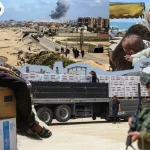
The World Health Organisation’s Robert Blanchard, Emergency Operations Team Lead at the Dubai Logistics Hub, acknowledged that the first two weeks of the crisis “really set us back.” There is cautious, partial recovery: most Gulf airlines are now operating at around 50 to 60 percent of their pre-war capacity. Commercially scheduled cargo bookings are resuming. Charter flights are being arranged to accelerate the delivery of supplies — including, critically, a convoy of lifesaving medicines heading to Gaza through Egypt.
But partial recovery at a logistics hub in Dubai is a long way from restored normalcy in Tehran, Qom, southern Beirut, or the isolated districts of southern Lebanon. The systems that move medicine and food around the world were disrupted just when they were most needed — and even as they begin to recover, the people who needed them most may already have paid the price for that disruption with their health, or their lives.
THE AFRICAN ANGLE: A WAR WITH GLOBAL CONSEQUENCES
For Africa and the broader Global South, this war is not a distant affair. The disruption to Gulf logistics arteries carries direct consequences for humanitarian supply chains that serve the continent. Rising regional instability affects oil prices, shipping routes, and the fragile diplomatic architecture that underpins humanitarian access across multiple theatres of conflict — from Sudan to the eastern DRC.
More fundamentally, the silence of much of the international community in the face of documented attacks on hospitals, ambulances, and civilian shelters sets a precedent that Africa has seen before — and paid for before. When the rules that are meant to protect civilians in war are abandoned without consequence in one theatre, they erode everywhere.
The African Mirror will continue to report on the human cost of this war and its consequences for the Global South. Because the people of Tehran and Beirut, like the people of Khartoum and Goma, deserve witnesses.