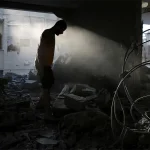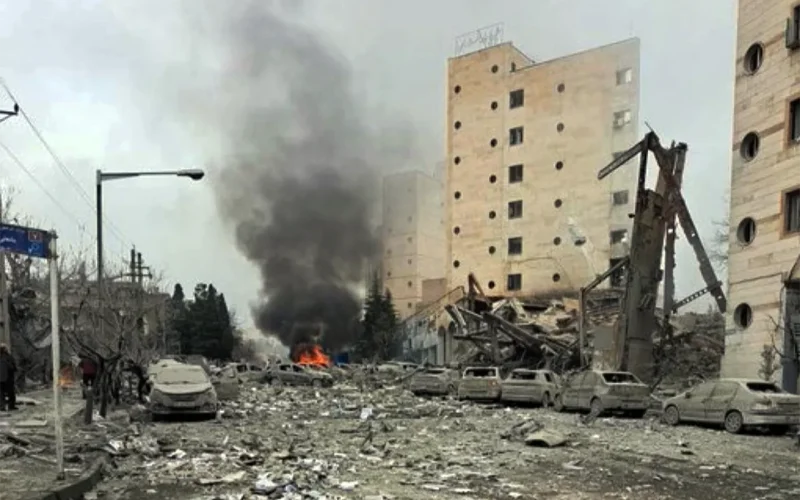
DURING the morning rush hour of 28 February, Tehran was rocked by loud explosions as the United States and Israel made good on months of threats against the nation’s Islamic Republic government.
US President Donald Trump had been warning Iran’s leadership that he would strike if their crackdown on protests that began in late 2025 was too harsh or violent, while Israeli Prime Minister Benjamin Netanyahu claimed that Iran was weeks or months away from producing nuclear weapons. Over the first two weeks of the war, the US and Israel have repeatedly been accused of striking civilian and commercial areas, including a direct hit on a school in southern Iran that killed more than 170 people, most of them schoolgirls.
This has left a lingering stress on the Iranian people, as they try to escape the bombardments. That stress was palpable in Marjan Ghafouri’s voice when she spoke to The New Humanitarian over a patchy phone line. The 29-year-old had recently secured a new office job in the capital and recalled how, immediately after the first blasts, her family began calling. They were urging her to leave Tehran and return to their hometown, 657 kilometres away.
“First, my father called,” she recalled, her voice wavering slightly with the heavy memory. “He told me to just come home and not worry about money or losing my job.”
Her father had promised to pay for everything, but Ghafouri said she planned to stay until she could discern how her office would address the situation. When her brothers called, they were “saying the exact same thing” as their father.
It was the frantic phone call from her mother that finally convinced her to pack up. “She had seen the bombings on satellite TV and was panicking,” Ghafouri recalled. “She begged me to come back that very night, crying. Her panic made me anxious, too, so I finally agreed.”
Later that afternoon, her company announced that all staff would work from home for at least a week. With her job temporarily secure but the threat of war looming, Ghafouri decided she would leave for her hometown of Khorramshahr, in southwestern Iran, the next day.
She packed her bags and went to the bus terminal, but found it overwhelmed with people trying to leave the city. Eventually, a driver agreed to take her, but only if she paid 3 million tomans ($20), three times the normal fare of about 1.1 million ($7). With few alternatives and the fear of further strikes growing, she said she felt she had no choice but to accept the price.
“Roadside rest areas were packed shoulder to shoulder, with anxious crowds forming long queues just to use the restrooms… Intercity gas stations were completely overwhelmed by panicked drivers scrambling to refuel.”
She left at 9 pm, but due to heavy traffic, she didn’t reach home until 3 pm the next day, completely exhausted. The gruelling 18-hour journey took nearly twice as long as usual.
“The highways were choked with endless convoys of cars and buses desperately fleeing the capital,” she said, describing the scenes of the chaotic exodus from her window. “Roadside rest areas were packed shoulder to shoulder, with anxious crowds forming long queues just to use the restrooms… Intercity gas stations were completely overwhelmed by panicked drivers scrambling to refuel.”
So far, the bombardments have displaced as many as 3.2 million people in Iran, according to the UN’s refugee agency, UNHCR.
A failed system
The New Humanitarian reported in late January how Iran’s economy was already in a state of severe decline when reimposed US sanctions and the scrapping of subsidised exchange rates sent the rial into freefall. Food prices quickly soared, with cooking oil nearly tripling and meat and dairy surging by double digits.
The economic crisis ignited the largest protests since the 1979 revolution, which spread across more than 100 cities before a mass crackdown killed thousands. Those killings were used by Washington as part of its justification for its eventual attack.
Weeks later, US-Israeli strikes began, killing Supreme Leader Ayatollah Ali Khamenei on the first day. By the time Tehran’s residents tried to flee, many had already been priced out of basic groceries and bus and taxi fares.
“Despite being aware of the impending conflict, the government lacked any cohesive, practical contingency plan for the transportation sector.”
Experts point out that the extortionate fares are a symptom of a broader systemic failure rather than mere individual opportunism. An economics professor and faculty member at Tehran’s Allameh Tabataba’i University, who answered questions via a messaging app and requested anonymity due to security concerns, pointed to the state’s lack of preparation.
“Despite being aware of the impending conflict, the government lacked any cohesive, practical contingency plan for the transportation sector,” he explained, noting that when the mass exodus from major cities like Tehran to smaller provincial towns began, authorities merely reacted by making certain highways one-way in a feeble attempt to ease the traffic.
Government officials had converted the Chaloos road – one of the main routes connecting Tehran to the Caspian Sea region – into a one-way outbound road to manage the gridlock. State media reported dense, slow-moving columns of vehicles on routes leading out of the capital.
The measure came after Iran’s Supreme National Security Council issued a statement advising residents to leave Tehran if they were able to do so, urging them to remain calm and relocate to other cities.
In parts of northern Tehran, supermarkets saw a rush of shoppers stocking up on bread and bottled water, but supplies of staples, including bread, eggs, water, and milk, had run low or disappeared entirely from some store shelves. Long queues also formed at petrol stations across the city.
“In this environment, a severe shortage of supply, represented in available public and private vehicles willing to leave the city, collided with a massive, desperate surge in demand from fleeing residents,” he wrote. “Prices rose naturally as a result. It cannot simply be blamed on so-called ‘greedy drivers’ when the broader infrastructure failed to manage the situation.”
The price of survival
There are nearly 79,000 registered vehicles in Tehran, which are operated by a corresponding number of primary drivers. Beyond this official fleet, the city’s transportation network is significantly supplemented by a large, fluctuating number of drivers working for internet-based ride-hailing services, which collectively employ hundreds of thousands of active drivers across Iran.
Mohammad Kiani, 59, is a former textile factory worker who took up driving at the age of 44 after developing respiratory issues.
He has been taking passengers from Tehran to Rasht, a distance of 325 kilometres, for years. Behind the wheel of a silver Iranian-made Samand, its body heavily scratched and bearing the scars of past accidents, he used to wait on the north side of Azadi Square for walk-up passengers, but for the past few years, word-of-mouth referrals have allowed him to coordinate solely by phone, meeting passengers at designated pick-up spots across the city.
“I have a 19-year-old daughter,” he told The New Humanitarian. “She and her mother are staying with my parents in Rasht now. But every time I leave for Tehran, she cries and asks me what will happen if I die in the bombings there.”
For Kiani, the inflated fares are a matter of survival: a simple guarantee for the risk to his own life. He said he charges each passenger double the pre-war price.
“I believe it’s justified when I’m risking my life driving through the streets of Tehran under bombardment to pick them up, when I’m forced to buy gasoline at 5,000 tomans (about $0.03) a litre, and when the wear-and-tear costs for the car have skyrocketed.”
Like Kiani, many drivers are worried about their safety. On Thursday, March 6, an airstrike hit a roadside rest area on the Qazvin-Zanjan highway, a place where travellers usually stop for gas, food, and rest. At least 30 civilians were killed and dozens were injured.
Eyewitnesses report that a trip from central Tehran to Rasht, a journey that normally takes about four hours by road, now takes between six and seven hours and has become dramatically more expensive as residents try to flee the capital.
In one case, two passengers paid a private driver five million tomans (about $33) for the trip. In another, a driver reportedly demanded as much as 20 million tomans (about $133) for the same route.
Out of reach
Babak Ahmadi, a barber who appeared to be around 40, used to earn roughly $300 to $400 a month, not far from the country’s average of $500. But as the economy deteriorated, his earnings shrank to a fraction of that, and since the war began, his income has dried up entirely.
A few months back – before the war, the protests, and the financial crisis that strained the country – he had sold whatever savings he had tied up in his car to help buy a house for his wife and two children, leaving them with little financial cushion when the bombing started.
At first, he and his wife decided to stay put.
“One day, we were hiding in the hallway,” he recalled. “My two-year-old daughter was crying in her mother’s arms, and when the bombing finally stopped, I saw that my eight-year-old son had wet his pants out of fear. That was when we decided to leave.”
They turned to a ride-hailing app in the hope of finding a car to take them to a friend’s house in Sari, the capital of the northern province of Mazandaran. Ahmadi said the app initially showed a fare of 2.6 million tomans (about $17). However, each time a driver accepted the request, they would call back and demand anywhere from 5.4 million to 6.2 million tomans ($36 to $41) for the trip.
He said he simply could not afford the inflated rates and refused to pay. Instead, after waiting until nightfall, Ahmadi contacted a friend whose cousin happened to be driving north.
The family of four squeezed into the back seat of the cousin’s car, enduring an arduous eight-hour journey – for a route that normally takes about three hours – to safely reach Sari.
Ahmadi was not very hopeful that the war would end soon. Still, he said he would probably have to leave his family in northern Iran and return to Tehran before long. Why? Without an income, he cannot keep up with his bank loan payments.
This story is produced in collaboration with Egab. All names have been changed to protect the identities of those interviewed. Edited by Ali M. Latifi.